
The False Dichotomy of Spirituality and Science
Do you believe in God, or do you believe in science?

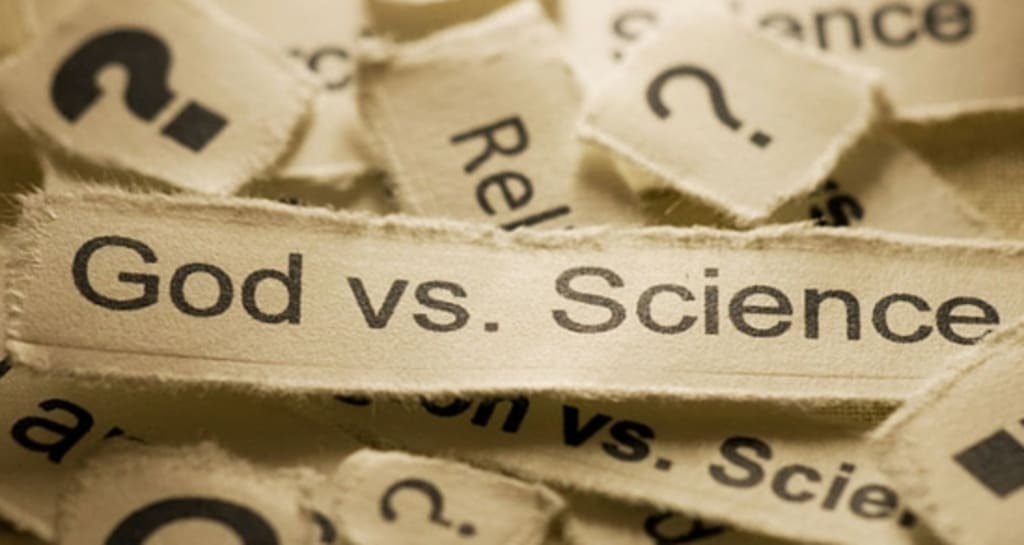
I am a teacher, and I get asked this question a lot by teenagers. It's pretty much inevitable that I'll be asked since I teach students about the Big Bang Theory, natural selection, Miller-Urey demonstrations, and the formations of life-giving stars throughout the galaxy. As a teacher employed by the state, I must be very careful to keep the conversation secular and not encourage or discourage any particular religion or even atheism. Before I respond to my students, I always ask them what they mean when they say “God”. It’s a question that almost no one ever asks. What exactly is a God, and I am talking about a God with a capital G. Traditionally, people have referred to a God with a capital G when they mean a Christian God, but in my personal opinion, this gives Christianity too much ownership of a term that can represent so much more than its version of the entity. I am not Christian, but that doesn’t mean that I do not think that a God can exist. The problem with discussions about God is that people make assumptions without providing a definition. Person A hears the term God because person B made a comment about it. Person A assumes that person B means Christian God associated with tablets, burning bushes, and forbidden fruit, but person B is really referring to a kind of super consciousness. Person B could also be referring to Shiva or Vishnu or even Zeus! The point is that there's often a discrepancy that both are unaware of as they continue to debate the issue or answer a question about God. Before I get into any discussion about God, I always define the term first. For purposes of this discussion, but not all discussions, let us define God as an entity that is capable of knowing all things simultaneously and responsible for creating the universe including the rule set within it. I suppose this definition could include a Christian God, but is not limited to one.
Once, I have a working definition, I always provide the same response to students, and I think it actually surprises them. I tell them that I am no more qualified to comment on the existence of God than they are, and to never let anyone, not even a scientist, convince them that there is no God. Further, I tell them not to let a priest or minister convince them that there is a God. What I want most from them is independent thought on the matter. I am careful to point out to them that I am not trying to convince them that God exists or doesn’t exist. What I am trying to do is to encourage you to think for themselves and avoid elevating scientists to the level of experts on all things that matter in their life, including your spiritual beliefs.
Many people have been exposed to the dichotomy of science and God for so long that they do not even question it. They simply assume its existence. Some have told me that my perspective is an attempt to “have my cake and eat it too”, which is an expression that I’ve hated since I was a child. I mean, who the hell wants a piece of cake that you don’t intend to eat? Of course, I’m going to eat it! Okay, where was I?
I think this false dichotomy can be traced back to a time when people actually believed that a Christian God directly controlled all aspects of our lives. If it rained, it must be because God wanted it to rain here. If there was a plague, it must be because God wanted some people to become ill. If there were an earthquake, volcanic eruption, meteor impact, it must be an event that God caused. People would’ve believed God caused these things because they wouldn’t have had a basis to explain it in any other way.
The process of science has allowed us to make discoveries about the universe. These discoveries have led to an increased understanding about biology, chemistry, and physics, which provide alternative explanations to these phenomena or at least explain it in a way that seems independent of a God. A person is sick because of a genetic disorder or pathogen. Disasters occur because of plate tectonics or low-pressure weather systems. Meteors? Well, those are just asteroids interacting with the gases within our atmosphere. Because we have used science to explain many of the things that we used to attribute to a God, it’s easy to suggest that all things that we attribute to the existence of a God can be explained using scientific discoveries, and if they can’t now, then they will be once we discover more about the natural world using science.
Science is dependent on a set of rules, which is used to gather empirical evidence. These rules or “laws” include things such as inertia, thermodynamics, and independent assortment of alleles. Empirical evidence is very useful because it is not based solely on personal experience. It is based on things that can be measured in the material world such as nucleotides, force, energy, and bacterial growth. Anyone can measure these things and compare data with other scientists to conclude that the observation and experience is not unique. Since it is not unique, it is something that we are all capable of experiencing and therefore must “exist”. Isn’t that how we define existence, after all? It's something that can be experienced by everyone regardless of personal bias, beliefs, or passions?
Why you can be a scientist and still believe in God ... just like Issac Newton.
Science has certainly given us a lot, but the main reason why the process of science and the idea of the existence of a God are not mutually exclusive is because if God exists, it must be independent of the rules that govern the universe itself. Simply put, a creator cannot be dependent on the thing that it creates. If God created the universe, the rule set that governs how the universe works can never be used to prove or disprove God’s existence. This being the case, there is nothing about science that prevents one from believing in God. Again, this doesn’t mean that God exists. It only means that science can’t prove that God exists or doesn’t exist.
So how can you possible know that God exists? Well, you can’t use science to know God. This is one of the main points of this article. You can only "know" that God exists through a personal experience. We all have dreams. There is some debate on what causes dreams, but we all have them, don’t we? These experiences that we have when we sleep happen to us, and few doubt that they happen because we’ve all had them. How about connecting your consciousness with God through deep meditation? When is the last time this has happened to you? Probably never, but if it has happened to you, did you tell anyone? Did that person believe you? Don’t be too hard on him or her, if there were doubts about an experience regarding your connection to a super conscious entity that can only be described as a God. You see, if we don’t all share an experience or observation like we do when we make measurements in science, we cannot confirm whether something truly exists. For this reason, knowing God must come from within your own personal experience and nowhere else, which is why no scientist is an authority on what YOU should believe in. This brings us back to my response to the students – anyone can have this experience regardless of whether you’re a scientist or a stupid, no good, lazy, fainéant, high school dropout. Okay, I don’t use that many adjectives when I make the comment, but it goes something like that.
About the Creator
Steven Allen
Steven Allen hold's a bachelor's degree in Biology with a minor in Astrophysics from Florida International University. He also holds a Master's Degree in Public Health with a specialty in epidemiology.
Keep reading
More stories from Steven Allen and writers in Humans and other communities.
Center Stage with Paul Stewart
*** I'm keen to republish the interviews I did for my series with Vocal creators. It's been a few years and I thought it might be nice to revisit these wonderful conversations. I'll be releasing them one at a time for a few weeks/months.
By Heather Hubler2 days ago in Interview



Comments
There are no comments for this story
Be the first to respond and start the conversation.