

“Look, it’s very simple,” said Dr. Keen, rubbing the bridge of his nose. “All you have to do is decide whether you’re going to keep the $20,000 for yourself, or give half to the participant in the other room. If you both choose to keep it, neither of you gets anything. If you give half away and they don’t, you get to keep what you have left. But if they give half away, and you don’t, you get to keep your own money, plus what they gave to you. Do you understand?”
Paul scratched his head. “So, like, the most I could end up with is $30,000?”
“Yes, Paul, exactly. Like I said last time. $30,000.”
“But, like, only if I give her nothing, and she gives something to me?”
“Exactly.”
“Wow, she’d have to be pretty dumb to do that.”
“Yes, she would. But remember, she can’t see you. She’s in the other room. She doesn’t know what you’re going to do.”
“But I know what she’s going to do,” said Paul, leaning back in his chair with confidence.
“You can’t,” Keen rubbed the bridge of his nose. “That’s the whole point of the experiment.”
“She’s going to give me the money.”
Keen put his head in his hands. They’d been there for fifteen minutes, and Paul still didn’t understand. In another small room in the basement of the Psychology Department, another subject was waiting, and she'd be wondering why they hadn't yet begun the experiment.
“Okay, Paul,” said Keen. “But did you consider that maybe she wants the $30,000 too? Maybe she thinks you’ll give her the money, and doesn’t want to give any to you.”
“That would be bad,” said Paul, his face darkening with childlike disappointment.
“It would be. For you. But good for her. Do you see why she might choose to do that?”
“I suppose.” Paul stuck a finger in his ear. Maybe some of his brains would come out with it, thought Keen. Paul’s total lack of ‘theory of mind’ was astounding. Under any other circumstance, he’d make a fascinating test subject, but right now, he was holding up the experiment.
Basic game theory turned up in half of the experiments designed by the Hopson Psychology Department. Most volunteers took seconds to grasp it. There was money on the table, and their job was to guess whether the other person was going to be generous, or not. They could then choose whether to match that generosity, or exploit it for a greater personal gain. You could tell a lot about a person based on what they chose to do in that basement, watched over by the pearly two-way mirror, and Keen wasn’t above judging his student volunteers on their decisions.
Of course, his own professor, Conners, had seen the experiment quite differently. “The subject’s job is not to guess whether the other person is generous, but to decide whether they themselves want to be generous. They have no way of knowing what's in the other person’s mind, all they can control is their own behavior. Therefore, all they have to decide is, ‘what kind of person do I want to be?’”
That was Conners all over. He always gave "because that’s the kind of person I want to be.”
Righteous smart-ass. Keen, on the other hand, knew you could always make more cash if you held out 'til the end.
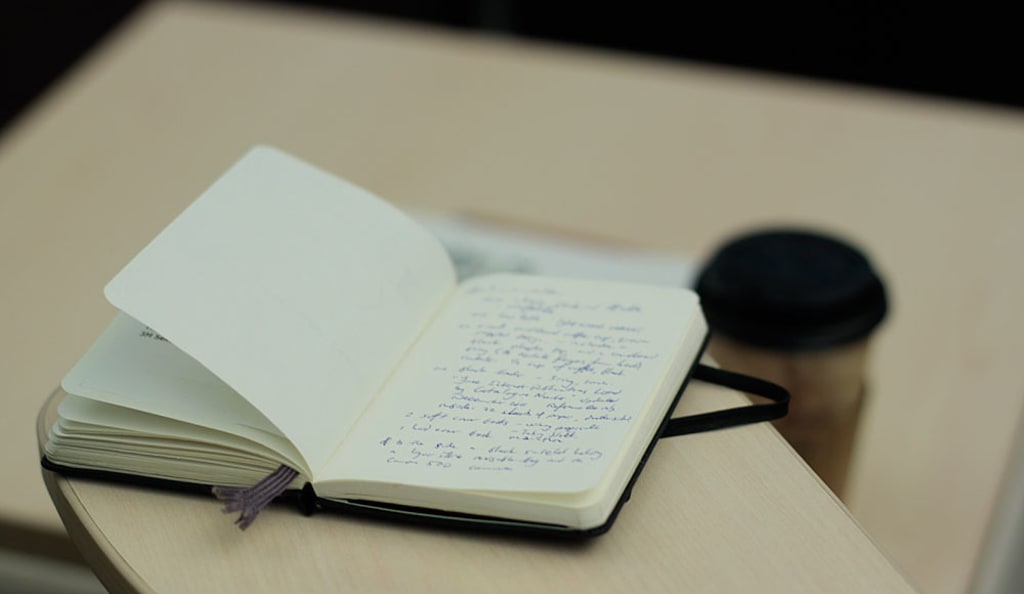
Paul was scribbling in a little black notebook, the stylish kind Keen’s collogues in the department favored. It didn’t suit Paul – what could a blockhead like him have to write about? Still, he kept at it, furiously making notes in his illegible scrawl, not unlike old Connors' own handwriting.
“I think I’ve got it,” said Paul. “If I give her the money, then she’ll like me, and give me money back.”
Keen sighed. How the hell had this guy got into Hopson? The other subject was a lovely girl, cooperative, clever. Pretty, too, thought Keen as she’d sat down in her tiny summer dress in the other room. He would have stayed and chatted to her, if she hadn’t been a student. That was the problem, really. Keen was surrounded by pretty young women, and could never go near a single one. Paul, meanwhile, could do whatever he liked. Keen had dealt with Paul’s type his entire career – young, dumb, tight blue t-shirt, stretched out in his chair like he owned the whole college, despite an IQ, Keen estimated, of three.
Keen looked at the two-way mirror behind which his fellow researchers were watching. He glanced in their direction and gave a ‘can you believe this guy?’ gesture. Paul followed his gaze, and checked his hair in the mirror.
“You know what?” said Keen. “Let me draw it for you.”
He reached across the table to take Paul’s notebook, but Paul jerked back and clutched it to his chest.
Keen laughed. “What’s in there? The nuclear launch codes?”
“A man’s notebook is his own, private kingdom, man,” said Paul.
Keen’s temples began to throb. Paul getting sage was the last thing he needed. He got up, crossed to a whiteboard on the wall opposite the mirror, and started to write. “These are the four possible scenarios:”
She Gives, You Give = $20,000 for you
She Gives, You Don’t = $30,000 for you
She Doesn’t, You Do = $10,000 for you
She Doesn’t, You Don’t = $0 for you
“Now tell me, Paul,” said Keen. “Which of these do you think is the best possible outcome?”
“Oh,” said Paul, nodding slowly. “I get it. It’s a trick!” He raised his hands in a gesture that took in the whole room, especially the two-way mirror. “You’re not testing game theory at all. You’re testing me. You’re a tricky guy, Mr. Keen.” He wagged his finger.
“Doctor Keen. And it’s not a trick. It’s an experiment to see how people react given the opportunity to be generous or self-interested. Will you stop that and start paying attention?”
Paul had been grinning at himself in the mirror, but he halted when Keen snapped at him. This was ridiculous. It wasn’t even Keen’s experiment. He’d been called in at the last minute to administer it for a colleague who’d run out of subjects at his own university. That’s what a nice guy Keen was, spending his morning with a meathead like Paul for someone he’d met once at a conference three years ago. He’d only said yes because the professor was from Deerpoint, the most prestigious university on the East Coast. It had to pay to do a favor for a Deerpointer. Keen had his future to think of.
“Which one do you want me to choose?” Paul said, chastened, looking at his feet.
“You have to decide for yourself.” Keen was checking his watch. He needed to move things along. “Okay, listen. If you don’t give, you might get $30,000, which is the best possible outcome for you. So, if I were you, I wouldn’t give.”
Paul, who’d been fidgeting since he walked into the room, suddenly became very still, and gazed at Keen for a long time.
“No,” he said at last. “I don’t agree with you. See, if I don’t give, I risk the worst possible scenario, getting nothing. But if I do give, I get $10,000, maybe $20,000 if she’s nice too. Either way, I walk out with more money than I came in with. So I give. Giving’s what I choose.”
Keen began to twist the whiteboard marker between his fists. It had taken Paul a full 32 minutes to understand. And when he finally did, he'd decided to be a goody-goody like Conners. What a chump.
Now he was staring at Keen again, grinning, like the world’s greatest notion had just occurred to him.
“I’m going to spend it on wings,” he said.
“Wings?”
“The $20,000. I’m going to spend it all on buffalo wings.”
“You’re going to eat $20,000 dollars’ worth of buffalo wings?”
“No. Not on my own.” He leaned across the table and pointed in the direction of the other room. “I’m going to ask her to come with me.”
***
Keen wasn't sure what had happened next, except that he'd tipped his chair to the ground and shouted at Paul for a solid two minutes. Then he’d stormed out of the basement and gone home to get a drink.
The next day, the professor from Deerpoint called, to thank him, and invite him in to view the results. Keen walked across the campus to the Psychology Department, where a research assistant led him back down to the basement. There, in the room behind the two-way mirror, a group of researchers were chatting and drinking coffee. The first thing Keen noticed was the pretty young student from the day before, wearing a lab coat and tapping at a computer. That was odd. Beside her was a tall, young man who Keen recognized as the scientist from Deerpoint, the one he’d met at the conference. Besides that one encounter, they'd only spoken on the phone.
The young man turned to Keen and smiled. “An experiment to see how people react under pressure, when given the chance to be generous or self-interested.” He looked down at his little black notebook. “You lasted 32 minutes.”
Keen was confused, then he noticed that beneath the lab coat and glasses, the young man was wearing a tight blue t-shirt.
The way he’d grinned at the two-way mirror, the way he’d said it was all a trick, the way he’d refused, point blank, to hand over the notebook – it all came back to Keen as the young man extended his hand.
“Dr. Keen, I’m Professor Paul Maxwell. Thank you for participating in the experiment.”
About the Creator
Keep reading
More stories from writers in Humans and other communities.
Marcia MacMillan: Illness, Net Worth, Height, Husband, Children, Annual Salary & More
Marcia MacMillan is a veteran Canadian television news anchor currently working for CTV News Channel. With a career spanning decades in broadcast journalism, she has become a familiar and trusted face on Canadian screens.
By Enoch Sagini5 days ago in Humans
~ Fired ~
— Ai Intrusion ~ Are you Next ~ Is Ai Evolution after your job? — Few workplaces haven't been affected. Ai is in supermarkets, at doctors' offices, and even monitoring farms. I just can't think of anything this machine is not getting into, can you? For instance: Education ~ Law and Tech jobs will one day have a major influence or be taken over by these inanimate machines, with accuracy and vigor. From mechanics' diagnoses to a wide variety of everyday jobs, including fast food workers, with this input having the ability to cut their unnecessary work hours. I'm certain all of us have been touched by this with our short stories and colorful headings, have you? Even comments are very questionable 'Non-Robot' insertions.
By Jay Kantor2 days ago in Journal



Comments
There are no comments for this story
Be the first to respond and start the conversation.