
The Dream of Ceasefire of Palestine
A Tale of Survival, Silence, and Unshattered Hope

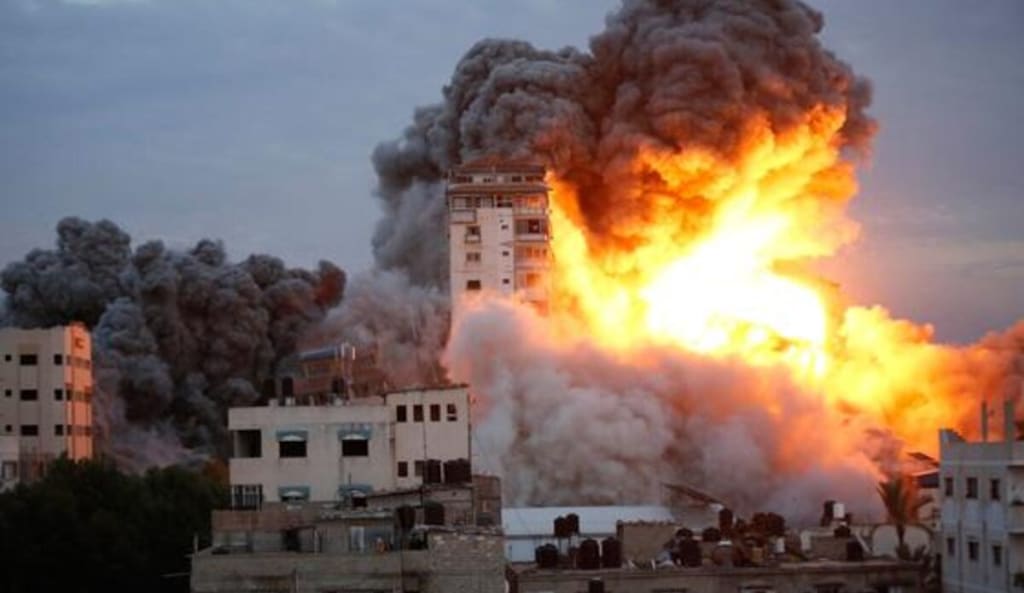
The sun hadn’t fully risen, but the streets of Gaza were already awake—not with the noise of morning chatter or the clatter of market stalls, but with sirens, smoke, and the low hum of drones circling like vultures above a wounded land.
In a narrow alleyway darkened by fallen stone, a twelve-year-old boy named Raza clutched his sister’s hand. They had been walking for hours, trying to find their parents after the bombing the night before. Yazan’s eyes, though young, had the exhaustion of a lifetime. His sister, Lana, only six, asked him in a trembling voice, “Will it be quiet today?”
Raza didn’t know how to answer. He hadn’t heard true quiet in months. His answer was silence—a heavy, choking silence shared by many in Palestine, where fear often speaks louder than words.
Not far from them, inside a collapsed building, an old man sat by the broken frame of a window. His name was Abu Kareem, a retired schoolteacher once known in the neighborhood for reciting poetry about peace. His wife was buried under the rubble below him. He had not moved her. He couldn’t. His legs were too weak, and help was too far. All he could do now was pray—not for victory, not for revenge—but for a ceasefire. A moment, just one moment, where no mother would scream, no child would run, and no homes would fall.
Everywhere across Palestine, people lived in moments—moments of dread, of waiting, of surviving. The dream of a ceasefire was no longer about politics or agreements. It was about breath. About time. About staying alive until tomorrow.
In a crowded hospital running on flickering generators, Dr. Sarah worked without pause. Her hands shook, not from fear but from exhaustion. Every hour, more wounded came. She no longer asked for names. Too many of them were children. Too many of them reminded her of her own son, who had died two months ago in a school strike. She wore his bracelet on her wrist now—a string of green beads that spelled "Peace" in Arabic.
"Peace," she whispered often, not knowing if it was a prayer, a memory, or a fantasy.
Outside the hospital, food lines stretched around corners. A man named Farid stood with his wife and three daughters, waiting for a bag of flour. He had been a carpenter before the war intensified, but now his hands, once skilled at shaping wood, were shaking from hunger. He used to build tables for neighbors, cribs for newborns, shelves for books no one reads anymore. Now, all he built were barricades against airstrikes.
Farid turned to his eldest daughter, Salma, only ten, who had learned to read by candlelight during long nights of blackout. "What would you write if you could send a letter to the world?" he asked.
She looked at him and said, “I would write: We are not enemies. We are just people.”
Her answer made Farid’s heart ache. In the ashes of a broken country, innocence still survived. For how long, he didn’t know.
At night, when the shelling paused briefly, voices would rise in whispers—neighbors checking on each other, mothers rocking babies to sleep, fathers standing watch with tired eyes. In those fragile hours, Palestine dreamed. Not of land, not of war, but of silence. A silence that didn’t come from fear, but from peace.
The dream of ceasefire was not just an end to bombs. It was the return of school bells, of bread baking in ovens, of laughter in the street. It was the return of choice—the choice to live, to hope, to grow old.
But until that dream came true, Palestine waited.
It waited with courage that rarely made headlines, with grief that never faded, and with hope that defied logic. Because in every broken wall, every shattered window, and every tear-streaked face, there was still the belief that the world would one day listen.
And maybe—just maybe—care enough to help them breathe again.
About the Creator
Miss Persephone's Manual to a Seemingly Ordinary Life
Miss Persephone was found at the dining table, her blue eyes swollen, her tears arriving and retreating like the tides of the ocean. Earlier that day, her family had visited her in the retirement home where she had lived for eight years. It was her eightieth birthday.
By Imola Tóth3 days ago in Fiction


Comments (4)
Hi
God help them
May world help them
Share for humanity