
The Cost of Living vs.The Priceless Being
How much are you willing to pay?
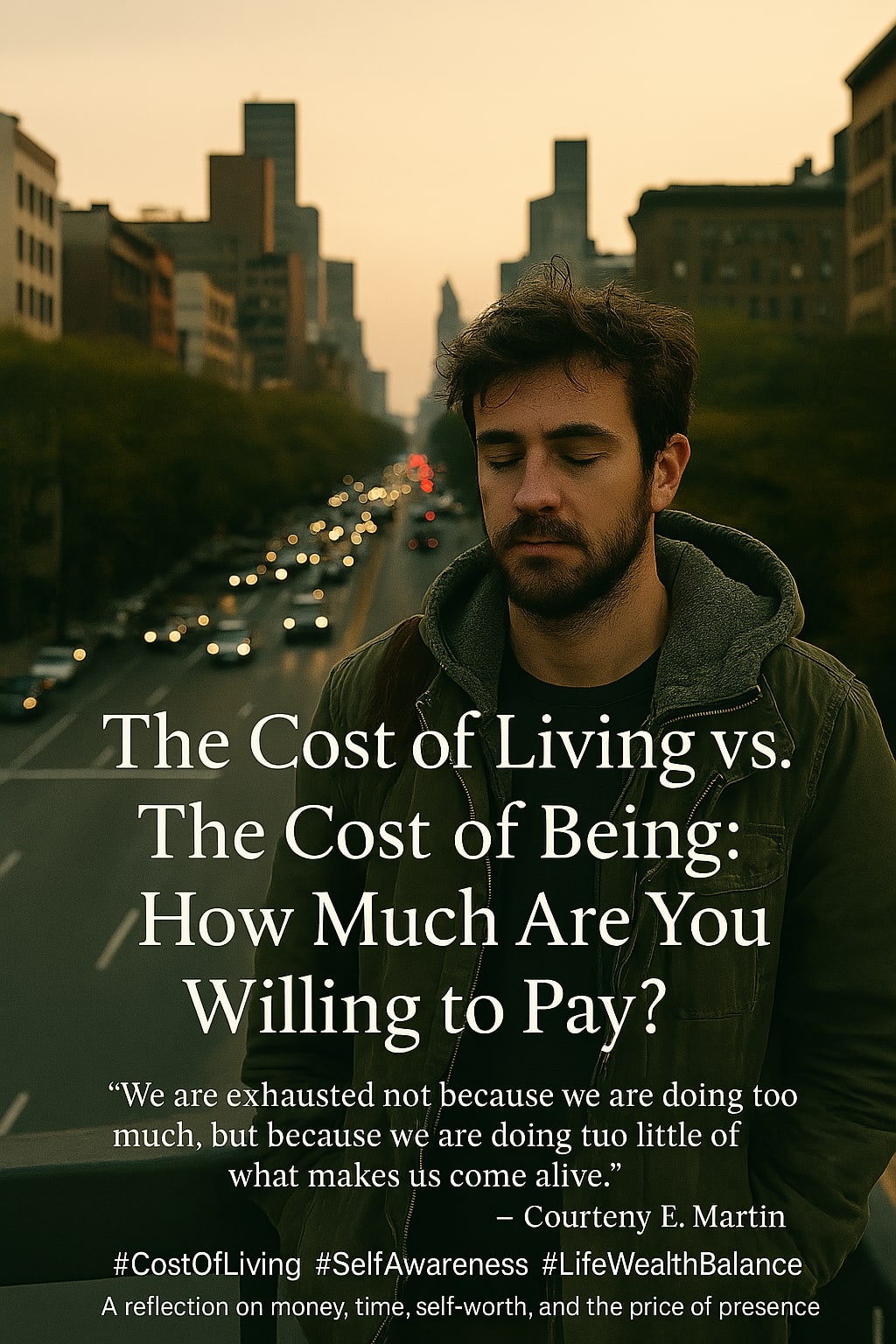
The Cost of Living vs. The Priceless Being: How Much are you Willing to Pay?
“We are exhausted not because we are doing too much, but because we are doing too little of what makes us come alive.” — Courtney E. Martin
Some mornings, you wake up and your chest already feels heavy. Before your feet even hit the floor, your mind races through bills, deadlines, expectations—the price of groceries, rent, gas. The pressure to keep producing, to keep up, to not fall behind. You stare at the ceiling and wonder how it became this hard just to exist. You're not alone. So many of us carry the silent weight of financial stress, of emotional burnout from trying to survive in a world that often demands too much and gives too little. The cost of living has become the cost of being, and in the process, our peace, our sleep, and our joy have become collateral damage.
At its surface, money is just a tool—a neutral placeholder, a system of exchange that saves us from bartering goats for bread. But when you look deeper into the recesses of our minds, our fears, our longings—you begin to see that money is never just about currency. It’s about security. It’s about self-worth. It’s about power. It reflects our hidden stories, our inherited beliefs, and our emotional wounds. It amplifies our anxieties and exposes our vulnerabilities. It becomes the mirror we didn’t ask for, reflecting how much of our identity we've outsourced to a number on a screen. The mystery of money runs deeper than we realize. Is it luck, or something more? The divide between the haves and have-nots isn’t just a matter of financial status—it speaks to fortune, opportunity, and the very structures that shape our lives.
Modern neuroscience reveals just how deeply money shapes our mental and emotional landscapes. Research by Mullainathan and Shafir shows that poverty—along with the relentless worry it generates—reduces cognitive bandwidth. Financial stress hijacks our attention, impairing decision-making, eroding emotional resilience, and clouding long-term thinking. In such a state, money ceases to be a mere tool—it becomes a tormentor. It undermines our sense of safety, our clarity, even our capacity for hope. In today’s world, lack isn’t just an inconvenience; it’s a psychological and physiological threat.
The effects of money on the brain go deeper still. Financial gain activates the brain’s reward system, particularly the release of dopamine—the same neurotransmitter involved in the highs of food, sex, and addictive substances. Over time, the anticipation of acquiring wealth becomes more neurologically stimulating than the reward itself, creating a loop of craving and temporary satisfaction. This cycle, known as neuroadaptation, means that greater and greater rewards are needed to produce the same emotional payoff. It's a pattern hauntingly similar to drug addiction—and it explains why even the ultra-wealthy often continue to chase more, even after their needs have long been met.
Yet, contrary to what many expect, more money doesn’t lead to more happiness. Hedonic adaptation ensures that we quickly adjust to improved conditions, only to return to our emotional baseline. Lottery winners, for instance, often find their happiness levels unchanged just a few years later. The pursuit of wealth becomes less about actual utility and more about chasing a fleeting sense of satisfaction—a moving target that always drifts further away. As the brain adjusts, the bar for contentment rises, making genuine fulfillment increasingly elusive.
Wealth, in many cultures, is deeply intertwined with identity and social standing. In affluent societies, personal worth is often measured by net worth, fueling status anxiety and endless comparison. The wealthy may feel pressure to maintain their position or outperform their peers, reinforcing a relentless drive to accumulate. Research by Paul Piff at UC Berkeley found that individuals of higher socioeconomic status were more likely to act unethically in controlled settings—cutting off other drivers, lying in negotiations, or cheating to win prizes. These behaviors often stem from a sense of entitlement and a diminished sensitivity to others’ experiences. As wealth insulates, empathy tends to erode. Emotional distance replaces social accountability.
Modern psychological and neuroscientific research shows that wealth can profoundly distort perception. This distortion isn’t always rooted in malice, but rather in the protective bubble that money creates—shielding individuals from dependence on others and slowly dulling their sense of shared vulnerability. Wealth distorts reality by removing people from the daily struggles of the majority: poverty, systemic injustice, climate stress, and existential insecurity. The result is a false sense of control and detachment from the broader human condition.
This detachment has consequences. When the wealthy hold influential roles in politics, business, or media, their decisions may reflect narrow interests rather than collective needs. Lacking exposure to real-world hardships, they can unknowingly shape policies and narratives that perpetuate inequality and social disconnection. On a larger scale, the psychological effects of wealth contribute to a world that feels increasingly "upside down"—where compassion is sidelined, harmful behavior is rewarded, and human value is tethered to financial success.
Ultimately, the very structure of society becomes distorted by the cognitive and emotional imbalances that extreme wealth creates. Empathy wanes, systems protect privilege, and culture elevates accumulation over well-being. In such a world, leadership often lacks the very qualities—humility, connection, and care—that are essential for a just and thriving humanity.
For many, money also becomes a stand-in for unmet emotional needs—security, connection, purpose. When deeper voids go unaddressed, the accumulation of wealth morphs into a coping mechanism, not a goal. In this light, money becomes a symbolic shield against vulnerability. But no amount of financial success can substitute for inner peace or existential fulfillment.
Without meaning, wealth merely distracts from the discomfort—offering protection without nourishment.
Furthermore, in today’s world, wealth doesn’t just confer power—it bestows something closer to divinity. Billionaires are idolized, their words quoted like scripture, their lifestyles aspirational, their success seen as evidence of moral superiority or cosmic favor. The rich are cast as visionaries, saviors, disruptors—as if their accumulation of wealth is proof of exceptional intelligence, discipline, or even virtue.
But this reverence is not just admiration—it’s mythology. It obscures the structural advantages, inherited privileges, and systemic inequalities that often pave the road to wealth. It turns financial success into a kind of secular sainthood, where questioning the rich is seen as envy, and regulating them is treated as sacrilege. We stop asking how someone became rich and instead ask how we can become more like them.
This mythology feeds into the dangerous illusion that wealth is always earned, always deserved—that those at the top are there because they should be. And by implication, those at the bottom must deserve their fate too. This logic reinforces a brutal meritocracy where suffering is seen as a failure of character, and compassion is replaced by condescension. It numbs us to inequality, making us believe it’s natural, even necessary.
In this framework, the wealthy are not just admired—they are trusted, emulated, and obeyed. They are given platforms in politics, education, and philanthropy, shaping agendas and policies that further entrench their power, all under the guise of benevolence. We call them “job creators,” “philanthropists,” “thought leaders”—titles that mask how their wealth often comes from labor they didn’t do, risks they didn’t bear, and resources they didn’t create. Ultimately, this deification distorts our collective values. It replaces communal wellbeing with personal gain, empathy with ambition, and justice with hierarchy. It teaches us to worship wealth instead of wisdom, and to measure worth not by who we are, but by what we own.
This distortion of value starts early. We're taught that success means productivity. That value is measured in output. That if you’re not generating wealth, you’re not contributing. A child growing up in poverty often internalizes the belief that they are somehow less. An adult juggling two jobs and still falling short may feel not just exhausted, but invisible. And slowly, that sense of inadequacy seeps into our relationships, our dreams, our very sense of what’s possible. We’re so busy surviving, we forget how to live.
And beneath all this lies a silent undercurrent: shame. When you’re struggling to survive, it’s not just about feeling poor—you feel like you are poor. Like you’ve failed. Like you don’t belong. Our culture moralizes wealth, equating it with merit and framing poverty as a personal flaw. The narrative whispers: If you’re not succeeding, you must not be trying hard enough. We internalize these falsehoods, not realizing they are rooted in exploitative systems built to extract, exclude, and oppress. The shame hardens into identity. The stress calcifies into trauma. And every sleepless night, skipped meal, and desperate glance at an overdrawn account becomes a wound—quiet, invisible, but always aching.
On a societal level, the damage is profound. When money becomes the ultimate metric, the very structures meant to protect life begin to bend under the weight of profit. Schools become businesses. Healthcare becomes a luxury. Nature becomes a resource to be extracted and sold. Even our laws and public policies reflect this distortion—favoring corporate donors over the common good, commodifying basic rights, ignoring the cries of the planet and its people. The system doesn't just fail individuals—it corrodes collective trust. We stop believing that things can get better. Cynicism sets in like rust.
You can see it in the erosion of the commons. Parks fall into disrepair. Libraries lose funding. Affordable housing vanishes. These were meant to be shared spaces—equalizers, sanctuaries. But now, if something doesn’t make a profit, it disappears. And in this privatized, monetized landscape, community becomes harder to find. We become fragmented. Suspicious. Isolated. The weight we each carry grows heavier, because there’s no one left to help hold it.
Even love and connection begin to feel like luxuries. When every hour of your day is monetized, when rest feels like a risk, tenderness becomes a distant dream. Burnout becomes a badge of honor. We glorify the hustle while quietly mourning our disconnection. We become so exhausted, we stop showing up for ourselves, for each other. And the loneliness deepens. It starts to feel like we’re each stranded on separate islands, shouting across the sea of our own survival.
Even the sacred gets touched by this. Religion and spirituality are not immune. When churches start to resemble corporations, when preachers sell salvation like a product, the divine is reduced to a marketing strategy. We confuse prosperity with holiness, success with righteousness. And in the process, something pure is lost—our shared sense of humility, of awe, of reverence for what cannot be bought.
And yet, spiritually, the paradox deepens. Because money, for all its destructive potential, can also be a force for good. It can fund dreams. Feed families. Build sanctuaries. It’s not money itself that corrupts—it’s the unconscious attachment to it, the belief that it defines our worth or determines our belonging. Throughout history, sages and mystics warned not against money, but against the illusions it weaves. When it becomes the axis of our lives, we begin to orbit around something inherently unstable. We lose our center. We forget that we were whole before we had anything to prove.
In such a world, integrity becomes endangered. When money is the ultimate goal, everything else becomes negotiable. Ethics, honesty, compassion—they’re seen as optional, unless they serve the brand. We start to admire charisma over character. We mistake popularity for wisdom. We consume people like products and discard them when their shine fades. This isn’t just a financial crisis—it’s a moral collapse. And its fallout touches every part of our lives, from politics to parenting to personal identity.
But why has money become such a pervasive force in society? The relationship between money and power is deeply embedded in the fabric of human civilization. Together, they form a symbiotic force that shapes political systems, economic structures, and societal norms. Historically and today, money is more than a medium of exchange—it is a mechanism of influence. Those with substantial financial resources have the capacity to shape legislation, fund political campaigns, and control media narratives, creating feedback loops that protect and expand their dominance.
For instance, research from the Center for Responsive Politics reveals that the top 0.01% of donors consistently provide the majority of funding for U.S. political campaigns, directly steering policy agendas. This wealth-to-power dynamic is evident in the outsized political sway of billionaires and large corporations, whose interests often override public welfare.
At the same time, power itself becomes a path to wealth. Political and corporate leaders use their influence to craft favorable regulations, secure government contracts, and manipulate markets. The 2008 financial crisis starkly illustrated this: decisions made by powerful actors—many with close ties to Wall Street—not only contributed to the collapse but also ensured that bailouts prioritized major financial institutions, while ordinary citizens paid the price. Similarly, lax antitrust enforcement has allowed corporations like Amazon and Google to dominate entire sectors, reinforcing economic hierarchies and limiting competition. Power, in this sense, is not just a means of accumulating wealth, but a tool for engineering systems that guarantee its continued concentration.
This entwinement also deepens social inequality. Wealth grants access—not only to material resources, but to quality education, healthcare, and political representation. Studies from Harvard’s Opportunity Insights show that children from wealthy families are significantly more likely to remain wealthy, revealing the persistence of systemic advantages. These disparities are reflected in governance and media, where affluent voices are amplified while marginalized communities struggle for visibility and influence. The consolidation of wealth and power among elites weakens democratic participation and entrenches exclusion, as the rules of engagement are often written by and for those already at the top.
And yet, this nexus between money and power is not unbreakable. History offers numerous examples of grassroots movements—like the Civil Rights Movement in the U.S. or the anti-apartheid struggle in South Africa—that have successfully challenged entrenched systems. In more recent years, movements like Occupy Wall Street and the global climate strikes have drawn attention to the disproportionate influence of wealth in politics and economics. While such efforts don’t always yield immediate structural change, they shift public consciousness and build momentum for reform. Ultimately, money and power are human constructs—malleable and contestable—subject to the will, values, and collective actions of people.
In theory, democracy empowers people to shape their collective future—built on the ideal of equal voice. But in practice, that process is often distorted by the very forces it claims to check. Media plays a pivotal role in shaping public opinion, yet much of it is owned or influenced by corporate interests and wealthy donors. Campaign financing has become a contest not of ideas, but of capital—where those with the deepest pockets control the narrative. Political lobbying by special interest groups further warps the legislative process, ensuring that laws serve those who can afford access. And then there is voter suppression and disenfranchisement—tactics that systematically silence the voices of marginalized communities.
What emerges is less a democratic process and more a curated performance. Citizens are given the appearance of choice, but that choice is often pre-selected, pre-funded, and pre-approved. The ballot may offer names, but the real decisions are made behind closed doors—by those with the means to shape the political landscape long before the first vote is cast.
When money becomes the gatekeeper of political success—determining who runs, who gets seen, and who survives—democracy begins to resemble theater. The people vote on stage, but the script was written before the curtains rose. Behind the spectacle of campaigns and debates lies a world of shadowy donors, strategic investments, and policy-for-profit deals.
This entanglement raises urgent and uncomfortable questions: Are we living under an oligarchy disguised as democracy? Are our political choices truly free, or are we merely navigating an illusion of freedom? Has politics become a marketplace where power is traded like any other commodity? And perhaps most crucially: Can democracy survive—let alone thrive—without a foundation of economic justice and equality? The answers lie with us. ‘We the people’ still hold the ultimate power—but only if we wake up, stay vigilant, and break free from the modern slavery of chasing the hollow illusion of "success." It’s time to reclaim the systems meant to serve us all, not just the privileged few.
On the other hand, the rapid decline in the value of money and the increasing cost of living, despite advances in technology, science, and medicine, is a multifaceted issue rooted in systemic and structural factors that affect the global economy, national policies, and even cultural mindsets. It’s frustrating to see these disparities, especially when we’re led to believe that technological progress should naturally improve quality of life and increase economic opportunities. However, the reality is much more complicated.
A significant reason for the rising cost of living is tied to the way economies are structured, particularly in capitalist systems. Over the past few decades, wages for the average worker have largely stagnated, while the costs of basic goods—housing, healthcare, education—have soared. Meanwhile, the wealthiest individuals and corporations have seen their fortunes skyrocket. This widening wealth gap isn’t just a coincidence; it’s a result of policies, tax structures, and corporate practices that disproportionately benefit the already wealthy. These systems often focus on profit maximization for corporations rather than ensuring that the fruits of productivity are fairly distributed.
You’ve also got inflation—a process that erodes the purchasing power of money over time. Central banks and governments often print more money to address national debt or to fund stimulus packages, which increases the supply of money in circulation. While this can be a short-term solution for economic crises, it leads to inflation, making everyday goods more expensive, even when wages don't keep up with the pace.
Globalization has contributed to this as well. In many countries, jobs that once paid a stable wage are now outsourced to regions where labor is cheaper. This, in turn, pressures local wages down while increasing profits for multinational companies. Technological advances also contribute to this by automating jobs, replacing human labor in many sectors, leaving workers with fewer opportunities for stable, well-paying positions. While innovation should theoretically make life easier, it often leads to greater disparities in wealth and employment, creating a paradox where technology drives productivity but leaves many behind.
On top of that, housing markets are becoming increasingly unaffordable. In many cities, especially those in high-demand areas, the cost of housing has outpaced the average wage by a significant margin. This is partly due to real estate speculation and investment from large corporations, which treat housing as an investment opportunity rather than a basic human need. This leads to bidding wars on properties, pushing out lower-income and middle-class families who are already struggling.
The healthcare and education sectors also reflect this trend. While advancements in medicine and education should theoretically lower costs and improve accessibility, the reality is that these systems have become increasingly privatized. In many places, healthcare and education are treated as commodities, where access is determined by one's ability to pay, rather than being seen as fundamental rights for all. This often leaves people with fewer choices and greater financial strain, despite the advances made in these fields.
What’s even more frustrating is that it’s incredibly difficult for the average person to get ahead because these systems are designed in such a way that they’re hard to change. It feels like the deck is stacked against you. No matter how hard you work, how much you innovate, or how many hours you put in, it often feels like the rewards don’t match the effort. Instead, wealth keeps accumulating at the top, and the cost of living keeps going up.
The idea of a "basic wage" seems increasingly out of reach, and many people are finding themselves working longer hours or multiple jobs just to keep up with basic expenses. In a sense, the problem lies in how value is assigned in the modern economy. Our work, our skills, and our lives are often reduced to numbers on spreadsheets. The intrinsic value of individuals as human beings is lost in the drive for profit. People are commodified in ways that dehumanize them, while the systems that were supposed to benefit society—labor markets, education systems, and healthcare—fail to provide basic stability.
In short, we’ve become passengers on autopilot—manipulated like zombies within a system that feels increasingly irrational and alien to us. What lies at the heart of this madness? At its core, the current system is driven by ego—both individual and collective. On a personal level, it conditions us to chase status, success, and wealth over deeper values like compassion, connection, and fulfillment. It fosters a culture of competition, isolation, and burnout. On a societal scale, the collective ego of nations, corporations, and institutions prioritizes power, control, and dominance—often at the expense of people and the planet.
This manifests as unchecked greed: the endless pursuit of wealth and resources that deepens inequality and imbalance. Ego feeds on short-term gratification, ignoring long-term consequences and ethical responsibility. It cultivates fear, scarcity, and disconnection from the greater whole. Put simply: the “genius” of greed is out of the bottle—and it’s rampaging unchecked.
This ego-centric paradigm promotes conflict, consumption, and competition, leading to widespread dissatisfaction, emotional exhaustion, and spiritual emptiness. Even amid material abundance, many feel a deep void—questioning whether there’s more to life than endless accumulation. The system thrives on separation—between people, between humanity and nature—when what we need is connection. To escape this spiral, we need a shift in consciousness: a return to the truth that our interdependence is not a weakness, and it is not for sale.
Astonishingly, money-which is just a mental construct, once a simple tool for exchange, has become the defining metric of modern life—a distorted symbol of success and self-worth. As a result, under global capitalism, our lives have been aggressively reshaped around the pursuit of profit. This obsession is pushing us toward a breaking point—eroding our humanity, our communities, and our sense of meaning.
But change is stirring. A growing movement of thinkers, activists, and communities is reimagining systems built not on extraction, but on empathy; not on competition, but on collaboration. They are pointing us toward a future rooted in sustainability, justice, and shared purpose—one that values life over profit, and being over having.
Alternative economic models such as gift economies, time banking, bartering systems, resource-based economies, and cooperatives shift the emphasis from profit to community-building and mutual support. For instance, many indigenous cultures thrived for generations on gift economies, where the sharing of goods and services was rooted in relationship-building rather than accumulation. Time banking, a more contemporary example, allows people to exchange services based on time instead of money. Successful implementations of time banks have shown measurable benefits, such as reduced social isolation, strengthened local relationships, and increased civic participation. These models emphasize trust, reciprocity, and human connection as the true currencies of social life.
Despite their promise, such models face significant obstacles when it comes to scaling and integrating into the broader frameworks of modern, globalized economies. For example, resource-based economies, such as those envisioned by The Venus Project, propose a world where advanced technologies and automation eliminate the need for money by ensuring that everyone’s basic needs are met.
While inspiring in theory, these systems require vast technological infrastructure, a reimagined societal architecture, and broad cultural acceptance—conditions that are still in development. Meanwhile, smaller-scale cooperative businesses and community-run initiatives have shown tangible success. These ventures, built on shared ownership and democratic governance, offer real-world evidence that economic structures centered on collective well-being can function effectively and ethically.
Nonetheless, transitioning entirely away from money in today’s consumer-driven and highly individualized society remains a formidable challenge. The entrenchment of capitalist values—competition, scarcity, personal gain—runs deep. Even with advancing technologies that could theoretically meet human needs more equitably, major questions remain about how to manage access, avoid new forms of inequality, and inspire widespread cultural transformation.
That said, hybrid approaches may hold the most realistic promise for meaningful change. Blending traditional systems with fresh ideas—like Universal Basic Income, digital cooperatives, and decentralized platforms for sharing resources—can start shifting us toward something better. Not just a world where we survive or chase profit, but a world that puts human connection, dignity, and shared responsibility at its core.
Because let’s face it—this system we’re living in? It’s broken. We feel it in our bodies, in our burnout, in the constant pressure to do more, be more, earn more. It’s not just draining our bank accounts—it’s draining our souls. We’re stuck in this endless loop of work, consume, compete, and repeat. And for what? We’re told that if we just keep grinding, happiness will be waiting on the other side. But more often than not, we end up exhausted, isolated, and wondering why everything still feels so empty.
Yes, struggle is ancient—etched into the bones of history, whispered through generations. But just because hardship has always existed doesn’t mean we must bow to it like a god. Saying “life’s always been hard” isn’t a revelation—it’s a resignation. Diversity is not the same as inequality. Being born into different bodies, cultures, and stories is a gift—a testament to the richness of human experience. But when those differences are used to justify unequal access to dignity, freedom, or rest, that’s not diversity—that’s injustice disguised as destiny.
We weren’t born merely to endure, to trade dreams for paychecks, or peace for productivity. When we say everyone’s struggling, it shouldn’t numb us—it should awaken us. It should spark empathy, not apathy. It should provoke the question: Why have we built a world where surviving costs our souls? Pain shared is not pain justified. Normal doesn’t mean natural. And perhaps real courage lies not in quietly bearing the burden, but in boldly reimagining life itself—a life where joy isn’t a luxury, and being human isn’t a debt we’re always trying to repay.
Granted. Not everyone will become wealthy. And that’s okay. Each of us carries different gifts, limitations, and potentials. But every human being—every single one—deserves their basic needs met: food, shelter, safety, rest, and belonging. This isn’t charity. It’s the foundation of any society that dares to call itself humane. Struggle may be part of the journey, but it should never be the price of simply being alive.
Somewhere along the way, we bought into this idea that the more we have—money, possessions, titles—the more fulfilled we’ll be. But at what cost? Our peace of mind? Our relationships? Our health? When does ambition turn into anxiety? When does progress become a race to nowhere, where we lose touch with what actually matters?
And here’s the thing—we know it’s not working. Deep down, we all feel it. So the real question is: When will we stop pretending this is the only way? When will we find the courage to imagine something different? A world where our worth isn’t measured by output, income, or how well we perform in a system designed to exhaust us. A world that values care over competition, kindness over control, connection over consumption. What if, instead of chasing status, we built systems rooted in solidarity? What if we stopped asking, “How much can I get?” and started asking, “How can we thrive—together?”
Yes, struggle is ancient. To live is to struggle. But can’t we choose which struggles are truly worth our energy? We have missed the real target, becoming our worst enemy. Instead of wasting time trying to dominate, manipulate, or outdo one another, what if we finally turned our attention toward our real, shared adversaries—poverty, diseases, injustice, loneliness, and ecological collapse? Maybe it’s time we stopped fighting each other and started fighting for each other.
Because if we’re honest with ourselves, the way we treat money today is strange. Money only has power because we agree it does. It's built on belief, on collective trust. Yet somehow, we've come to trust pieces of paper—and now intangible digital numbers—more than we trust each other. The more we lean on money to mediate our lives, the less we lean into community, into trust, into shared humanity. But it doesn't have to be this way.
Trust is not some idealistic fantasy—it’s the foundation of survival. We’re social beings. We’ve made it this far because we’ve looked out for one another. So how can we possibly thrive if we don’t trust the people around us? How can we put our faith in faceless systems, false idols, while doubting the warmth of a helping hand or the sincerity of someone’s word? Maybe it's time we flipped the script. Because the more we trust, connect, and love, the less power money has to divide us, to control us, to consume us.
So pause—take a breath—and really let that sink in. Let’s shift the perspective. What does it truly mean to live—not just to survive or get by, but to be fully alive? What’s your most precious asset? It’s not your paycheck, your house, your phone, or your job title. It’s your life. And its value is beyond measure. Whether you realize it or not, you’re already the richest person on Earth. Just consider how extraordinary you are: a one-of-a-kind miracle in a universe teeming with possibilities. A living, breathing being capable of thought, emotion, creativity, connection, love, and transformation. Life is paramount—without it, nothing else is possible. No machine, no invention, no amount of wealth can rival the wonder of a single human soul. And this miracle? It enters the world freely, born from something as natural and sacred as love itself.
Yet, to live authentically—to truly live—comes with a cost. Not a financial one, but something far more profound. It requires showing up with integrity, living with intention, choosing freedom over conformity, speaking your truth even when it's hard, giving love freely, and practicing deep gratitude. These aren’t abstract ideals—they are the true currency of a meaningful life. And so, the real question becomes: Are you willing to pay that price?
In other words, the true cost—the real investment—is aligning our actions with our core values and remaining true to who we are. That’s when success and abundance begin to flow, not through force, but through authenticity. Alignment is powerful because it brings us into harmony—within ourselves, with others, and with something greater than us. When our choices reflect our deepest values, we stop losing energy to inner conflict. We are no longer torn between our identity and our behavior. Instead, we become whole.
From that wholeness comes clarity, direction, and a quiet strength that radiates from within, even if no one else can see it. Alignment isn’t about striving—it’s about remembering who we are and living from that place. And when we do, life doesn’t just respond—it begins to resonate.
When we’re out of tune with ourselves—chasing goals that don’t truly belong to us, walking paths that were never ours, betraying our values just to keep up—we create dissonance. Life starts to feel like static. But when we align, something deep shifts. There’s rhythm. There’s flow. We begin to vibrate at the frequency of our own truth, and suddenly, the world begins to respond. Opportunities, ideas, even people—everything starts meeting us where we are, not because we’re forcing it, but because we’re finally showing up as who we really are.
It doesn’t have to be a grand gesture. Sometimes it’s as simple as someone leaving a high-paying job that made them feel hollow, choosing instead to teach art at a local community center—not for status, but for soul. Friends questioned them. Family worried. But they woke up every morning feeling alive, feeling right. That alignment, quiet as it was, brought not just peace, but unexpected doors opening—connections, joy, a sense of meaning they had never known. That’s not magic. That’s resonance.
In a world full of noise, speed, and striving, alignment becomes a quiet, sacred rebellion. It’s not about perfection—it’s about returning to what’s real. And from that place, success and abundance—however we define them—tend to arrive, not as a reward, but as a natural expression of who we’ve become. Because when we are true to ourselves, we become vessels clear enough for life to flow through us.
Because yes—life is a struggle, and change is hard. It’s messy, uncomfortable, and full of uncertainty. But maybe, just maybe, that’s where the real transformation begins. In the discomfort. In the unknown. That’s where we rediscover what it means to be human. We’ve come to a turning point. This is not just a casual question—it’s urgent. It’s personal. It’s a do-or-die, step-up-or-step-aside kind of moment. The question isn't whether change is possible. It's whether we're ready. Because we already have the tools, the knowledge, the heart, and the power to create something better. The world we long for—the one with more empathy, more meaning, more connection—is not a far-off dream. It’s a choice. And we can make it. Today.
SOURCES
Mullainathan, S., & Shafir, E. (2013). Scarcity: Why having too little means so much. Times Books.
Haushofer, J., & Fehr, E. (2014). On the psychology of poverty. Science, 344(6186), 862–867. https://doi.org/10.1126/science.1232491
Piff, P. K., Kraus, M. W., Côté, S., Cheng, B. H., & Keltner, D. (2010). Having less, giving more: The influence of social class on prosocial behavior. Journal of Personality and Social Psychology, 99(5), 771–784. https://doi.org/10.1037/a0020092
Maslach, C., & Leiter, M. P. (2016). Burnout: The cost of caring. Malor Books.
Petersen, A. H. (2019). Can't even: How millennials became the burnout generation. Houghton Mifflin Harcourt.
Rosa, H. (2013). Social acceleration: A new theory of modernity (J. Trejo-Mathys, Trans.). Columbia University Press.
Piketty, T. (2014). Capital in the twenty-first century (A. Goldhammer, Trans.). Harvard University Press.
Giridharadas, A. (2018). Winners take all: The elite charade of changing the world. Knopf.
Center for Responsive Politics. (n.d.). Opensecrets.org. https://www.opensecrets.org/
Chetty, R., Hendren, N., Kline, P., & Saez, E. (2014). Where is the land of opportunity? The geography of intergenerational mobility in the United States. Quarterly Journal of Economics, 129(4), 1553–1623. https://doi.org/10.1093/qje/qju022
Fromm, E. (1976). To have or to be? Harper & Row.
Tolle, E. (2005). A new earth: Awakening to your life’s purpose. Penguin Group.
Thurman, H. (1971). The inward journey. Friends United Press.
King Jr., M. L. (1967). Where do we go from here: Chaos or community? Beacon Press.
Monbiot, G. (2017). Out of the wreckage: A new politics for an age of crisis. Verso Books.
Ostrom, E. (1990). Governing the commons: The evolution of institutions for collective action. Cambridge University Press.
Putnam, R. D. (2000). Bowling alone: The collapse and revival of American community. Simon & Schuster.
About the Creator
Keep reading
More stories from Daniel Walker Corasmin and writers in Humans and other communities.
Mismatch Challenge Winners
Blending genres isn’t about stacking elements side by side. It’s about what happens when two sets of expectations refuse to cooperate. The strongest entries in the Mismatch Challenge understood that tension and leaned into it. Rather than smoothing the edges, these stories let their chosen genres complicate one another, creating friction that carried through voice, structure, and consequence.
By Vocal Curation Team6 days ago in Resources



Comments
There are no comments for this story
Be the first to respond and start the conversation.