
The Capybara, Unbothered
What calmness can teach us about survival.
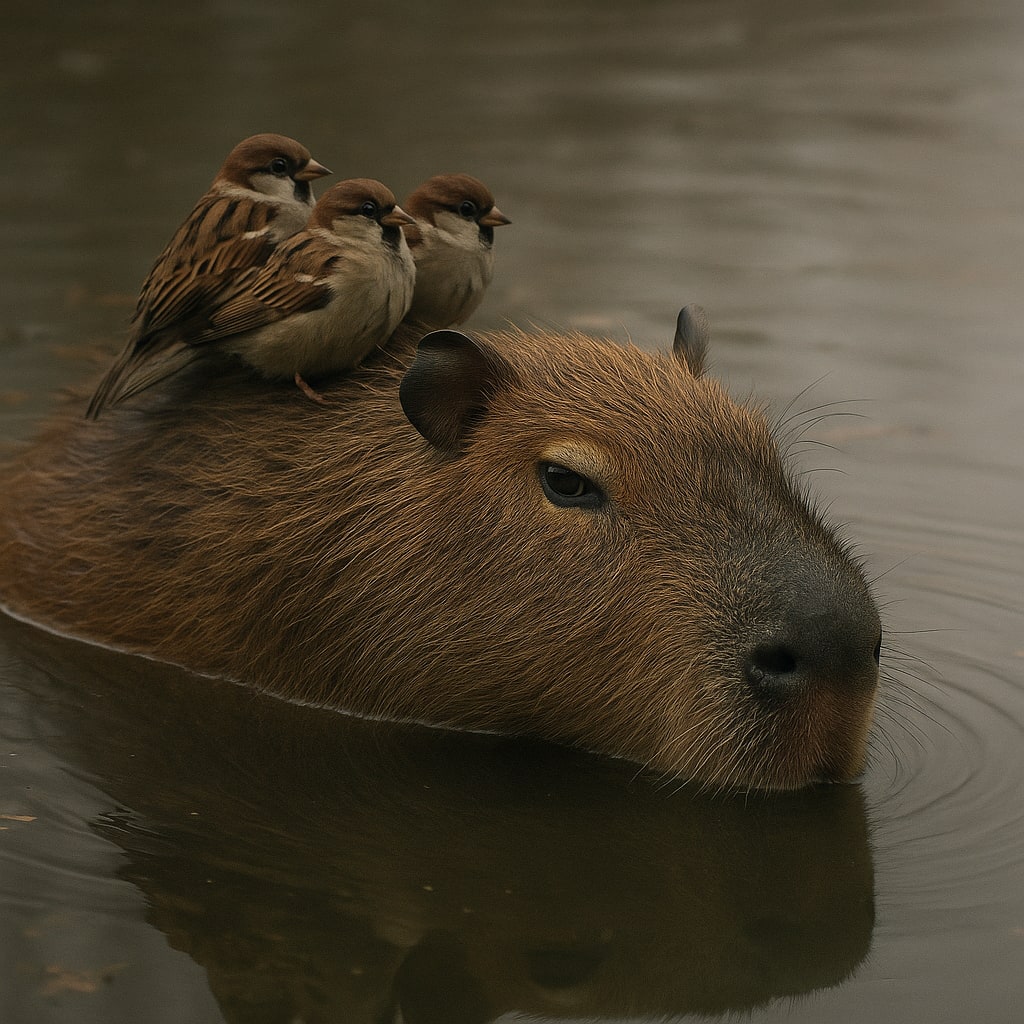
The capybara—she truly seems unbothered. Not because she’s numb, but because she carries water inside her. I learned that on a November day when the wind dragged wet plastic bags along the riverwalk, my phone chirped like an irritated bird, and the news stuck in my throat like a bone. I went to the city zoo on assignment and sat by her enclosure: a brown brick with eyes that weren’t trying to prove anything. Half her face in water, half in air. A sparrow gang perched on her back—brazen as kids hogging a park bench. She rocked ever so slightly, and it felt as if someone were gently rocking the whole world.
“Are they always like that?” I asked the keeper slicing carrots.
“Like what?”
“Calm. As if everything passes them by.”
“It doesn’t pass them by,” he said, glancing at my hat, my bare hands, the blinking phone. “They just don’t argue with water. Argue with water—you sink faster.”
He went off to the goats, and I stayed with her. For the first time in ages, the feeling that I was behind on everything let go. The capybara wasn’t keeping up—she was simply existing. I remembered how my father taught me to float: Don’t work, don’t prove, just spread out, inhale, and trust. Back then I could hold it for two seconds before I started grabbing at the water like belongings in a burning house. Now I sat on a cold bench and relearned one thing: don’t grab. My phone buzzed; I cut the sound. Out of habit I wanted to turn the moment into a lesson—Lesson One: keep half your head in water, and half your thoughts go quiet—but I stopped myself: the capybara doesn’t turn moments into lessons. She exists like a boulder no one remembered to carve into monuments.
A school class filed past. “Look—a giant hamster!” the kids pointed. The teacher called her “the largest rodent on the planet.” A boy asked, “What’s she for?” The teacher smiled, tired: “Same as us. Just because.” Just because sounded truer than any growth program. I came back a week later. Wet snow fell in thick flakes; tough, rubbery rings drifted on the water. The sparrows had reclaimed their seats. That’s when I learned Principle Two: let whoever is lighter than you use you as a pier. Not out of self-sacrifice—out of physics. That day a friend called with heavy news, the kind you usually scream into a pillow after. I stood by the enclosure and didn’t scream. I watched rings spread from the capybara and thought: maybe this is how to do it—let another’s pain sit on you, warm itself, and fly off. Don’t swallow it, don’t repack it as your drama, don’t fix it on command—be a surface. She poured it out, said “thank you,” hung up. The water closed.
Then came a week of frost, the kind that makes you feel like a gear tooth scraping metal. “Urgent for yesterday,” emails with no meaning, an argument with a man who came to argue. I realized a small brown capybara had moved in inside me. When the news turned into the kind that freezes normal people’s palms, she made one circle and went still. Not because she didn’t care. Because circles are better off as circles, not storms. I started calling that state the lake inside. It didn’t cancel pain or fear. It gave them a bottom. Lakes hold fish that always keep quiet; they know what language can’t. In my lake one such fish stayed silent, and its silence calmed me more than any words.
“People keep writing ‘they don’t care,’” the keeper told me once. “That’s wrong. They just choose what to spend movement on. Movement is expensive.” I remembered—and began counting my moves. I’d feel the itch to dive into the comments and prove my point, then ask: How much will one proof cost in energy? Will there be any left for breathing? Usually, no. I kept quiet. The world didn’t get better, but I stopped drowning.
Sometimes the capybara felt like an ancient teacher who simply doesn’t like to talk. In Japanese zoos they toss citrus into hot pools; capybaras sit there squinting with bliss. We had no citrus—only wet leaves, sparrows, and me. Once I brought an orange, peeled it, and set a slice afloat. It drifted toward her nose like a tiny sun. The capybara never moved. The orange steeped and sailed into a corner. I smiled to myself: Lesson Three—don’t take everything that’s offered, even if it glows and smells good.
The hardest exam came at the hospital. Cold corridor, linoleum, metal chairs, people speaking in low voices as if volume might break something. I waited for news about someone I love. My body knew the choreography of panic: fold up, chew your lip, twitch. I unlocked my phone—read two lines—locked it. I lifted my head. In the water cooler’s glass cylinder, a round world stood still. Bubbles rose, burst, disappeared. The lake inside, I told myself. Inhale and spread out. Don’t work now. Your job is to be a surface. I didn’t console anyone with proverbs, didn’t type out philosophical paragraphs in group chats, didn’t spill wisdom on the floor. I breathed. When the doctor came out, I was present enough to hear.
There was more after that: snow, other people’s meltdowns, my own mistakes. Sometimes I forgot the lake and turned into a stinking stream that undercuts the bank and hates the stones for holding. On those days I went back to the zoo the way people go back to the place where they were once given a name. I sat there, watched her, and remembered how not to prove anything.
And of course the ending found me where I wasn’t looking.
A mild, thawing weekend. A crowd pressed up to the railing; kids craned their necks. A little girl hooked her sneaker on the lower bar. Her mom glanced down at her phone. The rubber sole slipped—and the child toppled in, straight into the muddy water.
She screamed. The mom shouted. The crowd froze.
I lunged forward, ducked under the rail, and fell in after her. My knee slammed concrete; my hands punched into icy sludge. Mud splashed my face. The girl thrashed beside me, shrieking so sharp it scraped my ears.
The capybara lifted her head. Turned. Didn’t move. She stood there—stone, but alive. And it was that stillness, her unbothered calm, that knocked the panic out of me.
I scooped the girl, slick and shaking, pressed her to me, and passed her through the bars into somebody’s arms. I stayed in the pool—ankle-deep in cold muck, knee throbbing, hands trembling.
People buzzed: some thankful, some scolding, some filming. The keeper handed me an old rag and said quietly,
“Movement’s expensive. But sometimes it’s worth the price.”
I nodded, not trusting my voice. The capybara had already resumed her post—half a face in water, half in air. As if nothing had happened.
That’s when I realized I’d been reading her wrong the whole time. Unbothered isn’t indifference. It’s reserve held for the first necessary step. To keep the lake intact until you have to move for what’s bigger than you. And then to become smooth again so sparrows have somewhere to land—and leave.
On the way home the hospital called. “Stable condition,” they said. I heard the failed grandeur of my old self—the way I loved posting philosophy when I could have just breathed nearby. I said “thank you,” and nothing else.
I got home filthy and bruised and ran a hot bath. The neighbors upstairs were yelling again. I sank in, leaving only my nose and eyes above the water—like a capybara. The world split: their shouting up there, the hum of silence below. I chose the silence. I breathed. I rewrote a rule for myself: be a stone, but alive. Be water, but with a shore. The capybara knew this without words.
Then I sat down to write the piece for the editor.
There was a thin crust of ice on the water. The capybara touched it with her muzzle, and the ice rang, like a glass toasting something real. That ring is a small bell for us: the world speaks more simply than we like to think.
I smiled. The news didn’t stop being news; people didn’t stop rushing or making mistakes. But I had a lake now, and the lake had a shore. I knew where unbothered ends and movement begins. And if I’m lucky, sparrows will still land on the surface. I allow it.
About the Creator
Ula Mano
I write to explore what moves beneath words — desire, silence, truth. My work ranges from poetic prose to intimate dramas and philosophical tales. I believe in language that breathes — raw, honest, alive.
Are Fat People Disabled or Are Disabled People Fat?
There is a question people ask quietly, sometimes without even realising they are asking it. It lives in looks, assumptions, and comments muttered under breath. It sounds like concern, but it is actually judgement. It goes something like this: why are so many fat people in pain? Why are so many fat people using mobility aids? Why are so many fat people struggling to move?
By No One’s Daughter6 days ago in Humans


Comments
There are no comments for this story
Be the first to respond and start the conversation.