
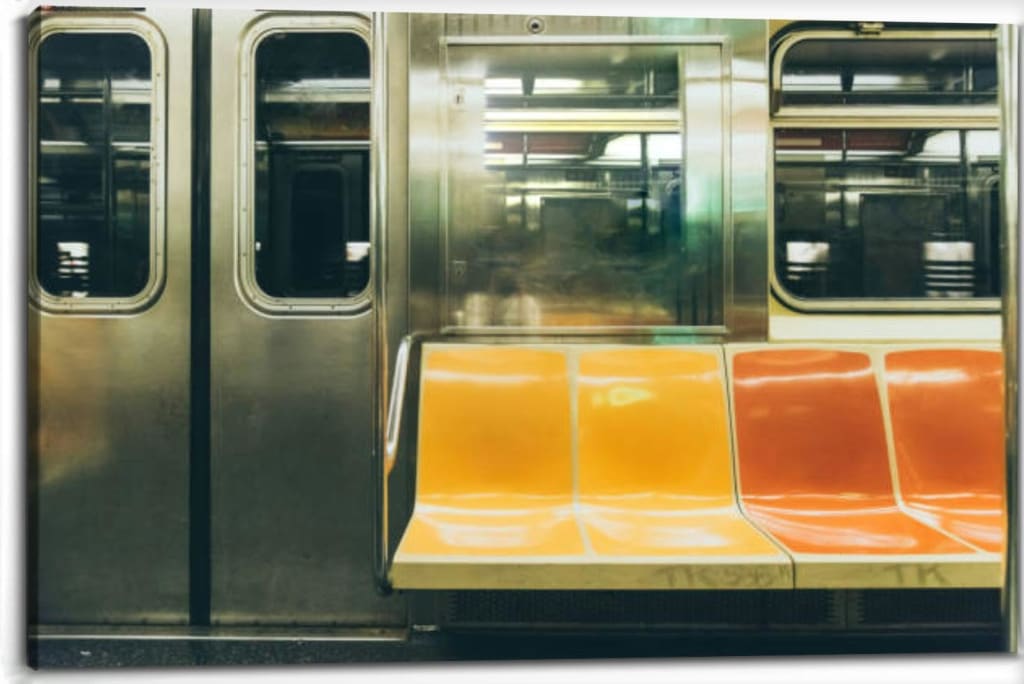
Paul stumbles in through the subway train doors, he thinks his foot was caught in the doorway but worries the other passengers think he’s drunk or ill. He catches himself and shamefully walks over to a pole or seat, he hasn’t decided yet. Nobody on the train noticed Paul’s fumble. He takes a moment to choose to sit or stand; his destination was only a few stops but if he sat, he worries he may zone out and miss his stop. He sits anyway, the pole is a little cold in the winter. It didn’t feel too cold beforehand but perhaps being the only passenger on the train without a coat on makes the temperature seem even lower. He quickly realizes he’s also the only solo rider, three other couples surrounding him.
He tries to avoid looking at other people, he tends to judge strangers and then feel guilty for said judging, an awful yet common cycle. He can’t help but notice the couple in front of him: the girlfriend nestling her head into her boyfriend’s plump jacket. She looks a little like Barbara Streisand, not current Streisand but Funny Girl era. Now Paul’s going to have that Rain on My Parade song stuck in his head. Damn it. The guy looks not too dissimilar to Paul, or as Paul sees it a better-looking version of himself. The stranger’s teeth are a bit shinier, clothes a bit nicer, hair better tamed, Paul feels inadequate in his presence. The stranger doesn’t look at Paul once during the entire ride.
Now that he’s stepped one foot into this game of people watching, he looks over to the other couples, one couple of two men, the other an elderly man and woman. The two men are playing some game on one of their phones. They pass it back and forth presumably taking turns in whatever game it is. Paul tries to guess but he doesn’t play too many games and can only muster up Pong as a theory. The elderly couple communicate in a faint voice, even if Paul were right next to them, he probably couldn’t hear them. He has met many older folks who speak at this volume to one another, like a secret language you unlock as you age. In general Paul tends to find most people speak a language separate to him, like there’s an advanced type of life he’s not fully seeing. He used to think maybe he had the advanced language that others didn’t understand, but now isn’t as sure of the hierarchy. At parties or get togethers he finds himself watching the occasion from a distance, even if he’s right in the center of it. He expressed this language idea to a friend once who assumed it was a superiority complex Paul was experiencing. Paul didn’t audition these feelings to others much after that.
He notices the elderly man notice him and gives him an awkward nod. Paul hopes the nod communicates “I’m not a weird person I just was staring off into space and you happened to be in my line of eyesight,” but the elderly man turns his head away. Paul tried to stop people watching, even that term he found was underplaying the guilt he felt while watching others. While he noticed other people have normalized watching strangers, he always felt as if he was a stalker when he did so. As if the police were always watching him and ready to send a SWAT team for his concerning behavior. He wonders if people ever watch him without him noticing, and how bored those watchers must be. He often thinks about the amount of stranger’s family photos he’s in the background of. How many cherished captures of family memories he unwillingly inserted himself into.
The train comes to a stop and the doors slide open. The couple in front of him and the two men saunter off the train. Like clockwork, a small family and homeless man wander in and take their spaces. The homeless man sits opposite Paul, lying down over three empty seats. The man coughs into a ragged face mask. Paul thinks about the spare bills in his pocket he could offer this man but then remembers the bagel he was planning to buy when he got off the train. He feels guilty having this weight of money in his pants in front of someone who could really need it but feels good about himself for even thinking about offering it. He bets most people would not even consider that. As the train shakily starts back up, he watches the man rattle through his plastic bag of belongings. He pulls out a half-eaten banana and starts to finish the rest.
Paul cringes as his immediate thoughts of the image turn sexual, as if the man is aware of the innuendo he’s offering to the world. Paul hates that that is where his mind immediately goes and wonders how many people have the same instinctive thoughts. Why does this man’s nutritious snack remind Paul of his inadequate penis? He looks away from the man, both to ignore the guilt he’s inflicting upon himself and it’s also quite sad to watch. He fantasizes again about giving him the money, then he imagines the homeless man as secretly a famous actor pulling some sort of an experiment, and Paul’s generosity is rewarded with a million dollars. What would he do with a million dollars? Who is this actor cosplaying as a homeless man to test people’s kindness like some real-life Willy Wonka? What is Paul doing with his life thinking this way?
He looks to his watch, not even for the time, he just needs to find somewhere to set his eyes. It’s a nice watch, an Armani his girlfriend Alice bought for him. It was for their six months; an anniversary Paul wasn’t aware couples celebrated. Maybe it was only some couples. Their year is only two months away, but he has a sinking feeling they will not make it. Their relationship had been quite passionless the last few weeks, perhaps months. Meeting each other started to feel more like appointments rather than exciting adventures. He remembered when they first dated, he would mention her with a smile and warm feeling in his chest, but now struggles to talk about her, which hurts his chest when he thinks about it for too long. He believes the feeling is mutual as any time they see each other she seems to struggle with forming any connections; sometimes after they have seen each other, mutual friends would text him making sure he was okay, as if they knew of a bombshell she should be dropping. Neither have ever dumped someone before and Paul worries they will spend their whole lives waiting for the other to have the courage to, or the other to die. He remembers once drunkenly texting a friend “obligatory love is like a prison,” hoping to be acknowledged for his profundity, instead getting “real” as a reply. He wonders if they even read his message.
He often thinks about the great life Alice would be leading if he weren’t always getting in her way. She nears her final semester soon and will be teaching kindergarten the following year, he knows how good she is with kids and imagining her with her students makes him emotional, which he often is confused by. He sometimes imagines her with a great partner who can keep up with her humor and can support her when she is emotional, something Paul always fails at. Sometimes when they’re out together he sees her interact with other guys and imagines her with them. Not in a jealous way but he knows he’s holding her back from a love he can’t provide for her. He tries to find ways to tell her this but knows she’ll assume it’s her fault, so instead they share an obligatory “I love you” and part ways till their next appointment.
The train stops again, and the elderly couple slowly shimmy over to the doors. Paul thinks it’d be amusing if the door shuts before they even get to it but then feels bad even thinking that. A middle-aged man enters the train in strides, he holds the door open for the elders, barring Paul of his twisted fantasy. The man looks like a doctor, Paul wasn’t sure if doctors wore their coats outside of their offices, but he was dressed how a child would imagine a doctor to dress, creamy shirt, dress pants and a spotless white coat. The doctor grabs onto a pole and makes a point of smiling at the homeless man with a small wave, the homeless man ignores him. The doctor locks eyes with Paul next and offers the same gestures, Paul gives back what he thinks is a smile, and opens his mouth to say hi, no real words coming out. The doctor moves on from the awkward interaction to his next victims of kindness. Paul hates people who make a point of these pleasantries; either stemming from a jealousy of their social skills, or a hatred of being put into this transactional exchange he didn’t ask for, more likely both.
The outfit makes Paul wonder if he’s ever met this doctor, or if this doctor maybe knows his doctors, or if this man is even a doctor at all. He has a love-hate relationship with his current doctor, or perhaps with doctors in general. He finds the questions are far too personal for people he’s never met and will likely never spend any notable time with. He remembers going for a checkup expecting to get weighed and his temperature checked but was first asked a series of questions. The doctor-or maybe their assistant, he doesn’t remember-asked him if he ever thought about suicide, they asked it so casually, as if they were asking what burger he’d like to order. He took a moment to respond, which he worried they considered an answer in it of itself. He then asked if there was a wrong answer which they told him to answer honestly. This answer wasn’t helpful for him giving his answer. He told them the honest truth, which is he thought about it often, but didn’t have any plans to do it. The doctors jotted down his answer routinely, leaving Paul worried as to if some mental hospital employees were about to drag him out of the room.
In reality, Paul thought about suicide the way he assumed normal people thought about vacations they knew they could never go on. Sometimes when he’d be stressed or isolated he would imagine it all being over and it brought him ease. He never thought about how he would do it, and never even thought about what he would write as a note, but he found peace in the idea that he had the power for it all to be over. Sometimes he thinks about what would happen if he suddenly died, how long would people care, and what would people remember him for. He thinks about the people he was rude to in school and how they would maybe make a joke about his death. He wonders how many people would view his disappearance as a weight off the shoulders, as if the burden of his existence has finally been taken away. These thoughts run around his head randomly sometimes, but at the end of the day Paul is too curious about what’s ahead to put an end to it. He entered an online sweepstakes for a cruise vacation last week, he wasn’t fully convinced it was real but refreshes the page every day in hopes it somehow was him who won. He wonders if it is really things like an online cruise raffle that keep him going through every day, and wonders if maybe that’s okay.
He also finds himself thinking of the afterlife often, particularly fascinated with the concept of hell. Paul usually refers to himself as an atheist and didn’t grow up with much religious influence, but still finds himself obsessed with certain religious beliefs and concepts. Trying to picture hell is hard though, he usually pictures some sort of firely wasteland, but how big is this area? With the billions of people that have existed what percentage go to hell and what percentage go to heaven? He wonders if you go to sleep in heaven or hell, or if you get hungry, and what food options do they have there? Paul was a picky eater, so these were the important questions to him. Surely these questions could be answered in a multitude of ways in different religious texts, but there is something more interesting about the what ifs of it all.
The train comes to another stop, Paul makes sure to note he needs to get off at the next stop. The doctor announces to the train that this is where he’s getting off, Paul wonders if he expected everyone to be upset at this news but deep down knows the doctor is well intentioned. A young woman walks onto the train as he exits, once again like clockwork. Paul keeps his eyes on his watch, scared if he looks to her, he will find something about her to judge, and then spend the next ten minutes finding someone else to judge, and letting that cycle take up his entire day. He is sure she has on a piece of jewelry that will remind him of a toxic ex, or a fashionable middle school bully and he would rather just stop-
I like your watch, the young woman says from a few seats over, interrupting his train of thought. She observes his usual five second delay as he realizes another human is speaking to him. He digests the comment. “I like your watch.” His immediate thought is flirting, due to the fact that Paul wasn’t able to accept a compliment from any person without assuming they must have some sort of physical attraction to him. He usually felt pretty bad about his appearance so perhaps he needed to let these meaningless interactions mean something to compensate. Paul realizes he hasn’t answered and surely seems rude, but also doesn’t want to seem like he’s flirting back. He tells her he has a girlfriend; the four words slip out of his mouth with an inflection of bragging, none of which he intended to do. His face reddens, she looks embarrassed, being shamed for a flirtation she didn’t intend. He struggles to think of a follow-up, a correction, he brainstorms several ideas, several excuses. Is he in love with this girl? He feels like the whole train is watching him with bated breath, wondering how he is going to get out of this one.
She’s out of town though, he blurts out, recognizing the stupidity and implications of each word as they spill out of them. She fires back a disgusted chuckle before walking over to the other side of the train to sit as far away from him as possible. Paul knows she knows how scary it is walking on a moving subway, and realizes she’d rather take that treacherous journey than stand near him any longer. He can’t blame her. He puts his tomato shaded face into his hands, perplexed as to everything that just happened. Why would he say Alice is out of town? She is in town, and he is seeing her tonight. Even if she weren’t in town why would he be telling a stranger that after he implied she was flirting with him? Paul had never really thought about cheating, his first relationship he had been cheated on, and left him with a feeling of unworthiness he would never inflict upon someone else. He wonders if he should go up to this woman and apologize or explain himself. Maybe he should say he’s high, maybe he should say he has a bad sense of humor. Maybe she’ll understand and they’ll become good friends. Maybe she’ll tell him it happens all the time and he’s not a bad person. Why did he say what he said without even thinking? Are his instincts that poor and baked in depravity? Did the God he doesn’t believe in plant those words in his mouth to ruin him?
He imagines this coming back to him somehow. A viral tweet about the creep on the train who was willing to cheat on his girlfriend. He pictures his mom sending him this tweet in disappointment, somehow knowing it was him it was referring to. Alice breaks up with him, he loses his job. Is his life over here? Is he explaining himself to her or not going to cost him his whole life? He suddenly feels an urge to call Alice, to tell her to leave him, she does not deserve someone who’s instincts are to lie about her whereabouts, someone who hates a friendly doctor, someone who would rather buy his second bagel of the day then give money to the homeless. With this storm of thoughts clouding his head he misses the fact that the train has stopped. He feels the movement slowing and coming to an end but doesn’t process it as a destination. In his current state, he doesn’t notice the family and the young woman get off at his stop. The doors shut and the train takes off, Paul still aboard.
It takes him several minutes of his anxiety settling to realize his mistake, he analyzes the map of the stops to figure out what he needs to do to get back to his destination. He realizes a funny thing, it’s not even stressful to him how ridiculous it is; he doesn’t remember where he was going. He walked fifteen minutes from his apartment in the January cold to get to this subway and doesn’t know why. He decides to get off at the next stop and walk around to his original exit in hopes of remembering. He isn’t meeting Alice until later that evening, he doesn’t have work today, what could it have been for?
The train comes to a belated final stop for Paul, and he gets off, the homeless man stumbles off behind him, directionless. Paul walks back over to him and gives him the four singles in his pocket. The man gives him a hug and says God bless you. Usually, Paul doesn’t pay those words back to someone, but it feels wrong not to. Paul walks back towards the stairs up into the outside world. The streets are cold, and worse, busy. Busy streets make Paul anxious. He walks around, racking his brain for where he was going, worried this is a sign of dementia or some sort of illness. The lighthouse in his brain sends a searchlight for any semblance of an answer, trying to remember what he would usually do on a day off work. He can do whatever on a day off, he thinks, meaning it as a clue but then holding onto that statement. He can do whatever. He thinks it again, I can do whatever. He stops in the middle of the sidewalk and breathes.
About the Creator
Reader insights
Nice work
Very well written. Keep up the good work!
Top insights
Easy to read and follow
Well-structured & engaging content
Excellent storytelling
Original narrative & well developed characters
On-point and relevant
Writing reflected the title & theme
Keep reading
More stories from Ben Langford and writers in Humans and other communities.
By The Oak Tree
1973 Andrew’s hand clutched the fall leaves that he and Marc were atop of, he crunched them between his fist as he finished. Marc got off top of him and leaned against the oak tree they had set as a meeting point. Andrew let out an exaggerated sigh of exhaustion before joining his lover by the wood.
By Ben Langford2 months ago in Humans



Comments
There are no comments for this story
Be the first to respond and start the conversation.