
The Age of Emotional Burnout
When Love Runs on Low Battery

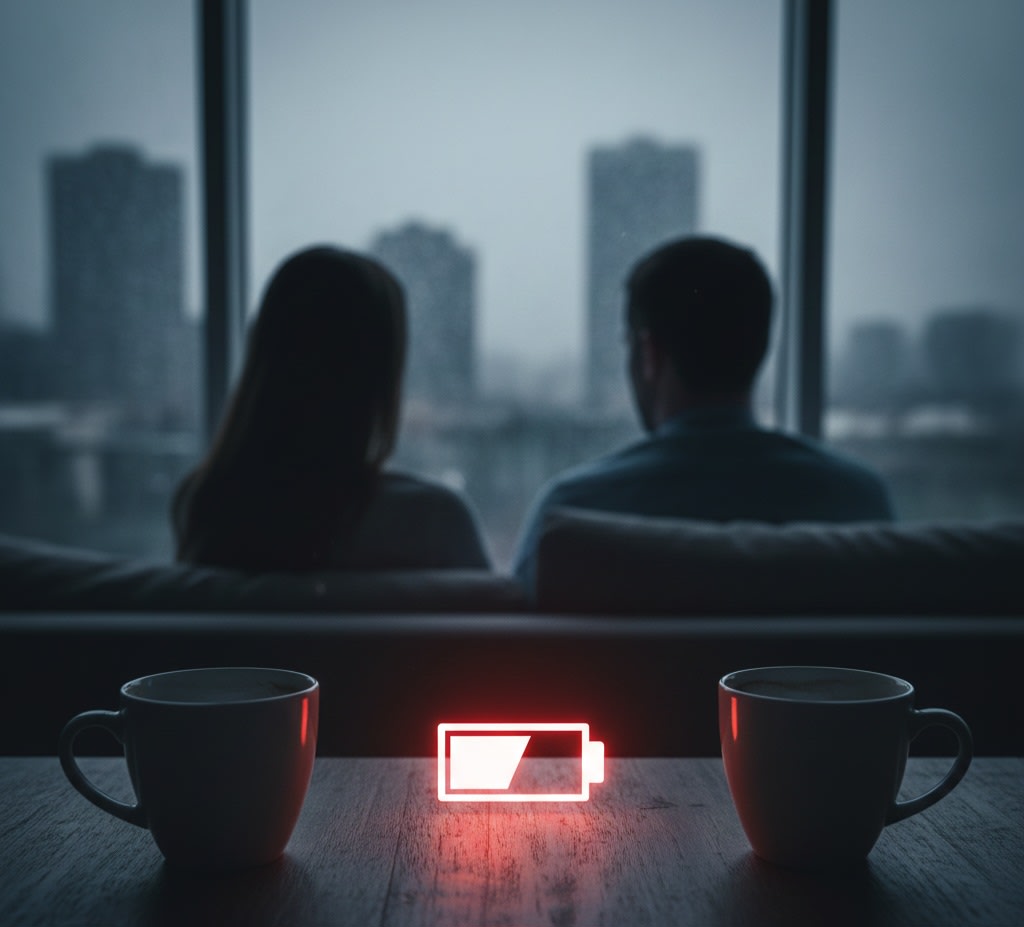
We live in an era of "more." More connectivity, more productivity, more expectations. We are told we can have the high-powered career, the curated social life, the perfect fitness routine, and a soul-deep relationship—all at once. But there is a silent tax on this lifestyle, one that doesn't show up on a bank statement but in the quiet, hollow spaces of our hearts.
We are entering the Age of Emotional Burnout.
It’s a specific kind of exhaustion. It isn’t the physical tiredness that a good night's sleep can fix. It’s the feeling of being "spent." It’s the sensation that your emotional bank account is overdrawn, and yet, life—and your partner—keep asking for a withdrawal.
The Quiet Erosion
In the relationship community, we often talk about "explosive" endings—infidelity, big lies, or dramatic fights. But emotional burnout is different. It doesn’t end with a bang; it ends with a sigh. It’s a slow erosion of intimacy where the person you once couldn't wait to see becomes another item on your to-do list.
I remember a night with my former partner. We were sitting on the same couch, the blue light of our phones illuminating our faces. He asked me a simple question: "How was your day?"
Usually, that was our bridge. But that night, I felt a physical weight in my chest. To answer him meant I had to reach into a well that was completely dry. I had used my "emotional budget" on a demanding boss, a friend in crisis, and the general noise of the world. I didn't have any words left for the person I loved most.
I just said, "Fine," and turned away. That is what burnout looks like: the inability to bridge the gap.
The "1% Battery" Relationship
Think of your emotional energy like a smartphone battery. In a healthy state, you start the day at 100%. Throughout the day, work takes 30%, social obligations take 20%, and self-care recharges you by 10%. You come home with enough "charge" to truly listen, to laugh, and to be present.
But in the Age of Burnout, many of us are starting our days at 40%. By the time we reach our partners, we are at 1%. We are in "Low Power Mode." We can perform the basic functions—we can talk about the grocery list or the bills—but we’ve disabled the "high-performance" features like empathy, playfulness, and deep intimacy.
When both partners are running on 1%, the relationship becomes a survivalist camp rather than a sanctuary.
Why Now? The Modern Context
Why does it feel like we are more burned out now than previous generations?
The Digital Tether: We are never truly "off." Our partners are competing with a 24/7 stream of work emails and social media comparison. Our brains are overstimulated, leaving little room for the slow, quiet work of connection.
The High-Stakes Romance: We expect our partners to be our best friends, our co-parents, our financial partners, and our passionate lovers. We’ve loaded so many expectations onto one person that the weight eventually crushes the joy.
The Neglect of the "Self": We often view self-care as a luxury. In reality, it is the only way to replenish the well. When we stop taking care of our individual spirits, we have nothing left to bring to the collective "us."
The Warning Signs
How do you know if you’re experiencing emotional burnout or if the relationship itself is the problem?
Irritability over the Trivial: You find yourself snapping at them for the way they breathe or how they stack the dishwasher. This isn't about the dishes; it's about your lack of "distress tolerance."
Apathy: You no longer have the energy to argue. You just stop caring about the outcome of the fight.
The Craving for Solitude: Not just "me-time," but a desperate, gasping need to be away from everyone—including your partner.
Numbness: You remember that you love them, but you can't feel the love in your body.
The Path to Recharging
If you find yourself in the red, the solution isn't a grand romantic gesture or a tropical vacation. Those are temporary fixes for a systemic problem. Instead, you need Micro-Repairs.
Radical Honesty: Tell your partner, "I am at 2% today. It’s not about you, but I don't have the capacity for a deep talk tonight. Can we just sit in silence?" This removes the guilt and the expectation.
Lower the Bar: Sometimes, you have to give yourselves permission to be a "boring" couple for a while. Order the pizza, skip the event, and just exist without the pressure to be "on."
Protect the Perimeter: Set boundaries with the outside world. If work is bleeding into your evening, it is stealing from your relationship.
The 6-Second Hug: Research shows that a hug lasting at least six seconds can release oxytocin and tell your nervous system that you are safe. It’s a low-energy way to reconnect.
Love is Not a Battery—It’s the Current
The ultimate truth of the Age of Emotional Burnout is that love shouldn't be another thing you do. It should be the space where you go to stop doing.
If your relationship feels like work, it might be because you’ve forgotten how to let it be a rest. We have to stop treating our partners like customers we need to satisfy and start treating them like the person holding the other end of the safety net.
You don't need more energy to love better; you need a love that gives you energy.
About the Creator
Jhon smith
Welcome to my little corner of the internet, where words come alive
Keep reading
More stories from Jhon smith and writers in Humans and other communities.
Emotional Timing Is Everything
We are often told that love is a matter of chemistry, shared values, and perhaps a bit of luck. We’re taught to look for "The One" as if they are a destination on a map. But after years of navigating the highs and lows of modern dating, I’ve realized that love isn’t just about who you meet—it’s about when you meet them.
By Jhon smith2 months ago in Humans




Comments
There are no comments for this story
Be the first to respond and start the conversation.