
Strategies for Effective Time Management and Prioritization
Real-Life Examples


In today's fast-paced world, effective time management and prioritization are essential skills for success. With numerous responsibilities and competing demands, mastering these strategies becomes crucial to achieve productivity and balance. In this article, we will explore practical strategies for effective time management and prioritization, supported by real-life examples that illustrate their application and impact.
Set Clear Goals and Priorities:
Establishing clear goals and priorities is the foundation of effective time management. By defining what matters most to you, you can allocate your time and energy accordingly.
Real-life example: Jennifer, a busy executive, sets aside time each week to identify her top three priorities. She then structures her schedule around these priorities, ensuring that she devotes focused time and effort to the tasks that align with her goals.
Plan and Organize:
Having a well-structured plan and organized system is key to managing time effectively. Breaking down tasks, setting deadlines, and maintaining an organized workspace can enhance productivity.
Real-life example: Alex, a freelance writer, uses a project management tool to create a detailed plan for each writing assignment. He breaks down the project into smaller tasks, assigns deadlines to each task, and tracks his progress. This systematic approach helps him stay organized and meet his clients' expectations.
Prioritize Important and Urgent Tasks:
Distinguishing between important and urgent tasks is crucial for effective time management. Prioritizing tasks based on their significance and time sensitivity enables you to focus on what matters most.
Real-life example: Sarah, a student juggling multiple responsibilities, uses the Eisenhower Matrix to prioritize her tasks. She categorizes tasks as urgent and important, important but not urgent, urgent but not important, or neither urgent nor important. This method allows her to allocate her time wisely and tackle high-priority tasks first.
Practice the Pomodoro Technique:
The Pomodoro Technique is a time management method that involves working in short bursts of focused activity, followed by short breaks. This technique helps maintain concentration and prevents burnout.
Real-life example: Mark, a software developer, uses the Pomodoro Technique to manage his workday. He sets a timer for 25 minutes of uninterrupted work, followed by a 5-minute break. After completing four Pomodoro cycles, he takes a longer break. This approach helps him maintain productivity and avoid distractions.
Delegate and Outsource:
Recognizing when to delegate or outsource tasks is crucial for effective time management. Delegating tasks to others or outsourcing certain responsibilities allows you to focus on high-value activities.
Real-life example: Rebecca, a small business owner, realized that administrative tasks were consuming too much of her time. She hired a virtual assistant to handle administrative duties such as email management and appointment scheduling. This delegation freed up her time to focus on strategic business decisions and revenue-generating activities.
Learn to Say No:
Saying no is an essential skill to protect your time and maintain focus on your priorities. Setting boundaries and politely declining non-essential tasks or commitments can prevent overloading your schedule.
Real-life example: David, a busy professional, struggled with saying no to additional work requests. However, he learned that by saying no to tasks that didn't align with his goals or overloaded his schedule, he could protect his time for more important projects. This allowed him to maintain a healthy work-life balance.
Regularly Evaluate and Adjust:
Effective time management is an ongoing process. Regularly evaluating your progress, identifying areas for improvement, and adjusting your approach are critical to staying on track.
Real-life example: Emma, a project manager, conducts weekly reviews of her time management strategies. She reflects on her achievements, identifies any bottlenecks or time-wasting activities, and adjusts her approach accordingly. This proactive approach helps her continuously improve her efficiency and productivity.
Mastering effective time management and prioritization is vital for achieving success in both personal and professional endeavors. By setting clear goals, organizing tasks, prioritizing wisely, and adopting strategies like the Pomodoro Technique and delegation, you can maximize your productivity and accomplish more in less time. Real-life examples demonstrate the practical application and positive impact of these strategies. Embrace these approaches, tailor them to your needs, and unlock the potential of effective time management and prioritization.
About the Creator
Nesou
📓🌌✨ Dive into poetry, stories, and thoughts. 📚✍️ Unveil the universe's mysteries through words. 🌌✒️ Share emotions, experiences, and magic. ✨🖋️ Explore a boundless world of expression. 🌟📝
Send Me Tips🍀,insights and❤️if you'd like😍✨
A Historic Declaration
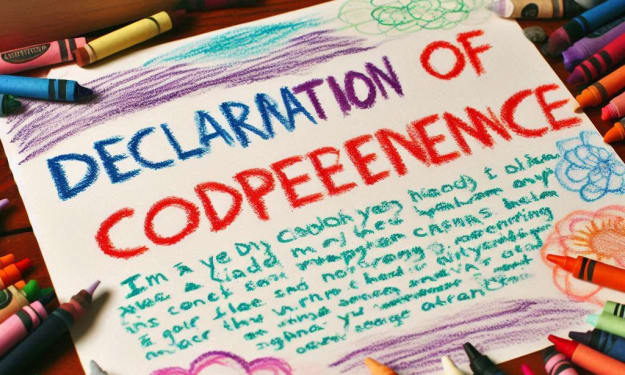
We the People of the Husbands of the United States of America, in Order to form a more perfect Union, and I mean you...with me...establish Justice, insure domestic Tranquility, provide for the common defence, promote the general Welfare, and secure the Blessings of Liberty to ourselves, after Puberty, do ordain and establish this Declaration of Co-Dependence.
By Gerard DiLeo5 days ago in Humans
Empathy As A Divine Gift: What It Really Is And Why We Have It
Empathy is often described as the ability to feel what someone else feels. People talk about it as if it is simply a personality trait, like being kind or being patient. But empathy is far more than that. It is not just a soft skill or a sign of sensitivity. It is a spiritual tool. It is a gift given to us by the divine, and it serves a deeper purpose than most people realize. Empathy is not meant to make us victims. It is not meant to be used as a badge of moral superiority. It is not meant to be a way to gather attention or sympathy. Empathy is a sacred instrument that helps us grow, connect, and evolve.
By Julie O'Hara - Author, Poet and Spiritual Warrior5 days ago in Humans
Review of 'Man on the Run'
My wife and I saw Man on the Run, a nearly 2-hour documentary on Amazon Prime, about Wings, Paul McCartney's group that flew around the world from shortly after The Beatles broke up in early 1970 to shortly after John Lennon was murdered at the end of 1980, making a Beatles reunion forever impossible.
By Paul Levinson3 days ago in Beat



Comments
There are no comments for this story
Be the first to respond and start the conversation.