
six artists who utilize the body as a form of expression
beyond being the instrument through which work is created, the body itself — through movement, form, location and interaction — can express ideas. these six artists embrace their physicality in creating works of visual and performative art.
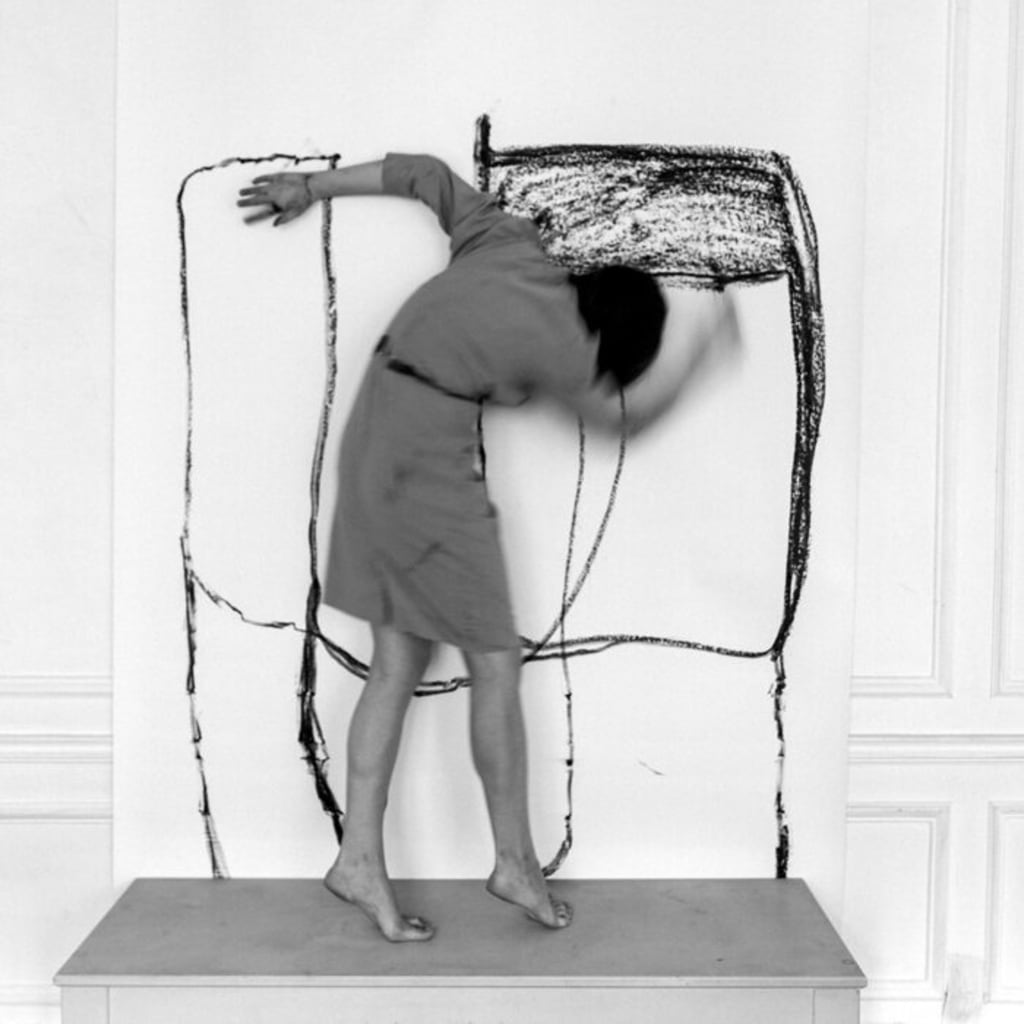
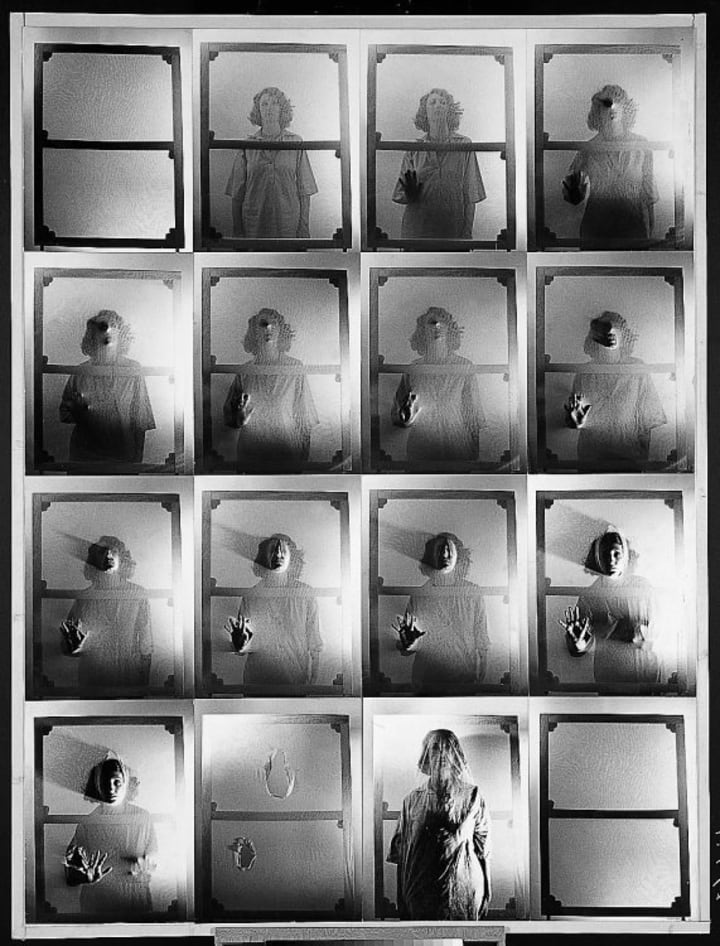
Helena Almeida was a Portuguese artist who said about her art: “My work is my body, my body is my work.” Utilizing a variety of mediums, including photography, drawing, and mixed media, Almeida’s work possesses a haunting quality; Tela Habitada, or Inhabited Painting, shown above, point to the painting as a location for the self — one which the body can enter, reside in, leave marks upon, and retreat from. Instead of acting upon the painting, the artists acts within it, transforming the work and the self simultaneously such that they merge into one entity.
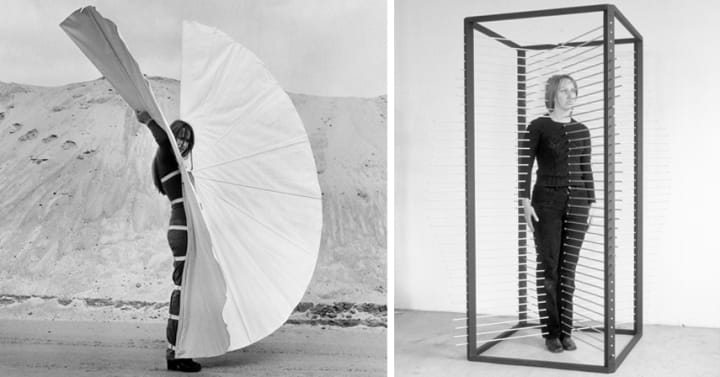
Rebecca Horn, Weisser Körperfächer, 1972. (left)
Messkasten, 1970, Photograph (right)
Photo Rebecca Horn Collection. © 2019: Rebecca Horn/ ProLitteris, Zurich.
Rebecca Horn, a German artist with an eclectic body of work, uses the body as a location of fantasy enactment. The body is a landscape to be costumed, re-imagined, and magnified through material and form. While on the one hand her works are controlled by her artistic vision, she also allows for the environment to shape the work. In White-body fan from 1972, shown on the left, the body piece is subject to the elements of the environment, moving in response to the wind. The interplay between art as creation and art as phenomenon creates a beautiful juxtaposition in which the viewer is prompted to reflect on subjective intention and the entropy that exists both in nature and within the self.
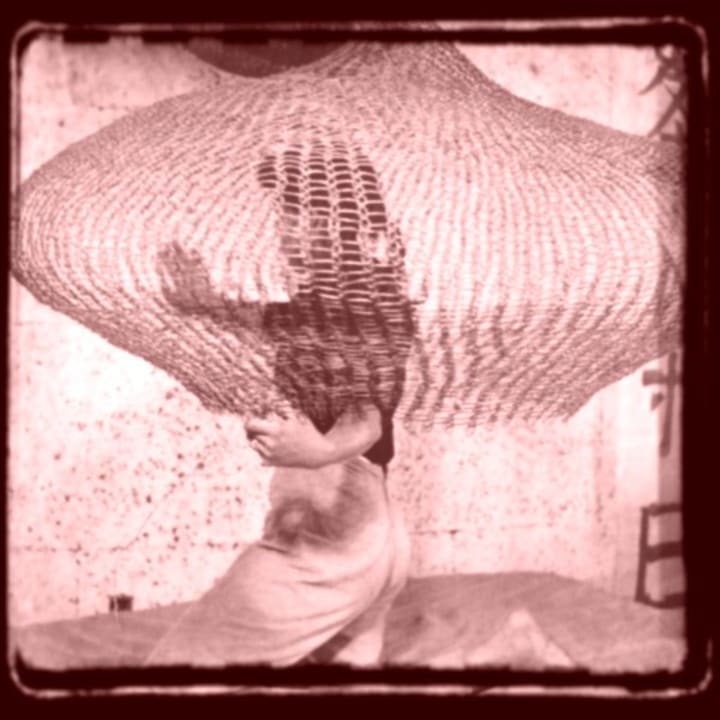
Ruth Asawa was a sculpture artist who lived and worked in San Francisco. In the book about the artist’s work, The Sculptures of Ruth Asawa, she describes her process: “All my wire sculptures are made from the same loop. And there’s only one way to do it. The idea is to do it simply, and you end up with a shape. That shape comes out working with the wire. You don’t think ahead of time, “this is what I want”. You work on it as you go along. You make the line, a two-dimensional line, then you go into space, and you have a three-dimensional piece. It’s like a drawing in space.” With this, she points to the idea that the unfolding of a work of art is similar to the phenomenology of a human being, it occurs organically and begins to take shape spontaneously. In this way she allows herself to identify with the work on an equal plane, as though it creates itself through her corporeal labor. This is demonstrated by how the pieces are often physically bigger than the artist herself — starting only as a piece of thread, they soon take on a life of their own.
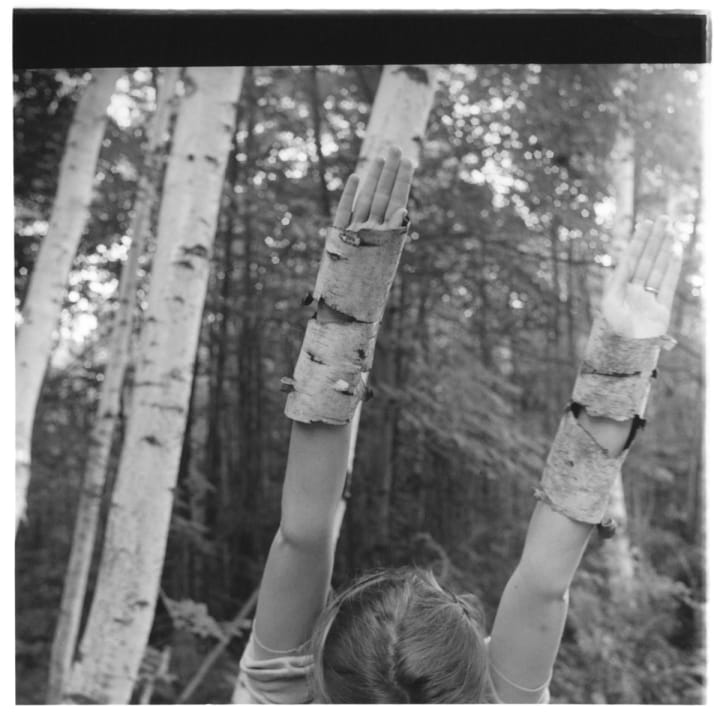
Francesca Woodman Untitled, MacDowell Colony, Peterborough,New Hampshire, 1980
Gelatin silver estate print
Francesca Woodman was a female photographer who lived in the United States. Born into a family of artists, she was surrounded by art and culture from a young age. Her work consists mostly of black and white self portraits in which she ingratiates herself into her environment, often using long exposure, movement, plants, and furniture to create a childlike mood, an innocent manipulation of one’s environment through exploration. Of course, we know her facetiousness to be a part of a more serious intent, and this is reflected through facial expression and body language throughout her body of work.
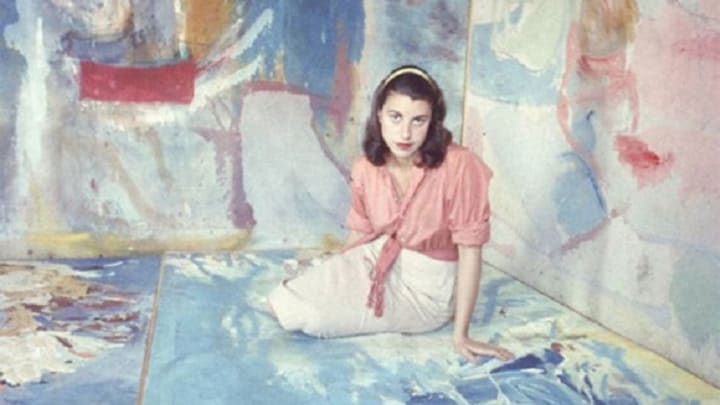
Helen Frankenthaler in her studio
Helen Frankenthaler was an American abstract painter whose large scale works necessitate a somatic approach. Her abstract compositions contain gestural energy and movement. The body creates aquatic and nature based abstractions, which in their expressionistic form act not only as an image, but as documentation of a physical process. The spontaneity of the gestures reflect a somatic spontaneity and the large scale of the works convey a resulting expansiveness of being.
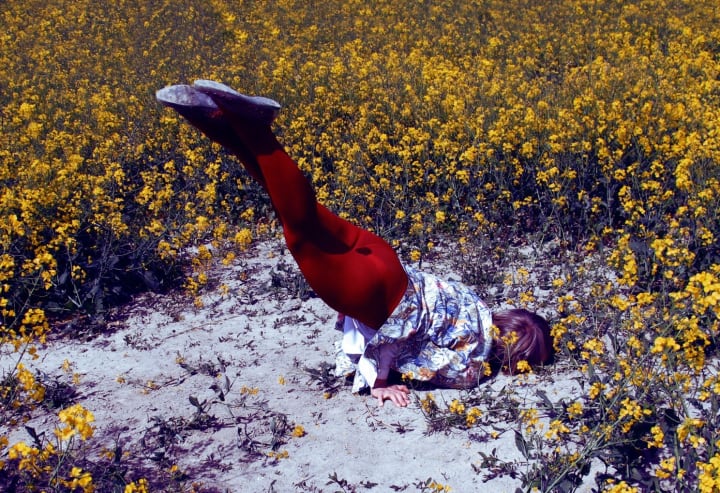
Isabelle Wenzel, photograph.
Isabelle Wenzel is a contemporary German photographer who also studied acrobatics, which she uses in her richly palleted self portraits. The works are often set out of doors in natural environments or in domestic interiors and always involve the body contorted into an unnatural position. Her photos work to invert ideas about the female body and the role of the female body in a variety of settings; their single figure also express a solitude, or aloneness, in the experience of being female, and more broadly, human.
About the Creator
Keep reading
More stories from Emily Smith and writers in Humans and other communities.
The Oppression of Objects
Of greatest importance this evening, above even happiness – an illusory phenomenon to which no one is entitled, least of all herself, thinks Hortensia– is an achievement of balance. As in a simple pendulum, the collective body of the self and the other oscillates between complements. It is not movement one seeks to control, Hortensia thinks, but simply its velocity.
By Emily Smith5 years ago in Fiction
The Connection Between Unforgiveness and Weight
It might not be your slow metabolism or your genes that keep you from losing weight. It might not even be what you are eating. Furthermore, it might be what's eating you. If you have tried every diet and nothing worked, it could be your inability to forgive that's keeping you fat.
By Margaret Minnicks5 days ago in Humans




Comments
There are no comments for this story
Be the first to respond and start the conversation.