
She's "Damaged Goods"
The Side of Addiction You Know Nothing About


Most people will never understand how much strength sits quietly inside a women’s addiction treatment facility—because they’re too busy believing the labels slapped on the women who end up there.
My job is one of those roles people love to romanticize.
“So rewarding,” they say.
And it is — but those same people are often the very ones who turn their noses up at the women I work with. They want the hero narrative without actually confronting the humanity of the people they think need saving.
Yes, my job is rewarding. But it’s also mentally exhausting, ethically messy, and full of internal tug-of-war moments that stick with me long after I leave the building.
Because on one hand, I’m here for the collective. I’m responsible for their safety, their structure, their adherence to the program, their recovery.
But I’m also responsible for their autonomy — their dignity, their independence, their right to be treated as grown women navigating the hardest fight of their lives.
And sometimes those two things… clash.
Hard.
Sometimes they contradict each other so sharply that it feels like I’m being pulled in opposite directions.
I find myself thinking about work even when I'm not at work.
How I can be better.
How to motivate them.
When to push and when to soften.
Whether compassion is helping or enabling.
Whether I said too much or not enough.
I get to see sides of these women the world never sees — versions stripped of performance, stripped of stereotypes, stripped of the outsider’s gaze. It’s impossible to walk these halls and not see how misunderstood they are by people who only know addiction as a headline or a mugshot.
Last week, I got a very real reminder of just how misunderstood they are.
I took the ladies on one of their weekly store runs. Just a normal Friday. Except it wasn’t.
The woman running the store didn’t just treat two of my girls “rudely.” She went straight into full-volume, aggressive hostility — the kind of behavior you wouldn’t expect from an adult, let alone someone working retail.
She wasn’t stern.
She wasn’t irritated.
She was yelling.
Like genuinely yelling — red-faced, loud enough for the whole store to hear, snatching their items, throwing their bags and change at them like they were garbage she wanted off her counter.
It was unhinged.
It was violent in tone.
It was humiliating.
As an individual — as Ashlee, the woman who will defend another before she'll defend herself — I wanted to step in so badly my hands were shaking.
But as staff employed by the facility I work at and as a role model for program participants, I had to tell the women to walk away.
Leave it.
Go wait in the van.
Then I had to turn around and speak to this woman calmly and professionally, like I hadn’t just witnessed her dehumanize two women trying to buy shampoo and snacks.
And while I stood at the register, forcing myself to swallow every ounce of anger, I heard her on the phone refer to those women as “black bitches.” Not whispered. Not mumbled. Loud.
Then she turned to me and said she didn’t want them back in her store.
And as if she hadn’t said enough, she proceeded to tell a random customer in line that the girls were from “that house up the road — you know, the one for all the fucking crackheads and low-lifes.”
Rich, coming from the night shift manager at the only store within twelve miles, who apparently has nothing better to do than take out her aggression on girls struggling to love themselves.
But again, I had to say nothing.
Because professionalism trumps morality’s screams — every day of the week.
Fast forward to Saturday night.
A client locked herself out of her room, so I walked down the hallway to unlock her door. On her door, I saw a sticky note. Didn’t read it. Just kept moving.
Later, making my rounds, I saw the same sticky note, now on a different door.
Did I read it?
Well, yeah. Wouldn't you?
“I love you. Proud of you.”
Then, a little heart. No name.
Someone had received that note… and instead of keeping it, she passed it on. A small, quiet act of love. One woman lifting another without needing recognition.
Sunday night, it clicked even harder.
One of the women walked up to my desk with tears in her eyes.
“What’s wrong?” I asked.
She took a shaky breath and said,
“I got my first sticky note.”
And when she held it out — this tiny message of hope and encouragement — it hit me that inside this building, these women are building each other up in ways the outside world can't even begin to comprehend.
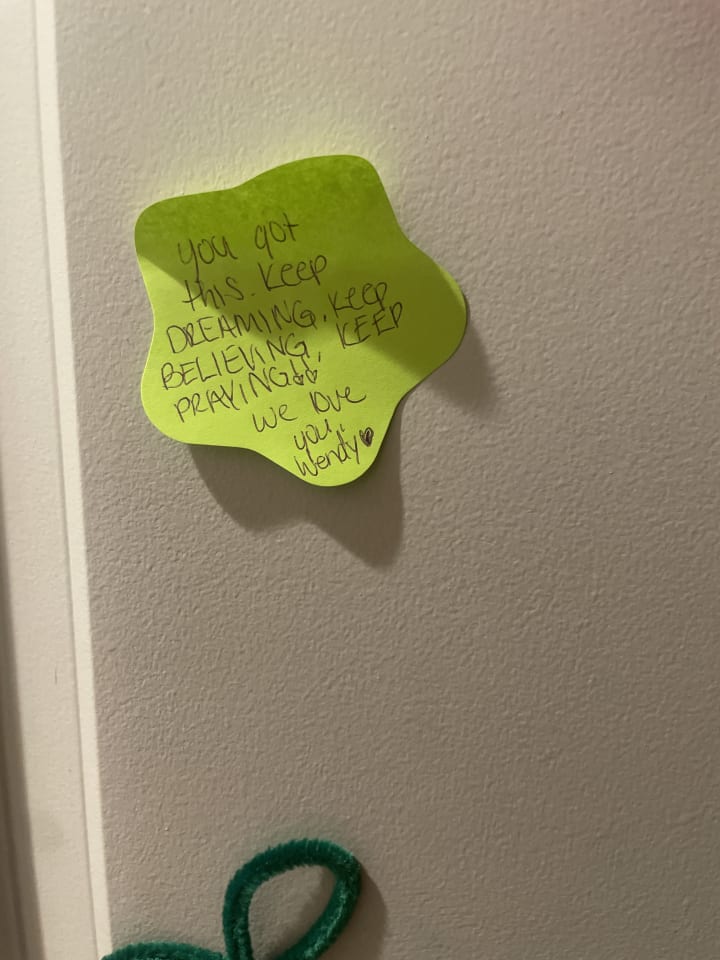
Driving home that night, the contrast between the Dollar General incident and the sticky notes weighed heavy on me.
Because the world judges what it doesn’t understand.
It fears what it can’t categorize.
So some professor at a prestigious university, who thinks addiction is reserved for homeless Vietnam vets and young girls who grew up without a dad, throws a neatly written label on it, tosses in key phrases like “clinical evidence” and “case studies,” and carries on with his day…
Leaving the individuals in that category to rot in stereotypes and prejudices.
To a judge, these women are file numbers.
To a probation officer, they’re future violations.
To that store manager, they were “crackheads” and “low-lifes.”
But what I see?
I see women confined to a place for 30 days or more, stripped of control. Women with families who miss them, kids who love them. Women coming face to face with the scariest person to confront: themselves. Women taking one of the bravest steps a human being can take and admitting they have a problem — and that they want better.
I see emotional intelligence.
I see grace.
I see patience.
I see forgiveness.
I see community.
I see a girl arrive from jail, walls up, fists metaphorically swinging, and I see her soften.
I see another come in during active withdrawal, cursing the world, and then see clarity slowly return to her eyes.
I see a woman sitting on her bed with everything she owns in a bag, ready to walk out the door — until the reality hits her:
Where would I even go?
No phone. No money. Hours from home.
And so she stays. Begrudgingly, angrily, resentfully — but she stays.
And then I see the shift — subtle, but impossible to miss… if you know where to look.
Their posture changes.
Their energy settles.
Their clarity returns.
They start supporting each other instead of fighting each other.
It’s almost funny — in a beautiful way.
Women branded as hopeless causes and damaged goods, demonstrating qualities the very people branding them fail to show, under much simpler circumstances.
Women who have lived through absolute hell, learning to love freely and without judgment because they know what humans become when forced into survival mode.
And I can’t help but be proud.
Proud of them.
Proud with them.
Today, I’m the one standing behind this desk, guiding, advocating, protecting.
But three years, five months, and ten days ago?
It wasn’t this desk, but one just like it, about 35 miles away, that watched me walk through the door — 98 pounds and still high from my last fix.
I understand these women on a much deeper level because I know their vantage point… intimately.
I know the fear, the shame, the stubborn pride, the tiny sparks of hope you’re almost afraid to admit, for fear that they might disintegrate right in front of you.
So when I look at these women, I don’t see burdens.
I don’t see cases.
I don’t see stereotypes.
I see women walking a road I once had to crawl down.
Because before I ever stood on this side of the desk,
I was one of them.
And if you thought this was just a sheltered R.S.S. sharing a little insight… well, you’ve proven my point.
If this story shifted something in you—challenged a label, sparked hope, or just hit too close to home—good.
Say so. Let’s talk about it.
Leave a comment. Share this story. Remind someone they aren’t alone.
#BreakTheStigma #WeDoRecover #MentalHealthAwareness
About the Creator
Ashlee Laurel
imagine Douglas Adams and Angela Carter on absinthe, co-writing a fever dream...
that's me.
Keep reading
More stories from Ashlee Laurel and writers in Humans and other communities.
I wanted to title this something different, but worried that my chosen title might cause problems entering the United States in the future so this is the new title. It's the greatest title. No one has ever written a title better than this. (All titles unrelated to content).
Let me be honest. I am finding this difficult. Now, I like a challenge, a stretch, a bit of an obstacle course. “Write about the decline of the British Empire in the form of a narrative poem in which your protagonist is an artichoke” I read, and flex my fingers. “Write a haiku to evoke the sensation of sibilance using only the first half of the alphabet.” “Well”, I think to myself, “this should be fun.” But “write about a system that isn’t working”? A system that isn’t working? Now? In 2026? ONE system? My favourite system that isn’t working? The sexiest system that isn’t working? The one giving me the most angst day to day? The one giving me the most existential dread? I am, as I say, finding this difficult. I will own that I have contemplated writing a thousand words on why the steady “all on” setting on my fairy lights is the EIGHTH of seven options which must be sequentially activated to get there, because that is a system that some fool came up with and it definitely doesn’t work, and now who is paying the price, eh? But how can I write about my fairy lights when…. When…. When….
By Hannah Moore4 days ago in Humans
Nomophobia: The 21st Century Fear Nobody Is Talking About
Picture this: you reach into your pocket and your phone is not there. In the space of a single second, a wave of unease washes over you — a flutter of panic, a surge of disorientation, a sudden and overwhelming need to locate the device immediately. Your mind races through possibilities. Did you leave it at home? On the table at the café? In the taxi? And beneath the practical concern lies something rawer, something harder to articulate — a feeling not merely of inconvenience, but of vulnerability. Of incompleteness. Of being, in some fundamental way, cut off from the world.
By noor ul amin4 days ago in Humans


Comments (1)
Fuck. I went through a ringer of emotions reading this. I've heard many bad stories about addiction and clean living facilities so was nice to hear a positive one and as an addict of a different kind with a different gender but a pariah class, judged heavy and greatly misunderstood vice I feel I understand a little. People don't understand my own addiction. I was so angry that the store clerk was such a pious bitch and jumped to conclusions and stereotypes and all manner of nastiness. I applaud you for showing restraint. Then I teared up at the sticky notes. One of the most beautiful things I've read this week. Makes me feel good to be human. That's what done people won't ever understand. Too busy dehumanising addicts to realise that most addicts are more human than the good and the pure that look down on them. Ironic. Anyway sorry for massive comment. Thank you for sharing this and well done on writing it so eloquently. Also love your description in your profile. Also well done on being clean.