
***Science Today*** Unlocking the Enigma of Human Survival: The Mystery of the 100,000-Year Transition
18/09/23 Revealing the Near-Extinction Event and Evolutionary Breakthroughs of Our Ancestors
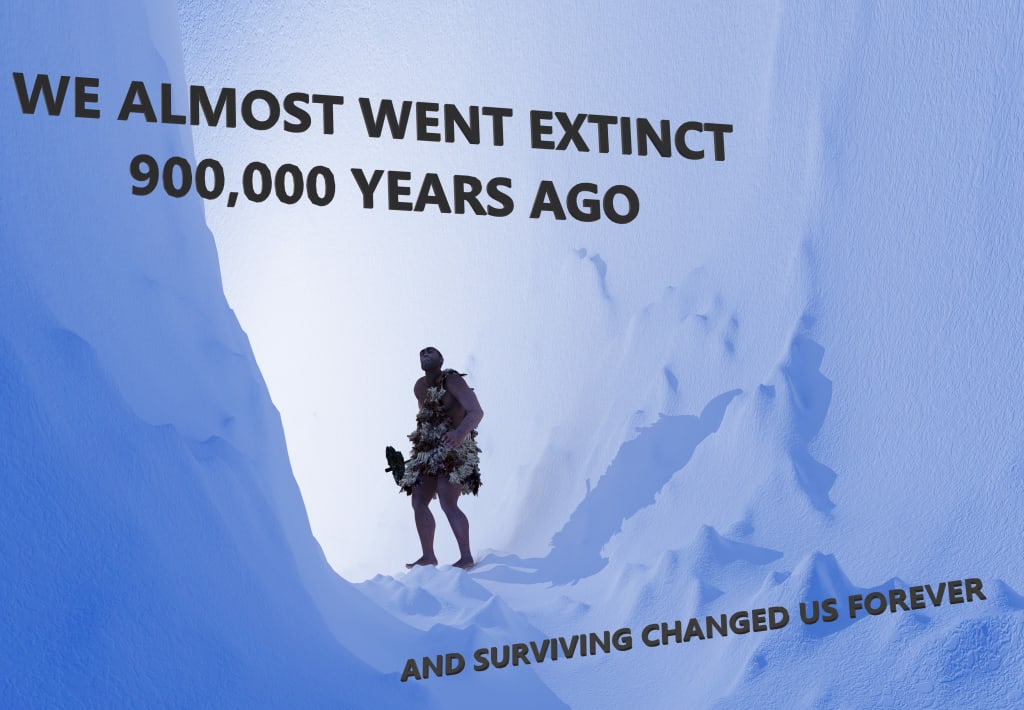
Unlocking the Enigma of Human Survival: The Mystery of the 100,000-Year Transition
Revealing the Near-Extinction Event and Evolutionary Breakthroughs of Our Ancestors
________________________________________
Introduction
The Quaternary Period, a geological epoch that spans from approximately 2.6 million years ago to the present day and is synonymous with the Ice Age, has captivated scientists for its cyclic climate shifts and the ebb and flow of ice caps. Yet, concealed within this grand narrative, a profound mystery has persisted for over a million years – the transition from shorter, milder Ice Age cycles to prolonged, severe ones. Genetic analysis now suggests that our early hominid ancestors faced a near-extinction event during this period, raising questions about their resilience and adaptation.
________________________________________
The Mysterious Transition
Around 1.1 million years ago, a remarkable shift occurred in the glacial cycles of the Ice Age. Initially, they followed a 41,000-year periodicity, resulting in relatively thin ice sheets and mild effects on the planet. However, suddenly, these cycles lengthened to about 100,000 years and intensified both in amplitude and cooling. This unexpected alteration in climate patterns, the "hundred-thousand-year problem," has confounded scientists due to its abruptness and unknown causes.
________________________________________
Discovering the Near-Extinction Event
Recent genetic studies have unveiled crucial evidence shedding light on this enigmatic period. Researchers analysed the DNA of over 3,000 individuals worldwide, including 10 African and 40 non-African populations. Employing a novel method called "fit coal fast infinitesimal time coalescent process," they traced changes in DNA over time. The results unveiled a stark population bottleneck around 930,000 years ago, lasting for a staggering 117,000 years. Genetic diversity plummeted by approximately 66%, an indication of a population under duress.
________________________________________
Population Bottlenecks in History
While the concept of population bottlenecks is not new in genetic research, the extent and impact of the bottleneck during this period are unprecedented. Earlier studies identified a bottleneck about 7,000 years ago, impacting regions across Africa, Europe, and Asia. This bottleneck was attributed to the collapse of the Y chromosome, leading to a significant gender imbalance with one man for every 17 women. However, it was primarily attributed to cultural shifts rather than environmental factors.
________________________________________
The Astonishing Genetic Contraction
In contrast, the genetic analysis of the period around 1.1 million years ago suggests a far more severe scenario. The total population of hominids on Earth dwindled from roughly 100,000 to a mere 1,200 individuals. This marked a staggering 99% drop in genetic diversity and persisted for over a hundred millennia. The near-extinction event suggests that the early human ancestors struggled for survival during this extraordinary climatic shift, likely due to unpreparedness and resource depletion.
________________________________________
Evolution Amidst Crisis
While the bottleneck represents a dire episode in our history, it also coincides with significant evolutionary developments. Notably, human chromosomes merged during this period, resulting in the formation of a substantial chromosome 2 – the second-largest chromosome in the human body. This genetic event is believed to have distinguished humans from other great apes. Additionally, the complexity of the human brain expanded, potentially enabling our ancestors to devise innovative solutions despite dwindling numbers.
________________________________________
Unravelling the Climate Connection
Although the genetic evidence hints at a close relationship between the near-extinction event and climatic changes, causation remains elusive. Evidence of extreme cold in regions like Portugal, where fossils suggest ocean temperatures of at least minus 6 degrees Celsius, raises questions about the hostile Mediterranean climate around 1 million years ago. However, a direct link between climate and the population bottleneck is yet to be established.
________________________________________
Conclusion
In the annals of our ancient history, the narrative of near extinction stands as a powerful testament to the resilience and adaptability of our early hominid forebears. This chapter illuminates the intricate interplay of climate, genetics, and evolution that has shaped the course of our species over vast stretches of time. As we venture deeper into Earth's past, we unravel the mysteries that have indelibly marked our lineage and provoke contemplation of our future as the reigning species on this planet.
________________________________________
Question for Reflection:
Considering past extinctions, what species, if any, do you think could potentially become the next dominant species after humans? Please leave your answers in the comments below.
________________________________________
Thank you for reading. Please like and share with anyone who likes learning about space and science.
About the Creator
Kyle Red
I am a passionate explorer of the fascinating interplay between biology, behavior, and well-being. With a keen interest the financial landscape, I delves deep into the science behind motivation, health, and success!
Anne Frank, Can We Talk?
Dear Ann Frank, I never thought I would write to you, but I am certain you would understand all that I will pen to you today. Today’s society probably looks a lot like the days you witnessed. Being a Native American, I am a minority and repressed more than many cultural communities. Even though the Hispanics and illegal immigrants are the target right now, Native Americans are now being detained too. I know you had seen the same social disorder happening around you as I am seeing in my world today.
By Sheila L. Chingwa6 days ago in Humans


Comments (1)
Great work! Very interesting! Glad we survived!