

Sankta Lucia Day
By Kirsten Miles
Sankta Lucia Day at the American Swedish Historical Museum has always been one of my most treasured days of the year. With singing, shopping, eating, and merry making, it holds a very special place in my heart. This year, I took my young niece to the show so she could experience the magic of it, just as I had as a little girl.
The museum in the great city of Philadelphia has always been a second home to me. My grandmother was once Vice-President of the Women’s Auxiliary and recruited me into the Lucia show when I was just a baby. In Sweden, this day is to commemorate the Italian Saint Lucia, who fed the poor and helped the needy. Legend has it that Lucia appeared to bring light to the households during the darkest night of the year. It has always reminded me of the importance of kindness and grace.
I am proud of my Swedish culture, and the museum holds an abundance of memories of love, laughter, and fun. My grandmother’s grandparents came to Ellis Island from Sweden during the early 1900’s, and my grandmother helped me learn and appreciate the Swedish traditions. Although my lovely grandmother passed away a couple of years ago, I will forever keep those memories with her in my heart as I carry her traditions.
The Swedish Museum is somewhat small for a museum, but it has a lot of rooms to explore. There is the Kristina room, all white, which is dedicated to a 17th-century Swedish queen. There is the Frederika Bremer room, which is made almost entirely of marble and cloth, named after a prominent Swedish women’s rights activist. There is also the Jenny Lind room, a bright, airy room named after the famous opera singer. One other unique room is the stuga, or cabin, which is decorated to look just like a farmhouse in 16th-century Sweden. I almost get a sense of stepping back in time when I walk into that wooden room, as there are old kitchen utensils, a spinning wheel, and artwork surrounding the paneled walls. It makes me reflect on how my Swedish ancestors might have lived! When my friends and I were children, we used to pretend that we lived in the 1500’s and would bring our dolls to play in that room (before we got in trouble for touching the artifacts!).
When my niece and I walked into the museum that chilly day, I greeted old friends whom I have known for years, all of us embracing and hugging. As we stepped into the grand entrance, the long brass doors closing behind us, my niece stared in awe at the gorgeous painting on the ceiling depicting the Swedes’ arrival in America, as well as at the stunning architecture surrounding the walls and balcony.
After greeting many people, my niece and I stood in the foyer and watched the Lucia performance. First, we sang Svenska (Swedish) Christmas carols and read traditional wintertime poetry. Soon after, it was time for the children to do their show. The big Christmas tree at the back of the stage glimmered with ornaments of goats and hearts made of gold, and there was a feeling of festivity all throughout the air.
In the Lucia show, there are a few different groups of children that sing and dance on a little stage at the top of the entrance stairs. Tomtar are much like little Santa Clauses in Sweden. Swedes leave out gifts or food such as porridge for the Tomte, and the Tomte protects the farm. If leaving nothing for the Tomte, they may curse one’s household. The little children wear red clothes, red stockings, and red hats, singing about making trouble in the farmhouse on Christmas Eve night. I was a Tomte from the ages of two through four, and I still remember a good bit of it. I recall one time even falling down a stair in front of the audience during one of the shows!
On this day, the Tomtar children danced around in a circle, a bit uncoordinated due to their young ages, and it was adorable to watch. They sung in Swedish about how the Tomte brings gifts to children late at night when everyone is sleeping, so long as gifts are left out for them as well. I watched in amusement when one of the little Tomtar fell down and had to be picked up by the instructor.
The next group to perform were the Pepparkakor. “Pepparkakor” means “gingerbread cookies” in Swedish. The children stood in brown costumes with white rims (to replicate frosting), singing while holding paper cookies in the shape of hearts and pigs on a wooden stick. I was once a gingerbread girl during the ages of five and six. I can still recall being the loudest singer on the stage, holding my paper cookie and belting out the lyrics that I did not yet understand! The Pepparkakor sang about traveling in the snow and how delicious gingerbread cookies are, especially with milk.
After the Pepparkakor, there were the folk dancers. These children danced ancient traditional waltzes in circles while the piano played, spinning to a few different classical songs. One dance required the children to maneuver around a red scarf, which made it a bit tricky, and the children had to be careful not to let the ribbon drop or trip over it.
I smiled when I saw the folk dancers skip out in their costumes. I have many fond memories of being a folk dancer from the ages of seven through nine. In fact, I still can remember some of the dances by heart! The dancers this year looked precious in their traditional costumes, which were strewn with colorful embroidery. They represented the children who dance during supper on Christmas Eve.
Once the folk dancers were done their part of the show, it was the Star Boys’ turn. The Star Boys sang in a line, holding a glittery golden star on top of a stick and wearing white. They represented many of the stable boys hard at work when they look up at the sky on Christmas Eve night. This group is mainly for boys, but girls can technically be in the group if they would like to. The Star Boys sang songs about how the stars shine brightly on Christmas night, and about a stable boy witnessing the magic of Christmas.
Lastly, there were the Tarnar, or the Lucia girl’s attendants. The Tarnar started singing as they walked down the carpeted stairs in the grand entrance. They wore long white gowns with red sashes as well as a crown of foliage in their hair. This was when all of the lights in the museum dimmed down, everyone hushed in silence, and we could only see the candles held in their hands.
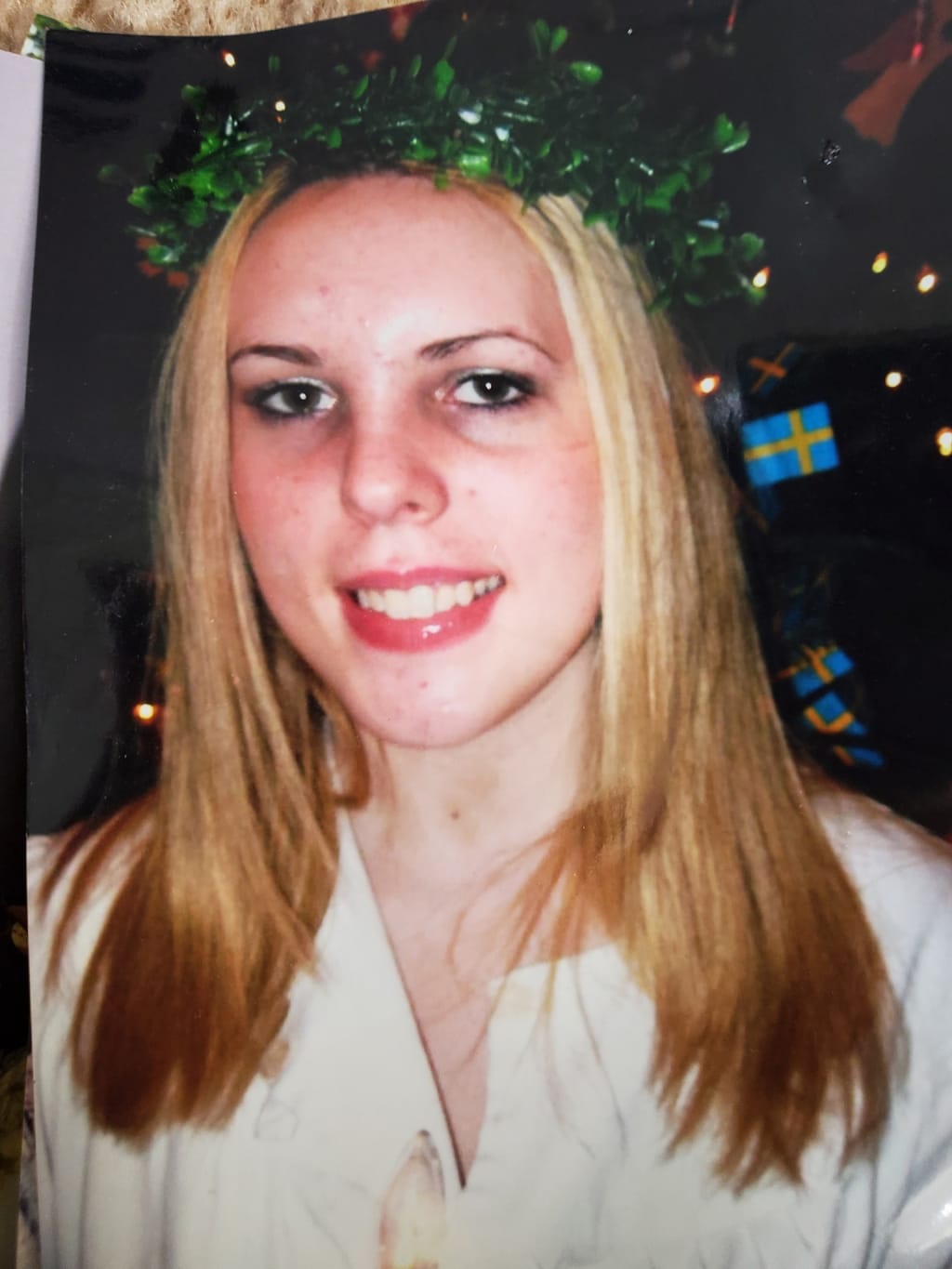
As they continued singing, the star of the show- the Lucia soloist- came around the Christmas tree on the stage and sang, carrying a tray full of goodies, candles in the crown of her hair. She traditionally wears a long white gown with a big red sash. The Lucia girl is typically the oldest girl in the household, who wakes her family early on Christmas morning and brings them breakfast. When I was ten, I was a Tarnar until I was eighteen. At the ages of fifteen and eighteen, however, I was also the Lucia girl myself, which was a huge honor for me as I got to take part in this tradition.
The Lucia girl is essentially the star of the show, all eyes and cameras on her. I still remember how grateful, proud, (and nervous!) I was when I was the Lucia girl singing the main solo, walking in a long gown in socks and carrying a tray while wearing foliage with candles on my head. I felt very grown-up and glad to make my grandmother proud of me. It was one of my dreams come true.
After the show, it was time to explore the museum. Sankta Lucia Day is celebrated with lots of Swedish songs, dances, food, games, prizes, and culture, and it was such an honor to watch my niece’s face light up at all the happy commotion. I bought some gifts for family and friends while my niece played the tombola, in which she spun a barrel and won a ticket for a prize. She won an adorable stuffed “Dala” horse (a famous wooden horse from Dalarna) and couldn’t have been more thrilled.
We ate plenty of good food, including mazariner (Swedish almond cupcakes), the cake part dissolving in our mouths like snowflakes and the icing creating a tangy, citrus taste on our tongues. We also filled our plates with roasted potatoes, lush vegetables, köttbullar (meatballs- plant based for me), and kanebullar (cinnamon buns). The food was delicious while the organ played lively music and people danced, laughed, and shared stories of holidays past. I saw some old friends, some whom I hadn’t seen in years, and met new people taking part in the tradition. My niece and I made more new and precious memories that day, ones that we will share years from now.
When we finished eating, I took my niece on a tour around the museum. She loved the stuga as well as the Pippi Longstocking room, named after a well-known book character. There is also a little gift shop in the museum which has some delicious Scandinavian candies and beautiful Jultide decorations. I bought my niece chocolate candy and a book about Lucia Day while we explored, seeing artifacts, jewelry, art, sculptures, and clothing of Swedes past.
The museum is always bustling with merriment and activity on this day. When I grew up, I was even the director of the Lucia program for a short time before life got too busy. Sometimes, I miss the old days when I was a child in the show, singing and dancing with my friends, watching my grandmother in the audience. However, next year, it will be the museum’s 100-year anniversary of doing the Sankta Lucia pageant, and I can’t wait to partake in a treasured family tradition and make new memories! This tradition will forever hold a special place in my heart.
About the Creator
Kirsten Miles
Hi! My name is Kirsten Miles and I am an author from New Jersey. You can check out my website for more information at KirstenMilesAuthor.com. I hope you enjoy my works! =)
Keep reading
More stories from writers in Humans and other communities.
The Process of Strategic Planning: A Step-by-Step Guide That Actually Works
Strategic planning isn’t just a corporate buzzword—it’s the backbone of long-term success for any business, startup, or even personal brand. Without a clear strategy, you’re not moving forward; you’re just staying busy.
By M Yawer Yousaf6 days ago in Humans


Comments (1)
Sharing special moments and traditions with others, especially young ones, is the best type of holiday magic! I learned so much about your traditions thanks for sharing!