
Saltwater and Ashes
A daughter, a father, and the quiet art of learning how to float through grief.

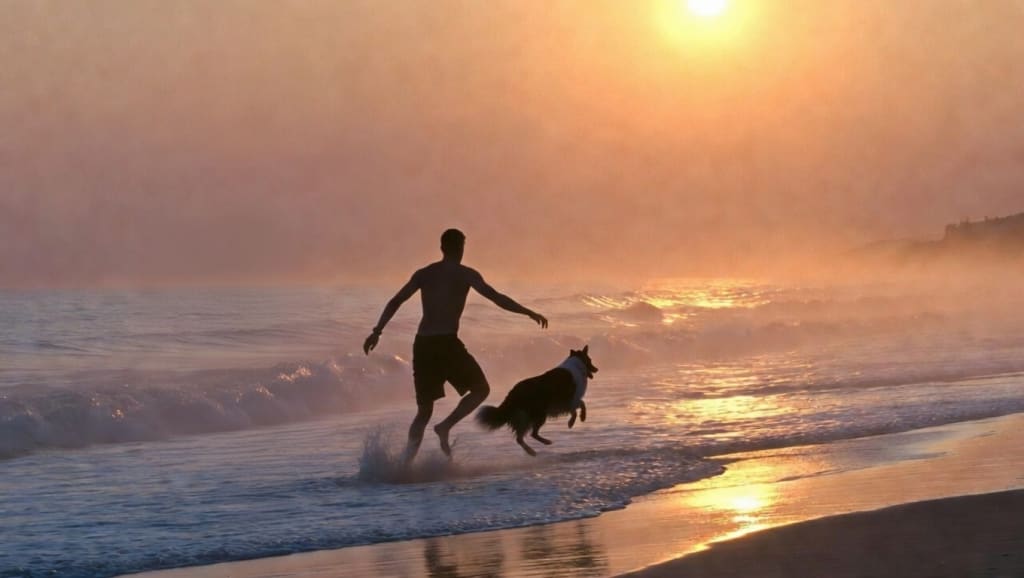
Sometimes the sea holds what we cannot.
The sea was quiet enough to take me.
Not violently. Not in a dramatic, thrashing way. Just quietly — the way grief does. I floated on my back, my ears softened by water, my eyes fixed on the wide, indifferent sky. Birds skimmed low across the surface, their wings almost brushing my face. I was only moments from shore — from my husband, from my boys, from my life. I could have stood up easily. The water was not that deep.
But I didn’t.
Here, in this cold suspension, there was no noise. No questions. No sympathy. No carefully chosen words. Just the steady rhythm of breath and tide. It was the absence of sound I had craved most since my dad died.
When I was a girl, I didn’t float. I jumped.
I jumped the waves with reckless joy, shrieking when the water smacked against my chest. I would stumble on the ridged sand as a breaker crashed down, and my dad’s hand would shoot out, gripping my arm before I slipped under. My hair was long then, tied in a plait that dripped down my back. My goggles always snagged in the loose strands. I remember tugging and laughing and squinting against the salt.
Dad couldn’t swim.
He said the salt helped him float, so he wasn’t scared. I believed him. He had once been a singer in a band with long hair, though by the time I knew him he was nearly bald. He blamed my sister and me for that — said we’d exhausted it right off his head.
We would play for hours. I don’t remember the water ever being cold.
Years later, I played the same game with my own boys. Their smooth hands clutched mine when the swell grew strong. They pressed their stinging faces into my chest after salt burned their eyes. “One, two, three — jump!” we would chant, bending our knees in unison before springing upward as the wave hit.
I tried to lift my youngest clear out of the water the way Dad used to lift me. But my boy had grown too tall. He bent his knees, trying to make himself smaller, trying to fit the memory I was reaching for.
The birds swooped low again above me now. Pale bellies. Curled claws. For a moment I imagined myself a selkie — something made for the water, something sleek and watchful and distant from land. My breathing slowed. The cold pressed against my ribs, testing me.
I could stand. I could break the surface and wave. I could become solid and human again.
But the silence held me there.
They say it only hurts when you move. Stay still and you won’t feel a thing.
My dad was the first person we called when our youngest son was born. He had given up drinking by then. It was early morning. The baby was premature and whisked away to special care before I could hold him properly. I remember looking down at his tiny, furious body — purple and waxy — and claiming him fiercely as mine.
While the midwife stitched me up — neat, endless stitches — I spoke to Dad on the phone.
“A boy?” he asked.
“Yes. Another boy. He’s very tiny.”
“He’ll be strong,” Dad said. “Don’t be scared. He’ll play football for Scotland. Win the World Cup for us.”
I laughed. “Aye, alright Dad.”
The baby took his name. Dad loved that.
He had two daughters but called us “boys” our whole lives. We didn’t mind. It felt like belonging. He was silly. Stubborn. He broke our hearts more than once. But we were always his.
The day he died, I asked the police officer if I could see him.
“It might not be how you want to remember your dad,” he warned gently.
“I’d like to,” I said.
Dad was face down on the bathroom floor. I didn’t check if his eyes were closed. I was too afraid. A thin green blanket covered his lower half. His elbow — dry, familiar, wrinkled — rested near the tiles. I knelt and smoothed the creases of his skin between my fingers.
He was cold.
Not sea-cold. Not playful-cold.
Hard cold.
Afterward, I avoided that room. Then slowly, deliberately, I went back. I packed away his slippers. I placed a photo of my children on the shelf. One afternoon, I lay down on the bathroom floor where he had lain, arranging myself like a chalk outline. Trying to understand the shape of his absence.
When the undertaker handed me the cardboard box of ashes, I nearly dropped it.
“It’s so heavy,” I whispered.
“That’s what everyone says,” he replied.
We scattered him in the River Clyde beneath the hum of the Erskine Bridge. No ceremony. No permission asked. Just us and the brown water. I had imagined the ashes drifting beautifully away.
They didn’t.
They hovered in a white cloud, thick and stubborn.
“Should we leave him like that?” someone asked.
I looked down at my wellies. “I could kick him out a bit.”
So my boys and I waded in together, holding hands, gently scuffing his ashes toward deeper water.
“Sorry, Dad!” I called, laughing and crying at once.
There were no waves to jump that day.
But rivers run to the sea. All of them do.
And now, floating here, I think of that. Of all the rivers and all the ashes and all the grief carried quietly to this vast, breathing body of water. The sea ripples around me, patient and steady.
The cold taps at my chest like a child asking questions.
They say the trick is not to panic. Not to let go completely. But not to cling so tightly that you exhaust yourself.
Breathe too fast and your chest will fold. Then you’ll sink — salt or no salt.
So I breathe slowly.
I float.
And when I’m ready, I will stand.
About the Creator
Keep reading
More stories from imtiazalam and writers in Humans and other communities.
Courage of the Heart
Calvin’s grandmother had always called his ability to see the future a “gift from the heart,” something passed down through her family. To Calvin, it felt more like a burden. People either feared him or relied on him too much. He couldn’t enjoy simple friendships without someone eventually asking about their destiny.
By imtiazalamabout 12 hours ago in Humans
The Many Worlds Of The Soul: Why Consciousness Does Not End And Why Lessons Continue
The idea that we die once and disappear forever is a belief that many people accept without question. It is simple, final, and easy to understand. But many spiritual traditions, and even some scientific theories, suggest that this is not how reality works. They teach that consciousness does not end. They teach that energy cannot be destroyed. They teach that the soul continues to learn, grow, and move through different experiences, even when the physical body stops.
By Julie O'Hara - Author, Poet and Spiritual Warrior6 days ago in Humans
I was in a Toxic Relationship, with my Workplace
“You got that?” My ex yelled. His hands were balled into fists at his side. At six foot three, he towered over me. A normal person would have been afraid, but I looked up a video of George Lopez repeatedly saying, “I got this,” and showed it to him. I had grown used to this treatment, so much so that I didn’t blink when he ripped the phone from my hand and threw it across the room.
By Jade M.6 days ago in Confessions



Comments
There are no comments for this story
Be the first to respond and start the conversation.