
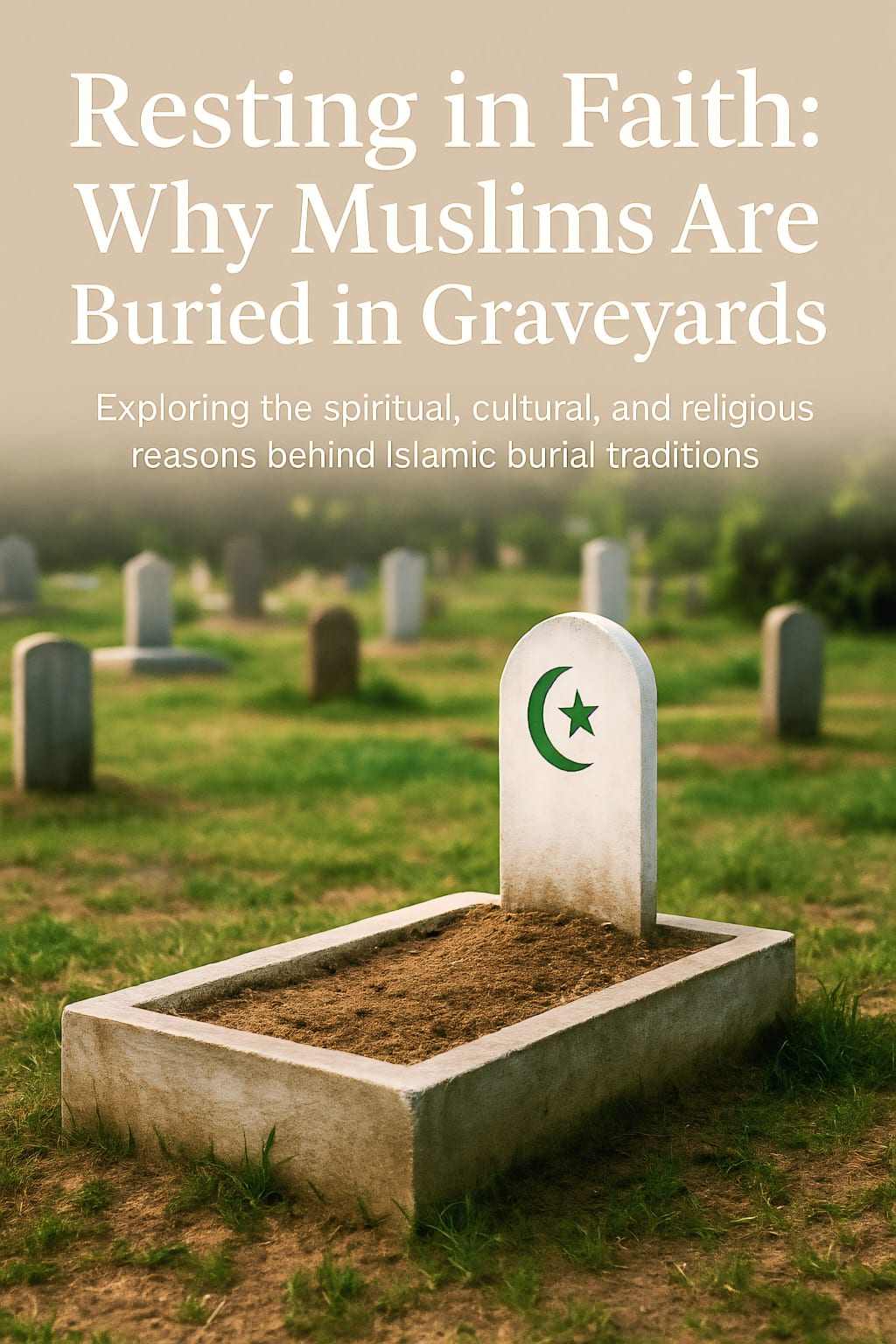
“Resting In Faith: Why Muslims Are Buried In Graveyards”
Exploring the spiritual, cultural, and religious reasons behind Islamic burial traditions

When someone dies, it is always a moment of sadness. People cry, pray, and remember the life that has ended. In Islam, death is not the end. It is the beginning of another life — the life of the soul. That is why Muslims have certain rules and traditions when a person dies, especially about the graveyard.
This article explains why Muslims are buried in graveyards, what Islam teaches about the grave, and how this simple act reflects deep faith.
---
The Body Belongs to Allah
In Islam, every part of our life belongs to Allah (God), including our body. When a person dies, their soul leaves the body. But Muslims believe the body still deserves respect and care. We are not allowed to burn it or throw it away. Instead, the body is cleaned, wrapped in white cloth (called kafan), and buried in the ground.
This is because the Prophet Muhammad (peace be upon him) taught us to return the body to the earth — the same earth from which we were created.
“From the earth We created you, and into it We will return you.”
(Qur’an, Surah Ta-Ha, 20:55)
---
Why a Graveyard?
Some people ask: why not keep the body at home or in a special room? Why not build a fancy tomb?
Islam teaches us to be simple and humble. The graveyard is a place where many people are buried together. There is no need for big decorations or buildings. Every Muslim, rich or poor, is equal in death.
Graveyards also help the living remember death. When Muslims visit the graveyard, they remember their own end and pray for others. It softens the heart and makes us live better lives.
The Prophet (peace be upon him) said:
“Visit the graves, for they remind you of the Hereafter.”
(Sunan Ibn Majah)
---
What Happens in the Grave?
Muslims believe that after burial, the soul begins a new stage called Barzakh. This is the time between death and the Day of Judgment. The grave becomes a place of peace or a place of hardship, depending on how the person lived.
Two angels, Munkar and Nakir, come to ask the person questions:
Who is your Lord?
What is your religion?
Who is your Prophet?
If the person answered with faith in life, Allah will help them answer in the grave. Their grave becomes wide and full of light. But if they rejected faith, the grave becomes tight and dark.
This shows that the grave is not just a hole in the ground. It is the first stop on the journey after death.
---
Simple Burials Are Sunnah
In many places, people spend a lot of money on burials — gold coffins, marble graves, flowers, and statues. But in Islam, this is not necessary. The Prophet Muhammad (peace be upon him) was buried in a simple grave with no big signs or stones.
Islam teaches us to avoid pride and waste, even in death. The burial is quick, respectful, and peaceful. Family members or community people dig the grave, lay the body on its right side facing the Qiblah (direction of Mecca), and pray Salat al-Janazah (the funeral prayer).
The simplicity is beautiful — it reflects that what matters is not what we leave behind, but what we send ahead in good deeds.
---
Visiting the Graves
Muslims are encouraged to visit graveyards. We greet the dead with peace:
“Peace be upon you, O people of the graves. You are the forerunners, and we, if Allah wills, will follow you.”
We pray for them and ask Allah to forgive them. This is not only for the dead — it helps the living too. It reminds us that life is short and we must prepare for the Hereafter.
But Islam also gives clear rules: we are not allowed to worship at graves, ask help from the dead, or cry loudly and hurt ourselves in grief. Respect, prayer, and silence are part of Islamic manners at the graveyard.
---
A Story of Peace
Fatima was only 12 years old when she went to a graveyard for the first time. Her grandfather had passed away. She held her father’s hand tightly as they entered the calm, green graveyard. The air was still. There were no loud voices, no music, no decorations. Just rows of simple graves.
She asked her father, “Why don’t we build a statue for Grandpa?”
Her father smiled gently. “Because in Islam, we remember with prayer, not statues. Grandpa’s soul is with Allah now. We pray for him, and that is better than anything made of stone.”
Fatima stood quietly beside the fresh grave. She whispered a short prayer she had learned at school. In that moment, she felt something she couldn’t explain — peace, softness, and faith.
She knew the grave was not the end. It was just the next step.
---
Moral of the Story
In Islam, the graveyard is not a scary place. It is a place of rest, reflection, and remembrance. Muslims bury their dead in graveyards because it follows the teachings of the Prophet, respects the body given by Allah, and prepares us for the next life.
Burial is not just about the dead. It is also a lesson for the living — a reminder to live with kindness, prayer, and purpose. For Muslims, death is not the end of the story. It is the doorway to eternal life.
About the Creator
Keep reading
More stories from Inam Zohan and writers in Humans and other communities.
The Blanket That Held Us Together
The blanket was old—its colors faded, its edges frayed—but to Mariam, it was sacred. It had started as just scraps: bits of old shirts, unused dresses, and soft cotton from her wedding veil. She began stitching it when she was pregnant with her first child. Her fingers were untrained, her stitches uneven, but her heart was full. Every thread she sewed was a silent promise to the child growing inside her. A promise of warmth, protection, and love.
By Inam Zohan10 months ago in Families
Identity and Access Management Over Ten Years: Security Lessons That Changed Digital Protection
Digital systems have grown rapidly over the last decade. Businesses now depend on online platforms, cloud tools, and remote teams to operate smoothly. Because of this change, security strategies had to evolve as well. One of the most important areas that improved during this time is Identity and Access Management. Ten years ago, many companies used basic login systems and simple password rules. Those methods worked when most employees used office computers and local networks. As businesses moved online and adopted cloud technology, their old systems became outdated and weak. Attackers began targeting user accounts instead of networks. A stolen login could allow someone to enter many systems without raising alarms. This shift forced companies to focus on identity as a main security control. Organizations learned that protecting accounts protects the entire system. Over the past decade, identity security has become one of the strongest foundations of modern cybersecurity strategies.
By Keith Brautigama day ago in Humans


Comments
There are no comments for this story
Be the first to respond and start the conversation.