

READING IS MORE THAN FUNDAMENTAL
Frogeye, The Ridge, Bradberry Point, Hackneyville, Loachapoka, Grace Point, Dowdell, Spraggins, Turner, Refuge Baptist, Mt. Zion, Providence and Glorify God Ministries, just to name a few, are places that hold a special place in people’s hearts.
While some of the names above are different, the locations and importance were just as significant in the summer of 1967, as they are today.
These locations, as well as many more, are the progeny of places that held a special place in the lives of many people. The places mentioned, their brothers and sisters, and their ancestors provided knowledge, joy and comfort to thousands of people, for these are the places that the bookmobile stops.
In the summer of 1967, while I was working for my parents, closing down our International Harvester dealership, I worked for a few weeks as the bookmobile driver.
We were closing my parents’ business because business was not what it used to be. From 27 full-time operating saw mills in the early 1950’s, there remained 3. From 5 or 6 dairies, there was but 1. Farmers were planting trees, to feed the demands of homebuilders and the voracious appetite of the paper mills, instead of corn, beans, cotton and the like.
While all of this was going on, the librarian of the Horseshoe Bend Regional Library called and asked if I could drive the bookmobile for a few weeks. The library is, unless you live in the area, an unknown, often under appreciated, place. It served then, and still does today, a three county area stopping at a wide variety of places that, at first glance, seem random and would give a normal person pause, but to those waiting for the bookmobile, these locations were second only to their church.
The Horseshoe Bend Regional Library serves a three county area in east central Alabama: Lee, Elmore and Tallapoosa, with its headquarters in Dadeville, Alabama, the county seat of Tallapoosa County.
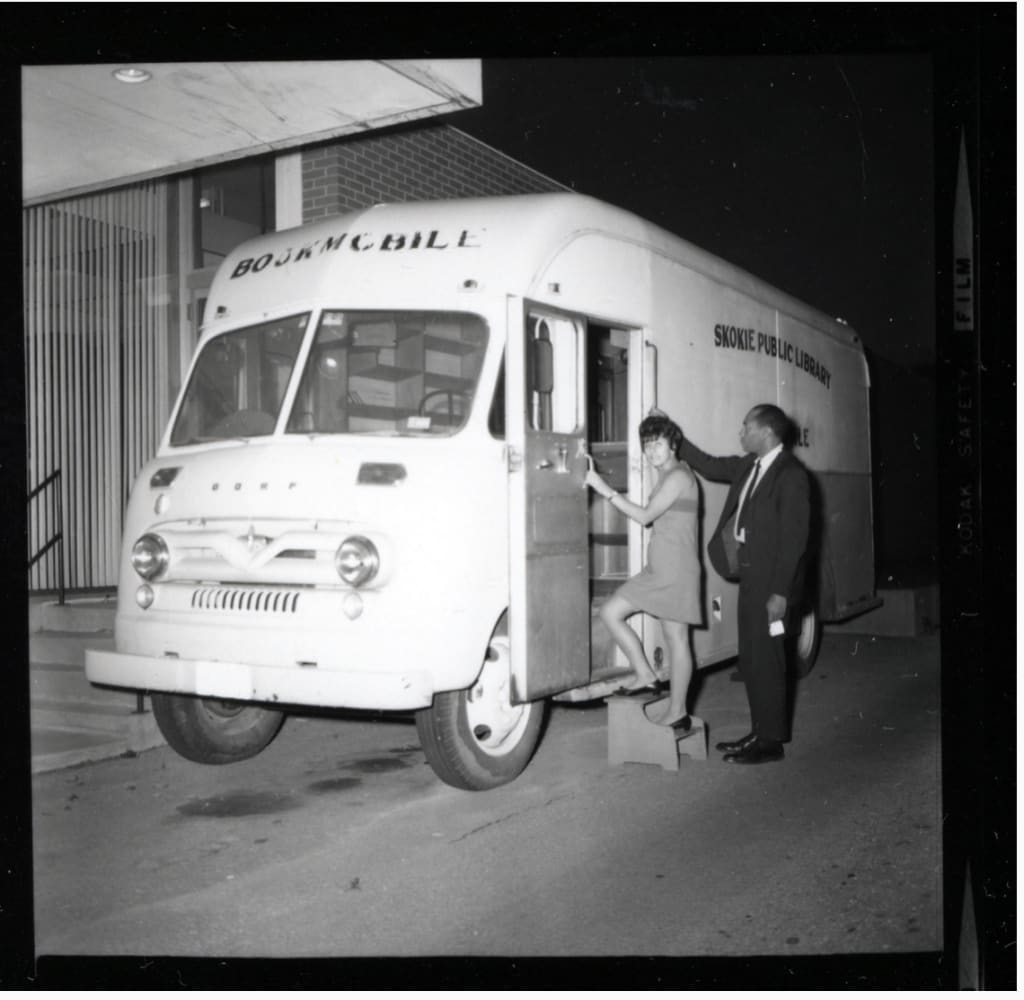
The bookmobile was a large, formerly white, tending toward beige van of the same design driven now by UPS, FedEx and the Post Office. It came with double doors in the back and sliding doors on both the driver’s and passenger’s side. The van was an air conditioner free zone and had no radio.
Book shelves were along the walls of the van with everything from biographies and murder mysteries to children’s books–as many as space allowed. I learned early in my time that the people could call the library and request that particular books be loaded and brought to them and, so long as the book was available, the librarian would fulfill the request. As you can imagine, there was no computer check-out system: a paper card in the envelope glued in the book would be filled out with the borrower’s name written in long-hand and the date the book was borrowed and due to be returned was stamped on the card. The stamp was a wooden handled device with rotating rubber belts containing the months of the year, days of the month and a sequence of years. This stamp would be hit on an ink pad and then on the book card with the date to the left of the borrower’s name being the date the book was borrowed and the date on the right being the date the book was due. This card would then be place in a drawer holding the days of the month and be placed behind the date that coincided with the due date.
Some of the roads on our routes were not paved and more than a few were just dirt. The dirt roads made for two issues. The first was dust, lots of dust, stirred by us as we drove along and by any breeze that blessed us with its presence. The other was mud which raised its slick, sticky head when the inevitable afternoon showers occurred.
The dirt roads were actually red clay roads. The red clay dust was of the kind that stuck to everything, especially your skin if you had the slightest sheen of sweat, and since the bookmobile lacked air conditioning, the librarian-I’ll call her, Mrs. White, and I were lucky if we only had a sheen of sweat.
The mud was “suck your shoes off” sticky while, at the same time, so slick that driving was akin to driving on ice.
I remember one farmer, who looked to be in his late 50’s or early 60’s waiting at a gas station somewhere in Elmore County. He was in a John Deere hat, bib overalls and work boots. His hands were massive and calloused, but when he spoke, his voice was quiet and restrained. I was shocked, at first, when he asked for two romance novels (I learned that they were for his wife, who was home sick), but then he asked for Jules Verne and Ray Bradbury and my shock returned, only to come to the realization that his looks had driven my thoughts as to what he might read.
There were children at every stop and almost half of our stock was children’s books ranging from baby books to required summer reading for high school students. There was a huge demand for Hardy Boys and Nancy Drew books, as well as, a wide variety of others.
At one of the three Calvary Baptist Churches where we stopped, the minister clucked his tongue and shook his head as one teenage girl checked out Catcher in the Rye and as a teenage boy got Brave New World. He clearly did not approve of the selections and started to say something to the kids when Mrs. White touched his arm and shook her head. He looked shocked, taken aback, angry and then resigned, as he quietly watched them leave. Mrs. White smiled at him and, in a voice just above a whisper, reminded him that keeping ideas away only serves to make young people more curious and that exposing them to controversial and challenging ideas serves to make them smarter and more understanding. I could look at him and see that he was not altogether convinced she was correct, but he didn’t challenge her.
After the near noon stop each day, we sat in the van, or, if there was a place to sit, in the nearest shade and ate the lunches we had packed. Mine was usually a bologna sandwich and hers a ham sandwich. One day, Mrs. White looked at me and asked if I wanted to swap. Not being wedded to the idea of another bologna sandwich, I did and she sighed as she bit into it and said that it had been a long time since she had bologna. Her husband did not like it, so she didn’t buy it. A couple of days later, I initiated the swap.
At some time during the second week, Mrs. White told me that the upcoming stop might be difficult. As we were pulling in to the stop, a location that served as a school bus stop during the school year, I saw what she meant. Before us were about twenty people, three of whom were in wheelchairs. There were no ramps and the aisle in the van would make the quarters tight, but we were there to serve everyone. I got out in order to help lift a wheelchair, only to discover that my help was not needed. Two teenaged boys had, without so much as a moment’s hesitation, lifted the first chair and placed it in the van. The occupant of the chair had to be nearly 90, yet she perused the book selections quickly, checked them out and whistled-her whistle was loud enough to be heard 200 yards away-and the boys lifted her down and went to the next chair. None of the other people who were waiting said anything about the selection order. Clearly, this had been done before and the unwritten rule was that the wheelchair bound people went first and it seemed that even the wheelchair bound people knew that among them it was oldest to youngest. As the others waited, some would go over to the people who had picked out their books and asked what had been selected. Listening to the conversations, it became clear that there was an informal library service going on, with the people who came to this location swapping books among themselves as they waited for the bookmobile’s return three weeks later.
Over the three weeks, I drove about 1000 miles, stopping at, what seemed to me, every wide spot on the roads of these counties. Without fail there was a crowd waiting to get their supply of books so they might go on their next journey finding romance, adventure, excitement or challenges. As these people expanded their knowledge and, I assume, pleasure, they taught me that if you want something bad enough, you can find a way. Mrs. White, also, taught me that a lightly placed hand, a smile and a quiet word can be a teaching tool as valuable as any computer.
About the Creator
Vader Pennington
southern man of a certain age, who has lived through the civil rights movement of the 50’s and 60’s, the Vietnam era and the Dodgers and Giants moving to California
Keep reading
More stories from writers in Humans and other communities.
Whiskey At Dusk
Guess the whiskey was more important to you in the end, wasn’t it? It was more than the well-being of your friends; more vital than showing up to the places you promised you would and could come to; more critical of a matter than fulfilling your damn responsibilities and getting the press off your back.
By Snarky Lisa5 days ago in Humans
(7) Populations, Not Persons
- The Mistake of Individual Framing - One of the most persistent misunderstandings in political and social analysis is the tendency to reason from individual cases rather than aggregate behavior. Individuals experience systems personally, so it feels natural to evaluate outcomes through personal stories, edge cases, and exceptions. But systems do not respond to individuals as individuals. They respond to patterns, distributions, and averages. Policy is not designed around who someone is, but around how populations behave at scale.
By Peter Thwing - Host of the FST Podcast4 days ago in Humans
🅼🅸🅳🅽🅸🅶🅷🆃 🆂🅽🅰🅲🅺🆂
"It's 10 in Tuscon! We all know what that means... It's Time for Midnight Snacks with your man, Gerald Gee! Ready to spend the night together? Me too! I'm full of snacks and can't wait to regurgitate them all back into your hungry ears. Crack a brew! Pop some corn! Anything to get ready for one hell of a show where the talk maybe cheap but the words cut deep...
By Lamar Wiggins7 days ago in Fiction



Comments
There are no comments for this story
Be the first to respond and start the conversation.