
Reach With Care
Ana Flávia Veiga’s path from rural Brazil to L.A. — producing with urgency, conscience, and scale


She remembers the exact moment cinema rearranged her interior life: fourteen, alone, fooled and then astonished by a mockumentary that felt truer than truth. The memory is tactile; the flush of embarrassment when she discovered the film was invented, the slow, astonished recognition that fiction could nonetheless hold a deeper honesty. That hinge, the willingness to let feeling stand for fact, is the smallest and clearest key to Ana Flávia Veiga’s work. It explains why she moves between formats with a trader’s calm, why a palm tree can become a witness in a documentary, why a ninety-second vertical can teach lessons that fund a quieter feature. Her practice is at once pragmatic and moral: make room for feeling, then build the systems to hold it.
Veiga’s path reads like two careers braided together. There is the apprenticeship; USC’s production crucible and internships at Paramount, Fox, Atlas, Mandalay, where she learned that producing is both spreadsheet and sanctum: scale requires discipline, but discipline without tenderness breaks people. And there is the studio of attention she carries in her head: a production classroom where three shorts in a semester stripped pretense from her and named the work she would do. “Producing stopped being an option and became vocation,” she says, because the rhythm of making revealed what made her come alive, organizing chaos so stories could breathe.
That twin sensibility; rigorous systems and a reverence for small human moments, governs everything she touches. Palmas, the documentary that made the palm tree not merely scenic but speaking, is a clarifying example. The image did not arrive as metaphor so much as as an observation: palms planted as glamour now tower over neighborhoods being remade, witnesses to displacement and erasure. Veiga’s production instinct was not to force allegory but to let the ordinary accumulate significance. She walked the streets, listened to stories, let the tree’s quiet repetition become a conversational device that folded history and present into a single, uncanny frame. The choice is instructive: documentary’s power often lives in what is already there, if only a filmmaker makes room to notice.
That attentiveness is practical, too. Veiga’s résumé reads like a school in production craft, DIT work, and assistant editing, and those rooms changed how she produces. Being hands-on with footage taught her patience and a certain humility: the story is not fixed at shoot wrap; it is an object waiting to be re-found in the cut. She knows how a glance missed on set can transform an arc in the edit, how a single frame can shift meaning. As a producer she thus operates with both foresight and curiosity: she protects the director’s space while remaining alert to unplanned detonations of truth. Her job, she often says, is to create conditions where those surprises are possible.
If that sounds like a romantic formulation of producing, her commercial record grounds it. In 2025 she directed a flurry of vertical films (seven, by her count), pieces that reached tens of millions and drove measurable consumer behavior. To many, verticals are a format of impatience; to Veiga they are grammar exercises. She treats speed as a virtue, not a concession: tight crews, decisive choices, and an insistence that short does not mean shallow. “Never equating short-form speed with shallowness” is a rule she tends to break only deliberately. The result is work that funds and informs slower projects; virality becomes a resource for riskier, longer films rather than an end in itself.
That practical alchemy shows up in productions like A Virgin Surrogate for the Billionaire, a $300,000 feature that felt larger than its budget because resources landed precisely where they mattered: authentic football fields, a convincing world of wealth that doubled efficiently across scenes, casting choices that anchored the premise in human specificity. Spending, to Veiga, is an act of choreography. You don’t spend everywhere; you spend where the story needs to breathe like it’s big. The lesson is the same across her slate: scale is not a moral virtue. Intention is.
Her festival strategy is guided by the same questions. Festivals are not trophies to be accumulated, she believes, but rooms to be chosen for the conversations they enable. “Who needs to see this film first?” she asks. Premiere status matters less than momentum: the critics, curators, and communities that will carry a film forward. That calculus turned practical at San Diego and Hollywood short festivals, where the run for My Father’s Wedding shifted perception and opened doors. Those acceptances taught her that visibility carries responsibility; when a film travels, it arrives as an actor in civic conversation. That idea, that reach is also stewardship, is a recurrent theme in her producing philosophy.
There is also a strong throughline in Veiga’s ethics: democratizing access. She watches the industry’s hidden gatekeepers, unpaid internships, and invisible know-how, and tries, within her remit, to pull them open. In practical terms that has meant paid internships when possible, early credits and practical mentorship, sharing budgets and strategy decks, and a wish to build something more structured: a mentorship program combined with equipment and modest funding so emerging filmmakers from less privileged contexts can actually make mistakes and learn without financial precarity. Her aim is simple and ambitious in equal measure: shift the doorway so it is not only visible to the privileged few.
That ethic bleeds into how she handles branded content. Veiga’s playbook is to strip a brief to its human core: find the story that would survive absent a logo, then ask whether the brand’s objectives can ride naturally on that narrative. She insists on alignment early; impact goals, audience intentions, and whether the story holds independently. When it does, the brand’s amplification feels earned rather than pasted on. Her experience has taught her a counterintuitive truth: commercial and social aims can be companion currents that sustain one another. Virality buys runway; depth keeps the runway relevant.
Risk, then, is embedded in her slate choices. Of the three projects she has near announcement, one terrifies her in the best way: LA Taco Life, an unscripted series that looks at tacos as a prism on labor, memory, migration, identity. Food is deceptively simple; it carries histories, livelihoods, and grief. To treat it only as flavor would be to fail. The fear is not paralysis but a requirement: to find a language for complexity that works in formats hungry for clarity. That project crystallizes Veiga’s most interesting gamble; can stories scale ethically and commercially at once? Her answer so far is to build teams who can hold that tension, and to use the money from short, fast hits to underwrite patient, careful storytelling.
She measures success with a suite of metrics that refuses the tyranny of impressions. Views and virality are useful but not dispositive. Veiga tracks conversion, fundraising outcomes, audience retention, and whether a film seeds ongoing collaborations — whether someone reaches out weeks later to say a film changed how they think, or a community organizer uses a piece to convene people. Those are the meaningful afterlives she chases: resonance over reach, continuity over spikes. “If a film creates continuity, in audience, in impact, in community, then it is doing its job,” she says.
There is humility in her failures, too. She fought once for a film’s score and lost; the director’s choice proved right, unlocking a vulnerability she had not seen. The defeat taught her to pick battles and to trust collaborators in their zones of mastery. That takeaway is soft but seismic: producing, at its best, is not control but stewardship. The stories flourish when the producer knows when to insist and when to listen.
What ties these practices together is a posture toward beginnings: “Begin before you’re ready,” she tells emerging filmmakers. Make something small, imperfect, generous. The classroom that named her vocation demanded three shorts in a semester; the verticals she makes now demand speed; the features she protects ask for patience. All of it is practice in one skill: making space where belief can take root. The fourteen-year-old who believed a mockumentary taught Veiga the charter that still guides her today — that feeling can be truer than fact, and that the producer’s work is to shape conditions where that feeling can land without harm.
Ten years from now she hopes to be remembered not only for the films she shepherded but for the rooms she altered: sets where people were paid, mentored, and left stronger; festivals where the film’s arrival created new conversations; a small network of producers who learned to measure success by care as much as by distribution deals. “I want people to say I helped re-center the industry around attention and care,” she will tell you. It’s a modest, fierce hope. It is also practical.
Her work sits at a rare intersection: the speed of social attention and the slow endurance of documentary craft. She builds with both hands: one for momentum, the other for memory. The palm tree in her film keeps watch over a city’s change; Ana keeps watch over the work that tries to tell that change honestly. That is why her projects matter, because they are not simply attempts at presence but attempts at stewardship: small experiments in how to make stories that travel wide and land kindly.
About the Creator
Trickle Them Down, But Not Out
The thing about smart people is that they should know better, but alas, intelligence is not the same as wisdom. Not only do the mistakes of experts too short on vision—when they are not corrected—have the potential to do great and far-reaching damage, but they also undermine public confidence in the very notion of expertise. This is particularly so when expertise is wielded in defence of the rich and powerful as a cudgel against those laid low. As an academic, this lack of faith in “so-called experts” is painful to see as it plays out in the spread of dis-/misinformation, conspiracy theories, and anti-intellectualism writ large. But it is also an understandable impulse given the catastrophic failure of an economic ideology pushed by certain economic experts. Supply-side economics has shaped a broken system for the last half-century and has arguably done more to undermine the fabric of the American Dream than any policy framework of the past century.
By Cory Wright-Maley5 days ago in Humans
Do Himalayan pink salt blocks Really Enhance Food Flavor?
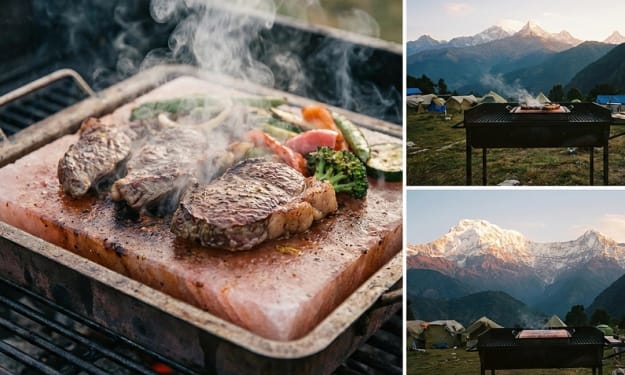
Cooking is not all about the process of hunger. It is also concerning taste, smell, and little details that make food memorable. Nowadays, a significant number of domestic cooks and restaurant chefs have begun to use Himalayan pink salt blocks within their kitchens. These pink salt blocks belong to the older salt mines that are currently in use as a grill, cold block, and also as a way of serving food.
By david smith3 days ago in Humans



Comments
There are no comments for this story
Be the first to respond and start the conversation.