
Radical Simplicity: Gandhi’s Cure For Industrial Civilization
Imagine a livable world

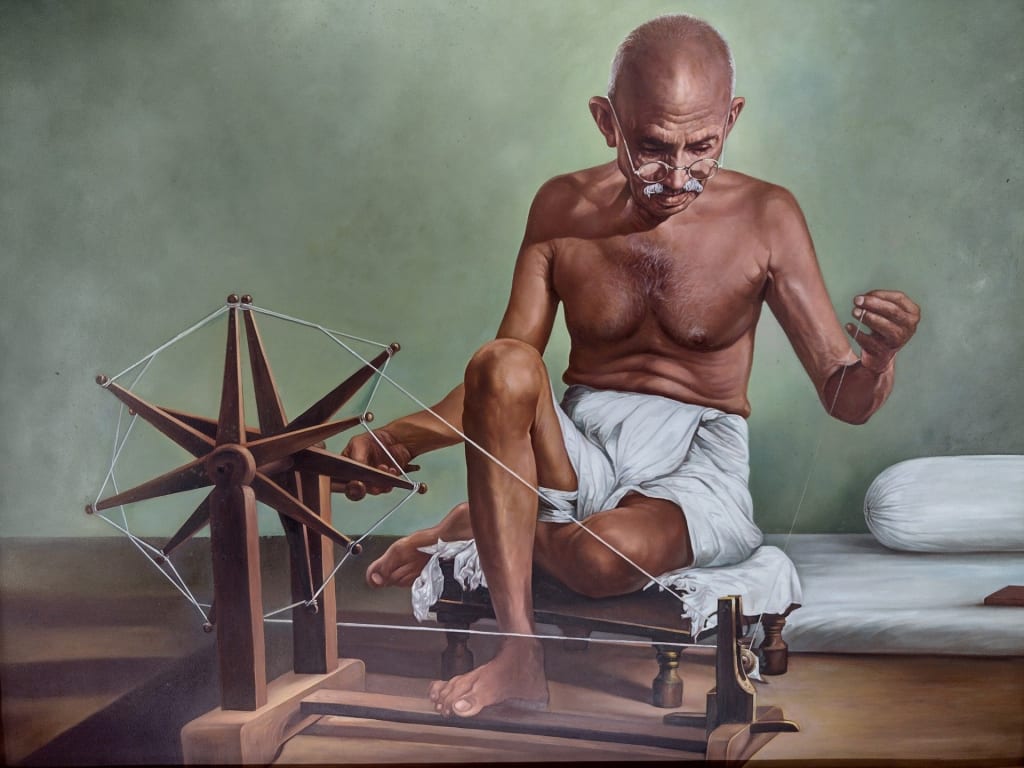
I do not believe that multiplication of wants and machinery contrived to supply them is taking the world a single step nearer its goal… I whole-heartedly detest this mad desire to destroy distance and time, to increase animal appetites and go to the ends of the earth in search of their satisfaction. If modern civilization stands for all this, and I have understood it to do so, I call it Satanic.
Mahatma Gandhi, Young India, 17–3–27, p. 85
________________________________________
Another Memorial Day has come and gone and nothing has changed. We remain blind to the insanity of war and violence. Modern society, stressful, meaningless, and absurd, driven by relentless craving, lurches forward, churning with fear, anger, grievance, and mayhem. Gun violence is the leading cause of death for American children.
World War I was the first clear indication that industrial civilization is suicidal. War fever swept the most advanced nations, offering a glorious cure for boredom, drudgery, discontent, and the generalized angst that arises when humans are disconnected from nature, each other, and the core of their being. When four years of bloodletting failed to heal our misery, we doubled down on materialism, a major cause of our suffering.
The remainder of the 20th Century brought more than 120 million deaths in countless wars, including another world war. It also brought nuclear weapons, addiction to fossil fuels, the depletion of natural resources, genocides, extinctions, overpopulation, DNA tampering, and climate catastrophe.
William Blake warned against dark satanic mills in 1804. Henry David Thoreau said in 1854 that most men lead lives of quiet desperation. By 1942, Albert Camus had a character say that everybody knows life is not worth living. Today, ordinary people utter words of despair once spoken by prescient writers.
Industrial civilization is unraveling. Childish beliefs in religion, benign government, and ever-increasing prosperity no longer anesthetize the pain of a dehumanizing way of life. Hate, arising from hurt, looks for a target, which it finds in the “other.”
At this very moment, we flirt with Armageddon, with civilizational suicide. A demented Putin invades Ukraine. The US political and military establishment — the folks who brought us the nuclear arms race, Vietnam, the Iraq war, and who squander trillions of tax dollars — now think it’s a good idea to box a crazed, humiliated, nuclear-armed Putin into a corner.
We are all in a game of Russian roulette. The empty suits running the American Empire are no less demented than Putin.
Gandhi was right, not just about nonviolence, but about how we should live. He advocated small, largely self-reliant villages, where people grow most of their food and produce most of their necessities. This requires acceptance of radical simplicity.
* * * *
Radical simplicity is acceptable only when society provides nonmaterial sources of happiness, such as the joy and contentment derived from a loving community, meaningful work, and close contact with nature, which can occur in a spiritually based village.
Fortunately for simple living, the ultimate source of happiness — which doesn’t cost a penny — lies within. Through spiritual practices, including meditation, we can dissolve egoic hindrances and begin to experience the inner source of joy, serenity, wisdom, love, and Divine Presence. We are then no longer driven by artificially created wants and dependent on excessive technology for satisfaction.
Questioner: Radical simplicity is a receipt for disaster! If everyone practiced voluntary simplicity, the entire world economy would collapse.
Answer: Do you mean the economy that’s dependent on infinite growth in a finite world? The planet-killing economy? Yes, that economy would collapse if everyone suddenly practiced voluntary simplicity. But they won’t. A gradual transition would give a new economy time to emerge.
Questioner: But still, it would mean a dramatic drop in the standard of living, right?
Answer: Do you mean for the 20% of the world who live in wasteful luxury or for 65% who live on less than $10 a day? Yes, inhabitants of the over-developed world would lose some toys.
Questioner: Toys? What about the miracles of high-tech medicine?
Answer: No one knows how much wealth would be left for complex technology in a world of radical simplicity. The privileged may no longer receive heart transplants.
But if the primary goal of the economy became meeting human needs, then basic medicine, food, shelter, and clothing would be available to all. As Gandhi said, “The world has enough for everyone’s needs, not everyone’s greed.”
Questioner: What if I can’t find a Gandhian village?
Answer: Simplify your life. Cultivate a loving community. Help others. Practice meditation.
Questioner: You make Don Quixote look like a hardcore realist. You’re a dreamer!
Answer: Yes. But I’m not the only one.
About the Creator
George Ochsenfeld
Secret agent inciting spiritual revolution. Interests: spiritual awakening, mindfulness meditation, Jung, Tolle, 12 Steps, psychedelics, radical simplicity, ecological sanity. Retired addictions counselor, university faculty.
Keep reading
More stories from George Ochsenfeld and writers in Humans and other communities.
Ukraine and Nuclear War: A Brief Essay on Preventing Armageddon
Give Peace a Chance Russia’s brutal invasion of Ukraine has been largely beaten back. Now is the time to negotiate a settlement. Continued escalation means more death, maiming, trauma, dislocation, and destruction. And the ever-increasing likelihood that hostilities will spiral out of control into a nuclear apocalypse. We will never know if negotiations can succeed unless they are tried.
By George Ochsenfeld3 years ago in Humans
What Makes the Maldives the Most Romantic Destination in the World
The romance of the Maldives begins with its geography. Scattered across the Indian Ocean, the islands are naturally isolated, surrounded by open water rather than neighbouring towns or tourist districts. This physical separation creates emotional space. Couples are not navigating crowds, traffic, or schedules; they are sharing an island that feels intentionally removed from the rest of the world. In the Maldives, privacy is not an upgrade or a premium add-on; it is the default. That sense of being alone together is the foundation on which all the romance is built.
By Claudia Fennelabout 11 hours ago in Humans


Comments
There are no comments for this story
Be the first to respond and start the conversation.