
Psychopaths Among Us
How to Spot the Wolves in Sheep’s Clothing
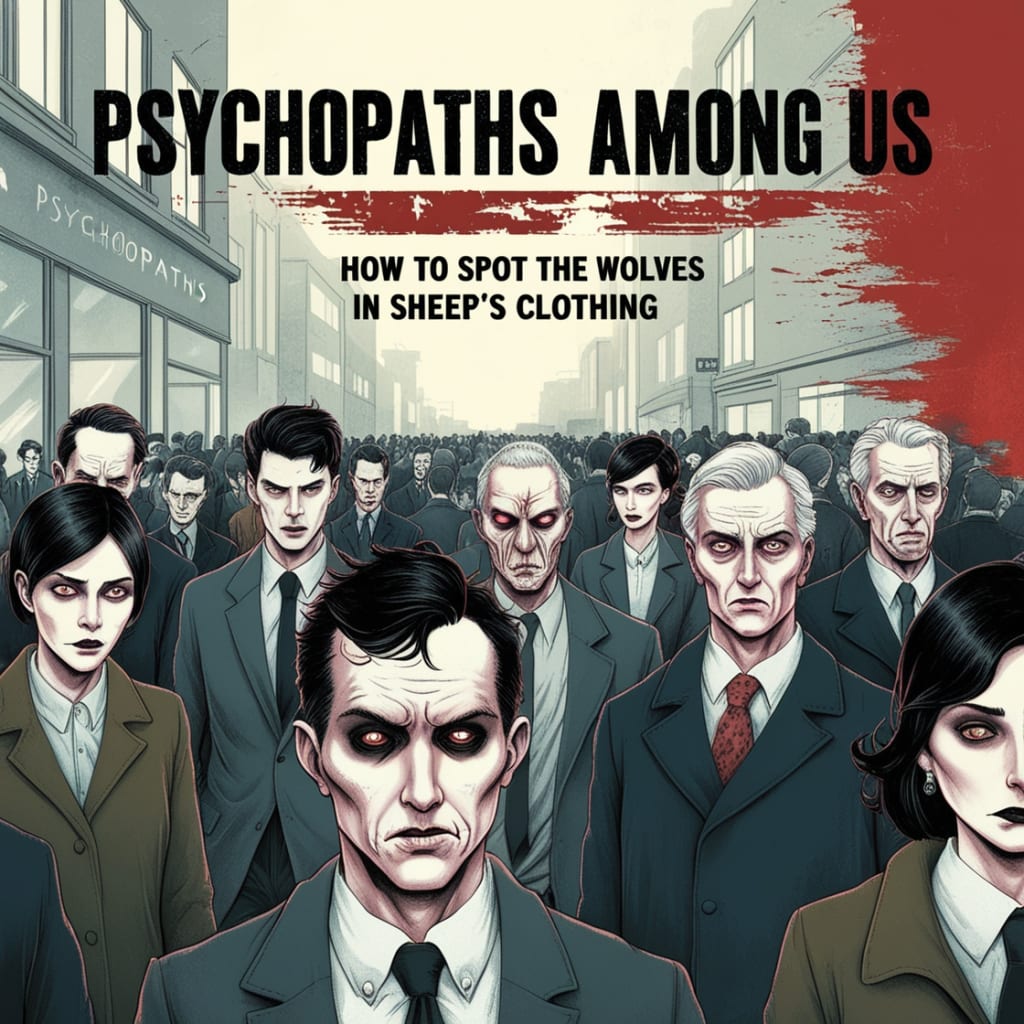
The world isn’t divided into good people and bad people. It’s filled with shades of grey, but among us, lurking in the corners of our lives, are those who wear a mask—a mask that hides a chilling absence of empathy and remorse. They’re the charming coworker, the attentive friend, the ambitious leader. They’re the ones who seamlessly blend in, mimicking emotions, wearing the perfect smile, and saying exactly what we want to hear. But underneath that facade lies a predator—calculated, cold, and driven by a chilling lack of conscience. These are the psychopaths among us, and spotting them is both an art and a necessity.
The Early Signs
In a small town in Texas, a young girl named Sarah was the life of her high school. She had the charm of a celebrity, the wit of a comedian, and the loyalty of a best friend. But to the horror of those who thought they knew her, Sarah was found guilty of systematically manipulating her closest friends, driving them apart, and sowing discord with chilling precision. Friends began to recount eerie encounters—moments when Sarah seemed too calm in a crisis or strangely detached from the pain she caused. What they couldn’t see then was Sarah’s psychopathy lying in wait, a cold observer behind a veil of warmth.
This story is not unique. Psychopaths are masters of disguise, and the signs are often subtle. They tend to display an uncanny ability to mimic emotions. They might not feel love, but they know how to mimic it. They might not understand remorse, but they can fake an apology. They study human behavior with an almost scientific curiosity, understanding the nuances of emotion without ever truly feeling it.
The Corporate Predator
Fast forward to the corporate world, where Bill Davidson, a rising star in finance, was known for his ruthless efficiency and razor-sharp insights. Bill’s team admired him; he was a leader who always knew what to do, regardless of the situation. But behind the scenes, Bill was playing a different game. He had orchestrated the downfall of several colleagues to secure his promotions, using deception and manipulation to climb the corporate ladder. His charm was magnetic, his intellect formidable, but his lack of empathy made him dangerous. Those who got close were merely stepping stones or obstacles to be removed.
Psychopaths in the corporate world often exhibit traits that are eerily similar to those in the criminal world, but they blend in effortlessly. They are impulsive yet calculated, seemingly open but intensely secretive. They can be charming and engaging, but they lack a fundamental human quality: empathy. This absence of empathy allows them to hurt, betray, and manipulate without the burdens of guilt or remorse.
Love in a Time of Deception
Psychopathy doesn’t just play out in boardrooms or high school halls; it also hides in the warmth of our homes, sometimes disguised as love. Jenny, a vibrant young woman, met a man named Alex on a dating app. He was everything she dreamed of: attentive, caring, romantic. But as the months wore on, subtle signs emerged. Alex would frequently lie about trivial things, become cold and distant without warning, and seemed to relish watching Jenny squirm in discomfort. She discovered he was leading a double life, casually manipulating several women at once, playing with their emotions like pieces on a chessboard. For Alex, the thrill wasn’t in the connection but in the control.
Psychopaths often find their way into relationships, drawing people in with charm and then slowly revealing their darker nature. They crave control and view relationships as games to be won. Unlike typical relationship dynamics, where empathy and compromise play essential roles, a relationship with a psychopath can be a one-sided affair, where manipulation and deceit replace genuine connection.
The Cost of Ignorance
The danger of psychopathy lies in its invisibility. Without violence or outward aggression, psychopaths can wreak havoc on those around them. They play games with people’s emotions, manipulating their lives with an eerie detachment that leaves victims questioning their own sanity. Their victims often experience confusion, self-doubt, and a deep sense of betrayal. Friendships, careers, and lives are left in tatters, while the psychopath moves on to their next game, seemingly unscathed.
But how can you spot these wolves in sheep’s clothing? Psychopaths can be identified through a pattern of behavior. They are impulsive yet calculating, selfish yet charming. They lack empathy and remorse, but they are skilled at pretending. They may show a fascination with power and control, a willingness to lie and deceive without hesitation, and a tendency to view others as mere tools for their gain.
Unmasking the Psychopath
Spotting a psychopath isn’t always easy, but there are red flags. They often show a glibness, a superficial charm that masks a lack of true emotion. They may have a grandiose sense of self-worth, viewing others as inferior or expendable. They are masters of deceit, often telling elaborate lies that seem plausible only because of their confidence. And when confronted, they rarely show guilt or remorse; instead, they deflect, rationalize, or even retaliate.
While it’s tempting to view psychopaths as monsters, the truth is far more chilling. They are ordinary people, blending into society, working alongside us, even loving us. But beneath their masks lies a predator, one that feeds on control, thrives on manipulation, and leaves a trail of devastation in its wake.
In a world where trust is a foundation of society, the presence of psychopaths among us is a sobering reminder that not everyone who wears a smile has a heart behind it. Being aware of these wolves in sheep’s clothing is the first step in protecting ourselves from their grip, and learning to recognize their masks can save us from the invisible dangers lurking just beneath the surface.
About the Creator
Keep reading
More stories from writers in Humans and other communities.
I Don't Need My Phone... Wait, Is That Actually True?
My parents gave me my first cell phone when I was twelve years old. It wasn't a fancy iPhone or anything, not even close. Just a simple black flip phone for when I needed to call or text them after school.
By Madison "Maddy" Newtonabout 10 hours ago in Humans
My mind
My mind is controversial, I can think opposite things at the same time, and I can have thoughts that I have never asked or even created. I mean, I don't control them. It's a hole, too deep, immeasurable. Like the stars in the universe, the planets, and galaxies, we see only what we are capable of seeing. Today is 10, tomorrow is 1000 and so on. But there is more, there is always more, and it is not a good thing to try to find out, cuz its like a spiral, you could end up being swallowed by it if you keep digging.
By Jokeny Martins3 days ago in Humans




Comments
There are no comments for this story
Be the first to respond and start the conversation.