

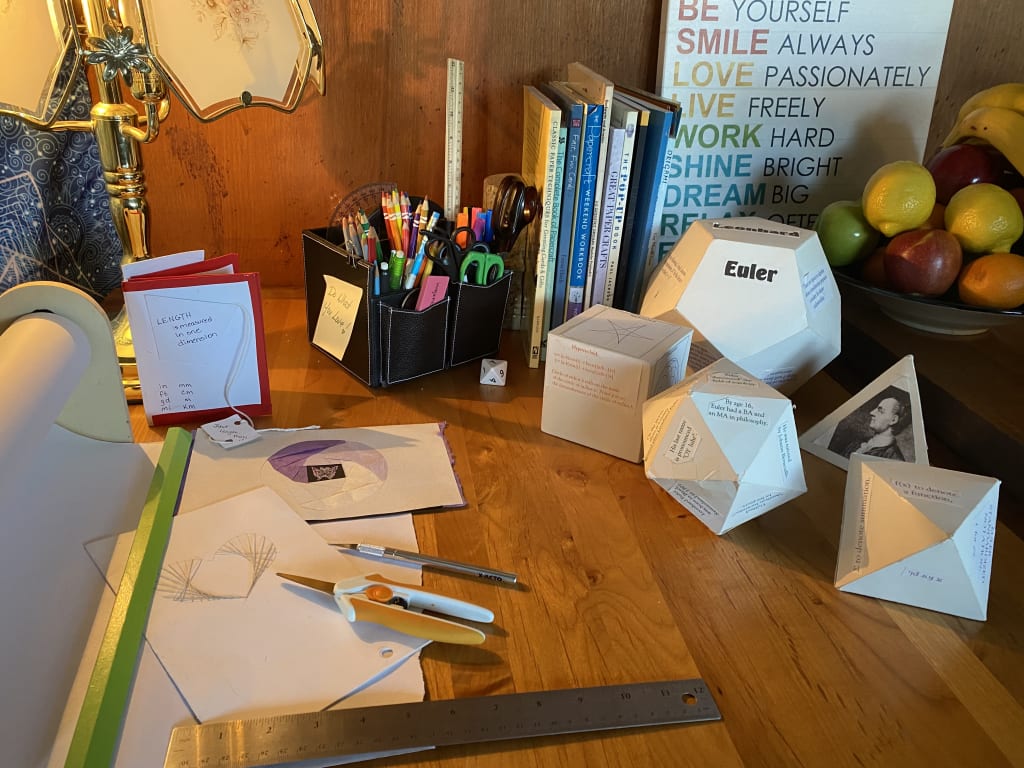
“What the heck is a polyhedron?” You may be asking yourself right about now. The short answer? Three dimensional shapes such as pyramids, crystals , and geodesic domes. More specifically, they are convex 3-D figures with faces, edges, and vertices. I am ridiculously fascinated by them and even recall exactly when the “a-ha!” moment hit me.
The year was 1984, in geometry class. My favorite math teacher finally gave us a break from the infinitely boring proofs. We spent the rest of the year on the unit involving Polyhedra.
My mind exploded with insight! Math and art had intricately melded. Geometry suddenly and finally meant something real. Who would have thought such beautiful shapes could be made from one simple piece of paper? I clearly remember taking great care to tuck away and preserve my templates of the five regular platonic solids (and no, this does not mean that they were just friends, ha ha). Little did I know that the decision to keep those five pieces of paper would be so pivotal.
Plato, the well-known philosopher, had discovered in 500 BC (BC!!) that there are five and only five “regular” Polyhedra that have that have identical faces: tetrahedron (4 sided), hexahedron (6 sided), octahedron (8 sided), dodecahedron (12 sided) and icosahedron (20 sided) all of which are perfect for fairness in gaming, such as in the well known game of Dungeons and Dragons.
I guarded those templates with my life. I had them still as I studied math and art in college. As a matter of fact, I gave a presentation on my favorite mathematician, Leonhard Euler, using those five regular polyhedra (see photo).
At one point, I enrolled in a class focused on mechanisms of pop-up books. This complex skill was added to my paper craft repertoire. Making pop-up cards ignited my fire for all things paper! Pop-up mechanisms added concepts of physics to those of art and math.
Many of my friends and relatives over the years have received a labor of love from me as a detailed pop-up card or fancy polyhedra. Once, I even created and bound an entire 20 page book. But of course, I have gifted that as well.
Not surprisingly, I went on to teach math for over 20 years. Those templates were still with me as I passed down the tools of geometry ( and my passion for them) to the younger generation. One memorable teaching moment that I am particularly proud of is this: I had a student who told me she thought that geometry was useless! I bet you can guess what I did. I went home and made a mini pop-up book using everything she had learned so far that year, and brought it back to her a few days later knowing full well that my actions spoke far louder than my words. You know, I used that little pop-up for years afterwards (see photo).
One conscious choice that I am quite proud of making is that I never monetized paper crafting, so to this day I remain passionate about it! There is something calming and meditative about visualizing 3-D objects and creating them from 2-D.
Accuracy is the ultimate key to success in paper crafting. In order for points to become lines they have to be in a row. Corkboard rulers are handy for that. Protractors and compasses help make sure those lines become angles, and ensure symmetry and balance are part of the final piece. X-Acto blades are good for the perforations. And finally, one of the most important tools is a sharp pair of decent scissors. I have always had a special pair of scissors that no one is allowed to touch. They are reserved for paper, and paper only. Anyone who touches my scissors may find themselves the subject of a not very complimentary pop-up book.
About the Creator
Keep reading
More stories from writers in Humans and other communities.
She Left Me For A Rich Guy, Look How She Turned Out
I sat back and watched you this weekend. I saw the photos. I saw the smiles. I saw the man you chose over the empire we were building. And for the first time in three years, I didn’t feel a sting of jealousy. I felt a cold, hard sense of irony.
By Nanu Nnabuife3 days ago in Humans




Comments
There are no comments for this story
Be the first to respond and start the conversation.