
On The Shore
A boy dressed in blue combed the beach for valuable debris. His limbs were just long enough now to carry him with some speed and surety, though green enough to take the batterings and bruises that the rugged coastline greeted him with. He was of that age where the mind has not yet caught up with its gangly vessel, the pilot still used to shorter instruments, and so he was always slipping and bumping into things. His family were away from the scene, back at the white house where they were staying, or visiting the village. He was alone on the shore, and beside the sea was where he wanted to be. The sea was always what he wished for her to be, and he accepted all her changing moods without question. She was one voice, clear when she spoke, perfectly stark against the clatter of everyday conversation, and she always listened. The boy and her understood each other, he thought, much better than his human relations. Her coolness was serious when he needed seriousness, and he understood her temperaments and respected them. When she was tempestuous, he did not enter, and when she was calm, she invited him. On those days he would lie skyward afloat on the spray, glossing over glassy waves.
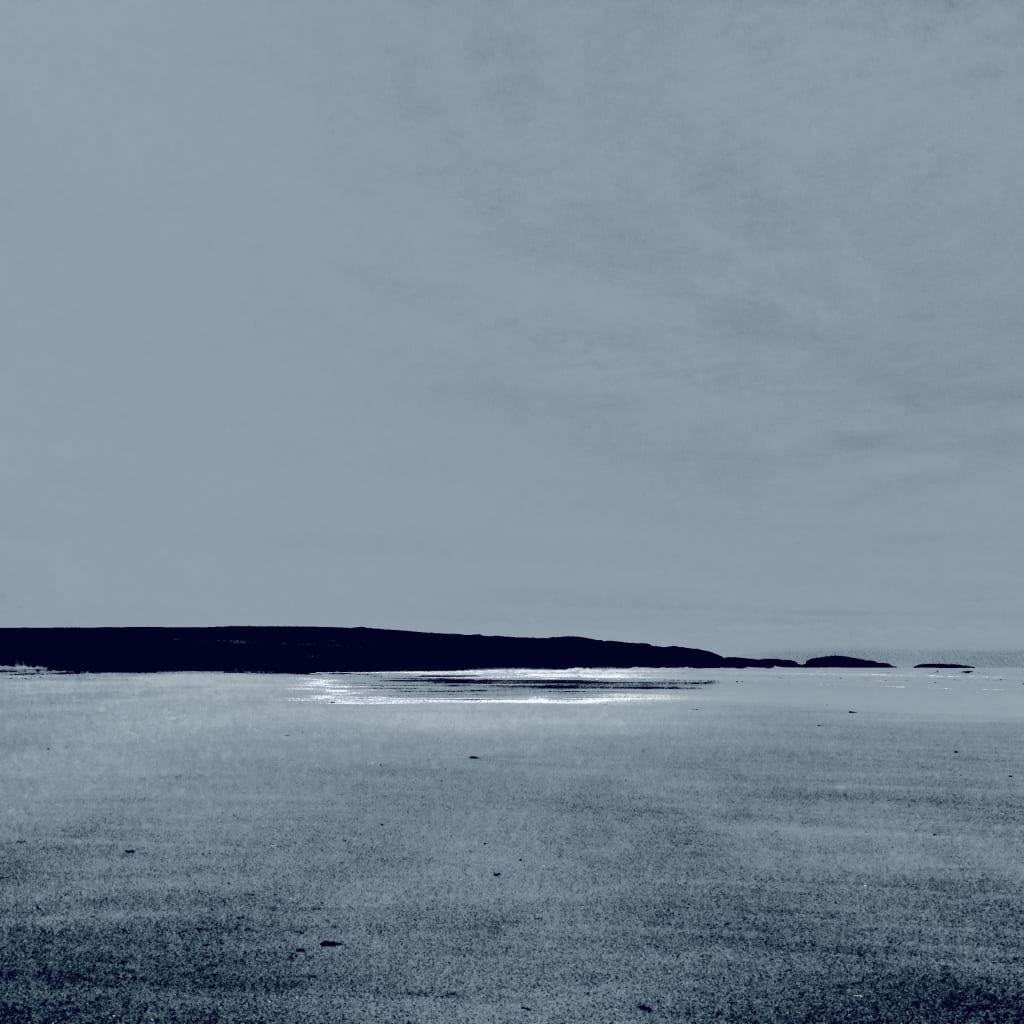
The shore he loved too, for there, upon the boundary line between the two mediums, he could observe her wonderful indifference. She rolled in, and she rolled out, and she did not tame her own moods, and she cast whatever was held in her chambers upon the shore by pure chance with childish caprice. He loved to collect what she cast away, and at present his arms were full of bundles of whitewashed wood, smooth shells, and bleached plastic.
He was nearing the far end of the beach, which visitors seldom reached. This was his favourite part of the whole coastline, and where the most bounty was usually found, on the virgin sands. Today they were particularly white, as a recent storm had caused some sand from further out to be pushed up the shore. Items stood out like buoys upon the tide. The boy had reached the very end of the bay, where a great arch marked the borderline between traversable ground and steep white cliff-face. Lying at the most remote point was a small black object.
The boy approached it with great curiosity, as he could tell immediately the item was complex in a way that could only mean it was designed by human hands, and had retained its original form, a real rarity amongst his usual collection of broken components and pieces of ocean flotsam. This rarity, he realised upon reaching it, was a little black book. The binding was very old, that was clear, the cover made of real leather and the pages, he could feel from their edges, were thick and uneven, as if cut individually. The book was sodden from seawater and the leaves difficult to prize apart, and the boy fancied they were doing their best to hold fast and keep any secrets from being viewed by any unknown eye. The sea breeze billowed in quiet agreement. The only thing to do, the boy resolved, would be to leave the book atop one of the great boulders that coated the far end of the beach, and wait for the sun, which was only just waning after noon and still had a lot of strength in its midsummer state, to tempt the pages apart. All would be revealed, he just needed a bit of patience, he thought. So he set the book upon a boulder and stretched out in the sunshine to warm his green bones.
The sun beat down upon the pair and seabirds wheeled in circles.
After a hazy amount of time, the boy’s eyelids fluttered and opened up on to the blue sky above that was just beginning to house an almost invisible tinge of red. Evening peered over the horizon but did not yet show itself. The boy yawned. And then he remembered the book. He stood up and walked to the boulder. The black rectangle looked as opaque as ever, but he could tell he had been successful in his plan. It had been tricked to relax in the sun, and the pages were dry and loosened. ‘Now I shall have your murky secrets, strange old thing…’ thought the boy. He opened the notebook. Dense, old fashioned, italicised handwriting stared back. He had opened to the middle of the text and begun to read a segment.
I am procuring what I can, in what ways I can, under what guise I must, in the times into which I am thrust, after an unknown end, finishing who knows where, I am without inheriting kin, washing atop these maddening and curing waters, after many event, before many more, without a clue of what is in store for me, ever, after the affair, into the main, I go on much the same…
The whole book was filled with these listings; every part of the paper was made use of. ‘It must have fallen from some long-gone ship’ thought the boy. He looked out into the distance and tried to imagine sails on the horizon, until his eyes de-focused and the sea and the sky blended. He turned to the first page and read aloud, though quietly:
Diary of A. Sailor. Who arrogantly and unapologetically speaks for all sailors before and after him, for we are all kindred and all burdened and bound the same…
Immediately after this declaration begun the streams of thoughts, observations, and philosophical musings that the boy had first come across.
Naturally, he turned now to the last page where, tucked into a makeshift pouch attached to the back cover, washed out pieces of paper were collected. The pouch was deep, so at first he could only see the tops of them. After pausing momentarily, he pulled them out…and froze. Money, old money, tarnished and archaic looking, is what he found he was clutching. They fluttered slightly in the breeze.
That afternoon he spent laying the bills atop the boulder. They marked twenty-thousand dollars in total. They looked so old, he thought, that, though they bore the same UNITED STATES OF AMERICA lettering, the country from which they came must have almost been a different one from that which he now stood upon. The scene was a silent one, and the only audience were the boy’s own thoughts. He returned to the notebook, searching for some explanation, or guidance, and read the final page aloud:
I have oiled this book and the paper enclosed so to keep it from the elements. If ever this reaches dry land, whoever finds it may have it, for to me it has no use. Where am I to spend this paper? And what on? Obliged am I to chase it, or at least appear to do so, but to me it has always been a cloak, not a desire. As a disguise it has served me well, but at last I am free, the least I can do is leave it to one to whom it is of more use, after me. I, of water, not blood, cannot wield it, for I am married to the sea.
The boy closed the book and looked upon the once-white shore that gleamed now like a pink diamond. The rosy sun was almost sunk to the horizon. A small white ship glinted in the final sunlight until, with a green flash, the day fell out of the sky. The boy collected the money, rolled it into a wad and cast it out into the silvery waters. He gathered up his shells and put the notebook in his pocket.
The sea smiled, and the boy began the long walk home.
About the Creator
Kell Tibenham
Hootka!
Keep reading
More stories from writers in Humans and other communities.
Cabin Fever Because of Snow, Sleet, and Freezing Rain That Turned to Icy Roads
What Is Cabin Fever? The short answer is that cabin fever is restlessness from being in a confined area. Cabin fever is the distressing irritability or restlessness experienced when a person or group is stuck at an isolated location or in confined quarters for an extended time. Research shows that prolonged cold, gray skies, and being stuck indoors can trigger mood shifts similar to “winter blues.”
By Margaret Minnicks3 days ago in Humans
Hearts Beyond Borders
In the heart of Mumbai, India, Meera Kapoor navigated the chaotic streets every morning on her scooter. The city was alive with color, noise, and motion — a symphony that thrilled and exhausted her in equal measure. She was a journalist, passionate about uncovering human stories, and she loved how Mumbai forced her to keep moving, to keep observing, to never settle.
By Ahmed aldeabellaa day ago in Humans
Killing him slowly
There’s an intruder in my house again. He stumbles through the door, wet carrier bags in hand. He’s bought me offerings. I show my appreciation, letting him caress my beautiful body. He wants to touch me. I rub myself against his legs. He sighs, dropping the bags. He can’t resist touching me. Running his hand slowly down my spine, I arch my back towards his caress, let out a low purr. It’s what we both need.
By N J Delmas6 days ago in Horror



Comments
There are no comments for this story
Be the first to respond and start the conversation.