
Not About Nigeria
How Trump’s ‘Christian Protection’ Narrative Serves Him First

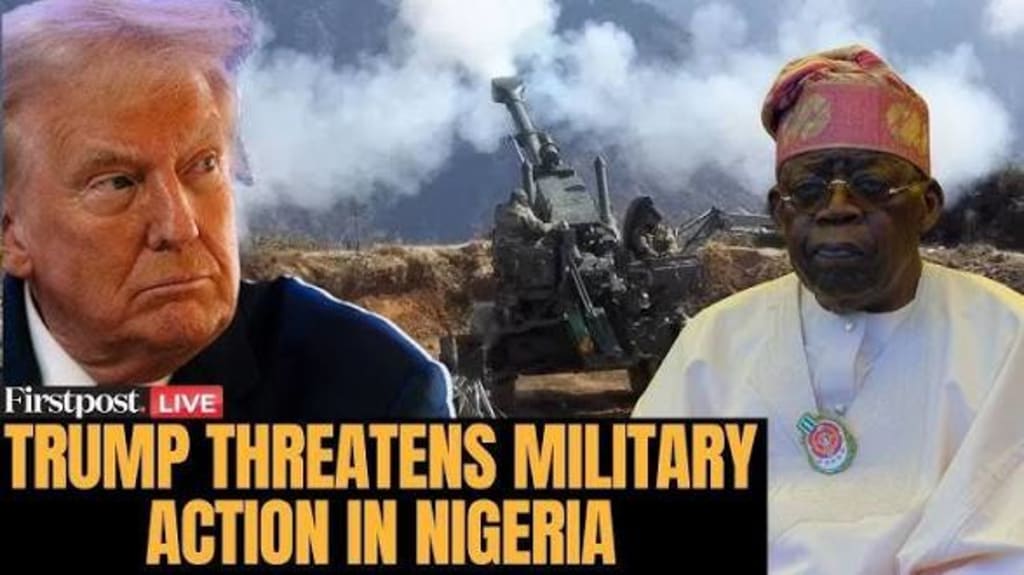
Donald Trump and Nigeria: A Self-Serving Agenda, Not Humanitarian Aid
Introduction
The world recently witnessed former U.S. President Donald Trump making headlines regarding Nigeria, invoking concerns over alleged religious persecution and threatening military action. On the surface, these statements appear to suggest a moral crusade — an intervention meant to protect oppressed populations. However, a deeper historical, political, and strategic analysis reveals a different narrative: Trump’s actions are primarily self-serving. This article argues that Trump’s threats toward Nigeria are motivated not by altruism or global humanitarian responsibility, but by political maneuvering, personal legacy-building, and attempts to appeal to a domestic and international constituency for his own benefit.
---
Historical Context of U.S. Interventions
Throughout history, U.S. foreign interventions have often been cloaked in moralistic language. Examples abound:
1. Iraq and Afghanistan: The stated goals were promoting democracy and eliminating weapons of mass destruction, yet strategic geopolitical and economic interests often took precedence.
2. Libya (2011): Intervention was framed as protecting civilians under the Responsibility to Protect (R2P), but critics argued the outcome favored U.S. strategic interests, especially regarding oil and regional influence.
3. Haiti (multiple interventions): Ostensibly humanitarian, yet interventions often secured U.S. geopolitical and economic footholds.
By positioning Nigeria as a moral crisis, Trump follows this familiar historical pattern — using humanitarian rhetoric to justify actions that are, at their core, politically or personally motivated. This historical lens suggests a need for skepticism regarding the true motives behind U.S. intervention threats.
---
Political Motivations
Trump’s involvement in Nigeria cannot be divorced from domestic political strategy:
1. Appealing to Evangelical Voters: Trump has cultivated a strong base among U.S. evangelical Christians. By framing Nigeria as a country where Christians are allegedly persecuted, he signals moral alignment with this base, reinforcing loyalty and galvanizing support for future political ambitions.
2. Legacy-building: Trump’s presidency and post-presidential influence hinge on his image as a decisive global leader. Threatening action in Nigeria positions him as a defender of persecuted Christians worldwide, enhancing his international reputation for moral leadership — a narrative that serves him more than Nigeria.
3. Distraction from Domestic Issues: Focus on foreign “crises” allows Trump to divert attention from domestic controversies, a technique historically employed by politicians seeking to consolidate influence and maintain media dominance.
The combination of these factors demonstrates that political gain, rather than altruism, is a primary motivator for Trump’s statements about Nigeria.
Strategic and Economic Interests
While humanitarian claims dominate media narratives, strategic and economic considerations cannot be overlooked:
1. Resource Access and Business Ties: Nigeria is a critical player in global oil markets. While Trump’s statements frame the intervention as protective, history suggests that U.S. interest in regions like Nigeria often aligns with resource access, trade agreements, or personal business advantages.
2. Geopolitical Leverage: Threatening action reinforces U.S. influence in West Africa, a region increasingly targeted by rival powers such as China and Russia. Trump’s posture can be read as an attempt to reassert American influence — benefiting U.S. global positioning and potentially enhancing Trump’s image as a tough, strategic leader.
3. Military-industrial incentives: Any escalation or threat of conflict benefits military-industrial stakeholders in the U.S., indirectly bolstering Trump’s political capital among defense advocates and donors.
---
Flawed Framing of the Nigerian Crisis
Trump frames Nigeria’s security issues in simplistic, moralistic terms: Christians versus Muslims. This framing is misleading:
1. Complexity of Nigerian Violence: Violence in Nigeria is multi-faceted, involving terrorist groups, bandits, herder-farmer conflicts, and local political disputes. By presenting it solely as Christian persecution, Trump oversimplifies the issue to fit a narrative that serves his agenda.
2. Ignoring Local Sovereignty: Threats of U.S. military action disregard Nigeria’s sovereignty. Genuine humanitarian concern would prioritize diplomatic collaboration, aid, and local solutions — not coercive threats that risk international backlash.
3. Media Amplification: Trump’s statements generate sensational headlines, both in the U.S. and globally, which can be leveraged to enhance his public profile, reinforcing the argument that personal benefit, not Nigerian welfare, is the goal.
---
Analysis of Statements and Rhetoric
Trump’s rhetoric exhibits classic signs of self-serving political strategy:
1. Grandstanding: Bold threats and moral claims are designed for media coverage and public spectacle. This amplifies his visibility while creating a sense of urgency that benefits his image.
2. Selective Emphasis: Highlighting Christian victims while minimizing other affected groups manipulates perceptions to fit a narrative appealing to a specific audience segment.
3. Conditional Engagement: Trump positions U.S. involvement as contingent on Nigerian compliance, signaling that action is negotiable — emphasizing leverage and power rather than unconditional humanitarian aid.
---
Comparative International Perspective
Looking at global reactions and historical precedents strengthens the argument that Trump’s actions are self-serving:
1. European Union and U.N. Responses: Multilateral organizations often favor diplomatic engagement and evidence-based interventions. Trump’s unilateral approach diverges from these norms, emphasizing personal, political, and strategic interests.
2. Past Humanitarian Claims vs Outcomes: Historical patterns show that U.S. interventions framed as moral obligations often result in political or economic gain rather than genuine humanitarian improvement. Nigeria, in this context, appears to be another case following this pattern.
---
Counterarguments and Refutation
Some may argue that Trump genuinely seeks to protect oppressed populations:
1. Argument: “Trump is acting out of moral obligation.”
Refutation: The selective framing, political timing, and media-focused delivery suggest that moral claims are secondary to self-interest. Genuine humanitarian efforts prioritize sustainable solutions over headlines.
2. Argument: “Intervention could save lives.”
Refutation: True humanitarian concern would first explore multilateral, diplomatic, and local solutions, not unilateral military threats that risk escalation.
3. Argument: “He has global credibility and influence.”
Refutation: Influence can be leveraged for personal gain. Threatening action without coordinated international strategy serves image-building more than practical humanitarian outcomes.
---
Conclusion
A thorough examination of historical patterns, political motivations, strategic interests, and rhetorical framing strongly supports the conclusion: Donald Trump’s engagement with Nigeria is primarily self-serving. While framed as humanitarian intervention, the actions are designed to enhance his political influence, reinforce his image among key voter blocs, and assert leverage on the global stage. Nigeria’s complex socio-political realities, the selective framing of violence, and the overt media spectacle all indicate that the former U.S. president’s threats are driven less by altruism and more by personal benefit.
In assessing global crises, it is imperative to look beyond surface rhetoric. Historical precedent, contextual analysis, and a critical evaluation of political strategy reveal the underlying motivations behind international statements. In the case of Donald Trump and Nigeria, these factors converge to demonstrate that the purported moral crusade is, in fact, a calculated pursuit of self-interest.
About the Creator
Keep reading
More stories from Keli Chris and writers in Humans and other communities.


Comments
There are no comments for this story
Be the first to respond and start the conversation.