

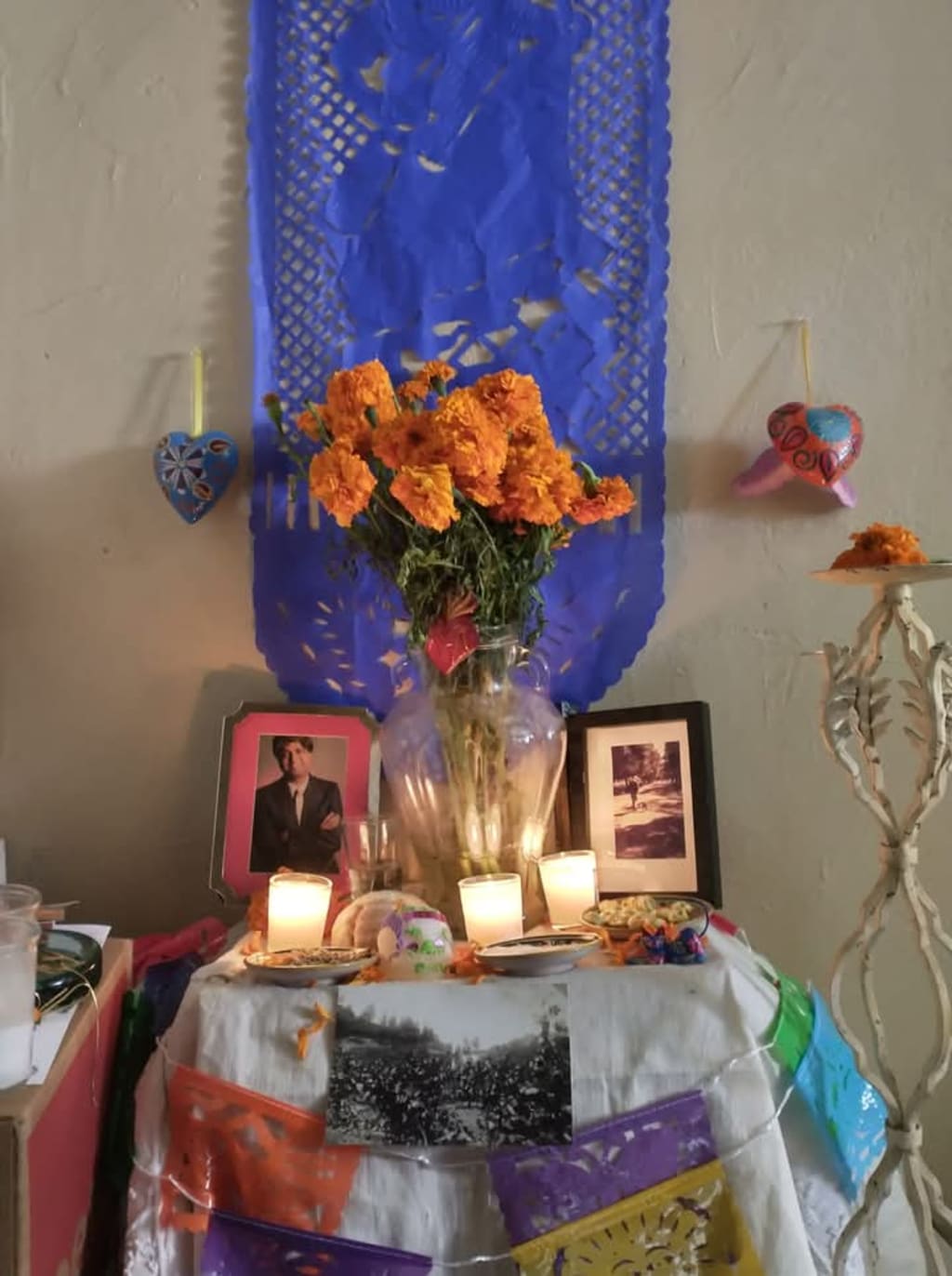
Dias de los Muertos/Days of the Dead (Nov.1 & 2) is a big thing in certain neighborhoods in San Diego- esp. the ones with large Latino communities. It can be a lot of fun. My friends and I like to wander around in a big group through my neighborhood, holding lighted lanterns and candles, and ohh and ah over the beautiful altars/ofrendas set up on porches or in yards. Sometimes, the people living at the house preside over the altar, and they hand out a little tequila and churros, and everyone greets everyone with appreciation and love.
Ofrendas can be set up anywhere. Traditional ofrendas here in the border region include paper picado (cut paper) banners with various designs from skulls to Muertos figures to greetings. Photos of the deceased are displayed on the altar- these can be family members, someone the altar maker wants to honor, or the victims of something. Food is frequently included, like a glass of water special bread and /or the deceased's favorite foods. Flowers are also important- mainly beautiful marigolds, called Cempasuchil (Nahuatl/Aztec) or Mexican marigolds- whose strong scent is said to help guide the dearly departed back.
Candles are also important, and their light also helps guide the dead.
On my Ofrenda, I have pictures of various family members and friends. I get the papel picado banners and sugar skulls from a local shop that specializes in this, and an artist's ceramic skull. I also have a little traditional figure for my cat. I include bread, rice, lentils, chocolate, water, and tequila. I always have candles- and some of those candles are dedicated to friends who are sick, who have a loved one who has passed, or need some care. And, of course, marigolds, which I get from a neighborhood flower seller. Because I live in a heavily Latino neighborhood, I prefer to keep what purchases I can within the community.
My Ofrenda is set up in the house, in the stairwell, and some years it is heavy to do because of things that have happened. So I love to see what beauty my neighbors have made to share with us.
Many of the traditional elements are displayed on the ofrendas in the yards, and it connects us all to hear the stories of the people being honored by the ofrendas. Sometimes, later at night when the walkabout through the neighborhood is finished, as the smoke rises from the candles, you can see wonderous moments of great beauty in the fading light.
Nights Like This-Nov. 2, Dia de los Muertos, San Diego
On nights like this, like Nov. 2, the final night of Dias de los Muertos, encounters between the quick and the dead seem exquisitely possible. The gates to the other world stand open, and centuries elide in the foggy air in the heavily Latino Sherman Heights neighborhood of San Diego.
Suddenly, it is both the years before Cortes and the 2nd night of a November present along the San Diego/Tijuana border as a young conchero, an Aztec dancer, glides through the light fog, his chachayotes, seedpod ankle rattles, marking every step, while the tall pheasant plumage of his headdress gently bobs in the candlelight of the ofrendas laid out with care and pride in every yard he passes.
The flickering lights bear witness to this otherworldly meeting of the ancestors and their progeny who dances in their memory, their blood guiding his steps, their heartbeats echoing in the sound of his chachayotes as he fades into the darkness of the street, proof that neither Cortes nor the Spanish clerics, nor the American experiment fully succeeded in suppressing the Nahua within.
About the Creator
Keep reading
More stories from Rebecca Romani and writers in Humans and other communities.
Whiskey At Dusk
Guess the whiskey was more important to you in the end, wasn’t it? It was more than the well-being of your friends; more vital than showing up to the places you promised you would and could come to; more critical of a matter than fulfilling your damn responsibilities and getting the press off your back.
By Snarky Lisa6 days ago in Humans


Comments
There are no comments for this story
Be the first to respond and start the conversation.