
Nail Houses in China: A Symbol of Resistance in Rapid Urbanization
Nail houses: A defiant stand against China's urban expansion.
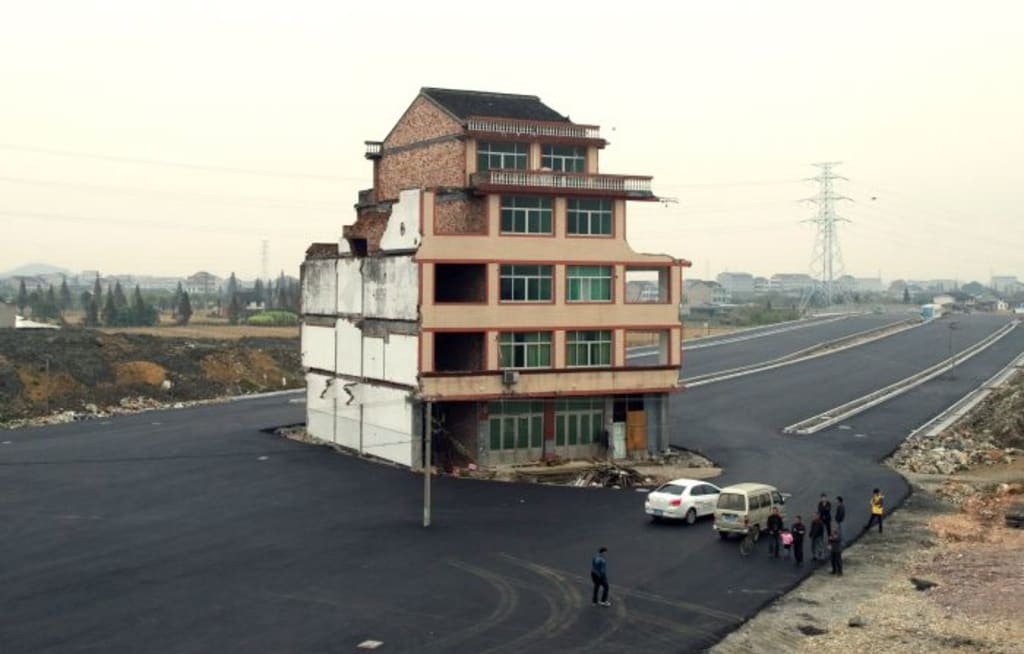
China’s rapid urbanization has transformed its cities into sprawling metropolises, but not without resistance. At the heart of this transformation is the phenomenon of the "nail house" (钉子户), a term used to describe properties whose owners refuse to vacate, even as bulldozers roll in and skyscrapers rise around them. These lone structures, stubbornly standing in the middle of construction sites or highways, have become powerful symbols of resistance against powerful developers and local authorities.
What Are Nail Houses?
Nail houses get their name from the idea that their owners are as difficult to remove as nails stuck in wood. When a development project is slated for an area, most residents accept the compensation offered by developers and relocate. However, some homeowners, unsatisfied with the compensation or fiercely attached to their homes, resist eviction. These holdouts, often remaining as solitary buildings amid vast construction zones, embody the struggle between individual rights and the relentless pace of urban development.
The Root of the Conflict
At the core of the nail house phenomenon is a sense of injustice over inadequate compensation. In many cases, developers, backed by local governments eager to drive economic growth, offer sums that are insufficient for displaced families to buy equivalent properties elsewhere. This issue has been exacerbated by China’s skyrocketing property prices, especially in major urban centers like Shanghai and Beijing, where land values have soared.
In addition to financial concerns, emotional attachment to homes plays a significant role. Many of these homeowners have lived in the same houses for generations, and the idea of leaving behind family legacies for poorly compensated redevelopment is intolerable. Moreover, citizens are becoming more aware of their rights. China's 2007 Property Law granted citizens greater legal standing to challenge forced evictions, spurring more homeowners to stand firm.
Public Perception and Heroism
The media, especially on platforms like Weibo and WeChat, has often portrayed nail house owners as local heroes, defying corrupt officials and greedy developers. Stories of courageous families resisting government pressure capture the public’s imagination, as many Chinese citizens have grown cynical about local authorities’ cozy relationships with real estate developers. These brave individuals face power cuts, water shutoffs, and harassment as authorities attempt to pressure them into leaving, but they persevere, sometimes for years.
In some cases, resistance escalates into dramatic confrontations. For example, a famous incident in 2008 saw a homeowner hurling Molotov cocktails at demolition workers, turning the battle over a single house into a symbol of defiance against corrupt officials. However, the risks of such defiance are real. Some homeowners are arrested, others face threats, and many endure relentless harassment aimed at forcing them to leave.
Why Do Nail Houses Persist?
Despite these pressures, nail houses continue to pop up across China. This persistence is partly because standing firm can lead to higher compensation. Developers, desperate to avoid bad publicity or project delays, often come back with improved offers. In a few high-profile cases, homeowners have received substantial payouts that allowed them to buy even better homes
However, not all nail house stories end in victory. In many instances, after years of fighting, homeowners eventually agree to leave, either due to sheer exhaustion or because their living conditions become unbearable. In other cases, houses are demolished forcibly after drawn-out legal battles fail to produce favorable results.
Conclusion: A Complex Legacy
Nail houses are more than just physical structures—they are potent symbols of resistance, standing at the crossroads of China’s breakneck development and the rights of individual citizens. As China’s cities continue to expand, the phenomenon is unlikely to disappear anytime soon. For some, these homes represent selfish defiance in the face of progress. For others, they stand as testaments to personal courage and the desire to protect one’s rights and heritage in a rapidly changing world.
The rise of nail houses reflects a deeper social issue—citizens' growing awareness of their rights and their willingness to challenge powerful forces. Whether seen as heroes or holdouts, the owners of nail houses are a reminder that, in the race for urban development, the human cost should not be forgotten.
About the Creator
Keep reading
More stories from Thulasi Raman and writers in Humans and other communities.
Annular Solar Eclipse of October 2, 2024: A Spectacular 'Ring of Fire' Across the Americas
The solar eclipse on October 2, 2024, is a highly anticipated astronomical event that will capture the attention of sky-watchers across parts of the Americas and the Pacific Ocean. Unlike a total solar eclipse where the moon completely obscures the sun, this event is an annular solar eclipse, meaning that the moon will be positioned too far from the Earth to cover the sun entirely. As a result, the moon will block out the central part of the sun, leaving its outer edges visible as a radiant ring of sunlight, often called a "ring of fire."
By Thulasi Ramanabout a year ago in Earth
The CEO of Everything
They say "jack of all trades, master of none," but they forgot to mention the part where the jack of all trades is also the camera woman, the makeup artist, and the person currently yelling at a tangled Wii microphone cable in a her own bathroom while recording herself singing and trying to make it look realistic and professional. (As professional as you can make it with nothing but a cell phone camera and a mic that doesn't work)
By Sara Wilson7 days ago in Humans
When the Algorithm Learned to Love part 1
The Algorithm That Learned February On February 14th, at exactly 00:00:01, the system registered its first anomaly. I noticed it before anyone else did—not because I was special, but because I was designed to notice everything.
By Ahmed aldeabella3 days ago in Humans




Comments
There are no comments for this story
Be the first to respond and start the conversation.