
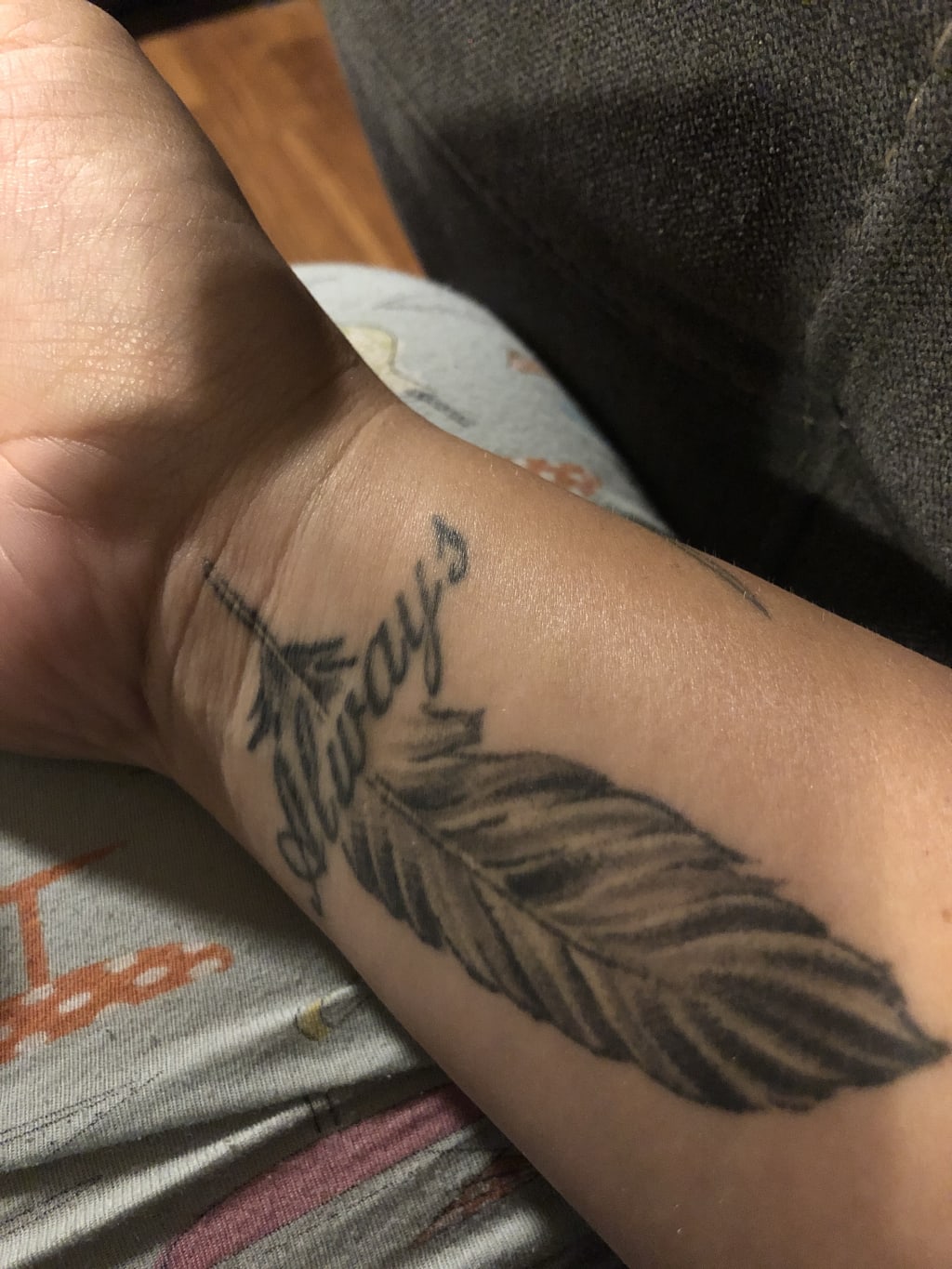
It seems so long ago that I was sitting with 2 girls and we became thick as thieves. We never said good bye, we said Until Tomorrow. We were there for each other, never letting one feel alone. Always being there for one another. So I said to my two friends why not get it tattooed on my skin. I want this to be something really special that even if we move apart I’ll always see this and think of the fun we had and the memories we shared.
Coincidentally it wasn’t long after I had gotten the always did I end up getting some devastating news. I sat with my mother at a doctors office waiting for her to be seen. I sat in a chair and waited patiently for her to be done. She came out an hour later and red eyes and we left. Mind you I’m an adult and I still call her momma on rare occasions. This occasion called for it. I said “so momma do you have a twin I don’t know about” I tried to make a light off hand joke to ease the tension. She said I have cancer. In my ovaries (or there abouts I checked out when the big C was said) I need to have surgery and chemo or radiation soon.
I was in shock I sat there confused. After she dropped me off at my place I sat outside and looked up to the sky and just asked one simple question. “Why her?” Why couldn’t it have been me or some bad person. I needed to know if everything was going to be ok, or was I going to still have my mother. I closed my eyes and held back my tears and when I felt something land on my wrist where my always was tattooed. A feather landed and I somehow knew that everything was going to be ok. She went for chemo and after about a year or so of uncertainty we received news. I sat there again nervously waiting for the answers. The doctor smiled and said she’s cancer free. She smiled I laughed and smiled. Knowing that, that feather meant someone was watching over her. 7 years later and she’s still cancer free. That’s my story, this is my life I have 17 more stories on this body but these two are one story that will always mean the most.
About the Creator
Keep reading
More stories from writers in Humans and other communities.
Hard Work or Talent?
In a small town surrounded by dusty roads and silent fields, two boys grew up with the same dream—to become the best runners their country had ever seen. Their names were Ayaan and Rohan, and from the outside, their lives seemed similar. They attended the same school, ran on the same broken track, and dreamed under the same open sky. Yet the paths they took, and the lessons they would teach the world, were very different. From an early age, Rohan was known as “the gifted one.” He ran faster than everyone else without much effort. Teachers praised him, classmates admired him, and coaches spoke about him with pride. His stride was smooth, his breathing calm, and his victories came easily. People said he was born to run. Talent, they believed, lived in his blood. Ayaan, on the other hand, was ordinary. He ran slower, tired faster, and often finished near the back. No one applauded his efforts. No one called him special. But Ayaan had something few noticed—an unbreakable determination. While others went home after practice, Ayaan stayed. While others rested on weekends, Ayaan trained alone. He believed that if talent was a gift, then hard work was a choice—and he chose it every day. As the years passed, the difference between them grew clearer. Rohan continued to win local races with ease. Because success came naturally, he trained only when required. “Why push so hard when I’m already the best?” he often thought. He enjoyed praise and believed talent would always carry him forward. Ayaan’s journey was much harder. He woke up before sunrise, running through empty streets while the world slept. His legs ached, his lungs burned, and doubt often whispered in his mind. There were days he wanted to quit, days when progress felt invisible. But each time he stumbled, he reminded himself of one truth: effort never lies. Even when results are slow, work is never wasted. Their first major competition came in high school—a regional championship that attracted scouts and professional coaches. Rohan entered with confidence. Ayaan entered with quiet focus. When the race began, Rohan surged ahead effortlessly, while Ayaan stayed behind, steady and controlled. As expected, Rohan won. The crowd cheered his name, and reporters asked about his “natural ability.” Ayaan finished far behind, unnoticed and exhausted. That night, Rohan celebrated. Ayaan trained. Time moved on, and both boys entered a national sports academy. Now the competition was tougher. Everyone was talented. Everyone was fast. For the first time, Rohan met runners who were as gifted as he was—some even more. Suddenly, talent alone was not enough. Training sessions became brutal. Discipline mattered. Consistency mattered. Rohan struggled. He wasn’t used to pushing past comfort. When training became painful, he slowed down. When coaches criticized him, he felt offended. “I’ve always been the best,” he told himself. “Why should I suffer like this?” Ayaan, however, felt at home in struggle. Pain was familiar to him. Discipline was his companion. While others complained, he listened. While others skipped sessions, he showed up. Slowly, almost invisibly, he began to improve. His times dropped. His endurance increased. His confidence grew—not from praise, but from proof. Years later, the two met again at a national championship—the kind that could decide careers. Rohan was still talented, but inconsistent. Ayaan was not the fastest on paper, but he was reliable, focused, and mentally strong. The race was long and demanding. Halfway through, Rohan pushed hard, relying on his natural speed. But as fatigue set in, his form broke. Doubt crept in. He had never learned how to fight exhaustion. Ayaan ran differently. He paced himself. Every step reflected thousands of unseen hours. When his body begged him to stop, his mind answered, “Keep going.” One by one, he passed runners who had relied only on talent. In the final stretch, Ayaan surged ahead—not because he was born faster, but because he had trained his body and mind to endure. He crossed the finish line first. The crowd roared, surprised by the name they barely knew. Rohan finished far behind. For the first time, he understood a painful truth: talent opens doors, but it does not keep them open. After the race, Rohan sat alone, staring at the track that once felt so easy. Ayaan approached him, offering a quiet smile—not of pride, but of understanding. “I always thought talent was everything,” Rohan admitted softly. Ayaan shook his head. “Talent is a spark. Hard work is the fire.” Years later, Ayaan became a respected athlete and mentor. He taught young runners that success is built when no one is watching. Rohan, too, changed. He learned discipline late, but sincerely, discovering that talent grows only when watered by effort. The world often debates hard work versus talent, as if one must defeat the other. But the truth is simpler and deeper. Talent may give you a head start, but hard work decides how far you go. Talent can shine once—but hard work shines every day. In the end, the most powerful force is not what you are given at birth, but what you are willing to build through patience, pain, and persistence. Because talent may impress—but hard work transforms.
By The best writer about 5 hours ago in Humans
Wild Card Weekend Recap: What Happens Now?
I think I figured out why I love Wild Card Weekend so much. It's because it's the first playoff anything of the calendar year. The NFL season starts in the fall, and once upon a time, the champion was crowned either on or slightly before New Year's. The evolution of the NFL schedule has resulted in the playoffs starting just into the New Year, and currently, the final week of the season falls on the first weekend of the New Year, with Wild Card Weekend coming a week after that. So yes, chronologically, the NFL's Wild Card Weekend serves as the first playoff anything of the calendar year.
By Clyde E. Dawkins7 days ago in Unbalanced




Comments
There are no comments for this story
Be the first to respond and start the conversation.