
Mesoamerican Landscape
Archeological Temple Sites

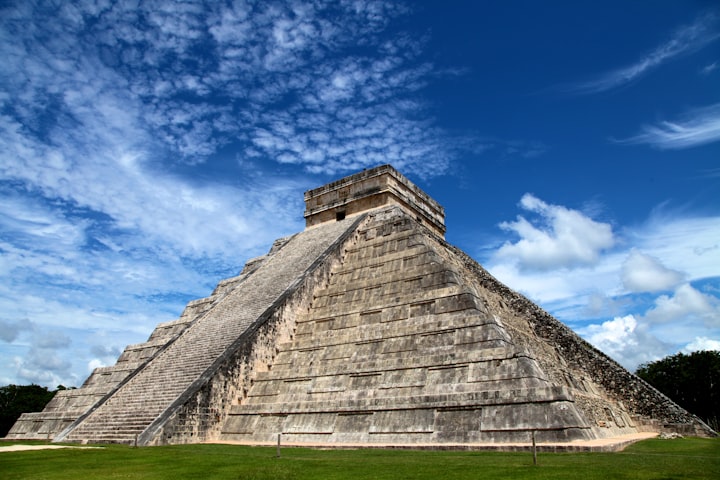
The Maya, Temple of the Warriors, Chichen Itza, Mexico, c. 800-1000 CE

The Temple of the Warriors is a structure 40 feet high and 133 feet wide. This structure features rows of columns carved with figures of warriors in low relief. These columns located in the front of the Temple of the Warriors were made from stone. These columns, evenly spaced, allowed for warriors to stand rank and file during specific rituals and processionals. The Temple of the Warriors is approached by a broad stairway with a plain, stepped ramp on either side, and each ramp has figures of standard-bearers to hold flags.

On the top, were serpent columns which had S-shaped supported wooden lintels (now gone) above the doorways. Carved warriors were not isolated to Chichen Itza, as seen in Tula, Hidalgo, Mexico.
Tula/Toltec, “Atlanteans,” Pyramid B, Tula, Hidalgo, Mexico, 10th-13th centuries BCE, Teopantecuanitlan, Guerrero, Mexico
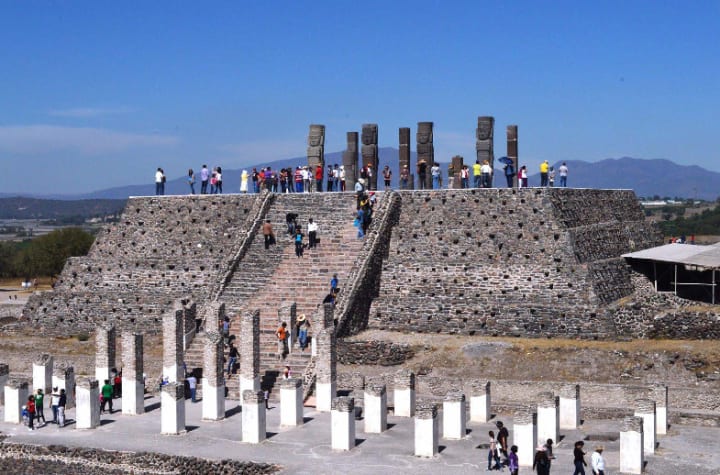
Tula is a Mesoamerican archeological site, which was an important regional center that reached its height as the capital of the Toltec Empire between the fall of Teotihuacan and the rise of Tenochtitlan. Like the Mayan culture in Chichen Itza, the Toltec carved basalt columns that measured approximately 11 1/2 feet in height depicting warriors that have been referred to as the "Atlanteans."
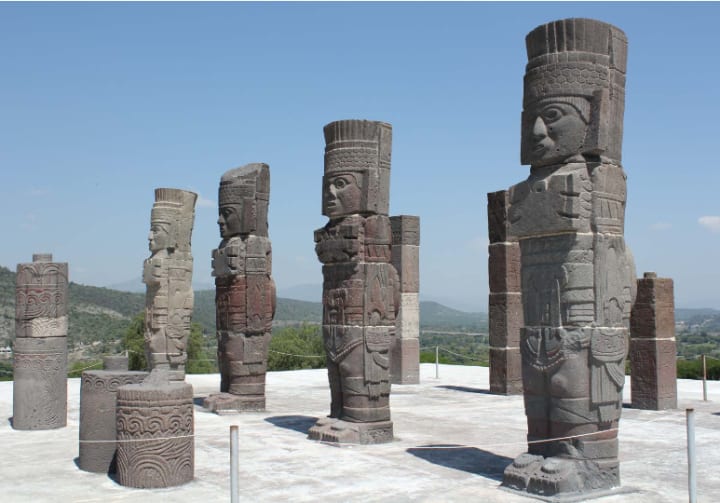
These warriors are a part of the Pyramid of Quetzalcoatl. The pyramid features four basalt columns carved in the shape of Toltec warriors by placing them on top of the Pyramid of Quetzalcoatl. In the Toltec Empire, the "Atlanteans" were displayed in two ways: World Bearers or Warriors. The carved "Atlanteans" as World Bearers were displayed with their arms up supporting the base of the temple, whereas, the Warriors, as depicted at Pyramid B in Tulsa, Hidalgo, México, were carved with their arms at their sides holding weapons, such as swords. In both cases, the carved warriors found at Chichen Itza and Tula, the warriors served the purpose of protection and a show of power and strength, similar to the Olmec Colossal Heads originally found in San Lorenzo. However, the Olmec Colossal Heads were not generally associated with temples like the warriors of Tula and Chichen Itza. Temples are a more consistent theme throughout Mesoamerica and South America; as seen in Machu Picchu, Peru.
Koricancha (Coricancha), (Temple of the Sun), Machu Picchu, Peru, 15th Century

Machu Picchu, Peru features the Koricancha (Coricancha), (Temple of the Sun) and the site has been designated a World Heritage site. This location has been under the protection of UNESCO; stipulating preservation methods to include tourism practices. This site is incredibly delicate and is easily damaged. Over the years, there has been a struggle between the Peruvian government and UNESCO, where the government is seeking increased tourism by building another airport close to this site and UNESCO's restrictions on the number of tourists permitted to enjoy this sacred space.

Machu Picchu, like other World Heritage sites, is at risk of being closed to the public because too much damage has already occurred. In the interest of increasing tourism (which means increased capital), the Peruvian government is risking the preservation of such sites as Machu Picchu and "Chinchero, the historic village in the Sacred Valley, near the town of Cusco." The persistence and unwillingness of the government to acquiesce to the requirements laid down for World Heritage Sites are alarming. If tourism increases as much as they are projecting, Machu Picchu and Chinchero may be closed to the public, and limited to archaeological studies will be closely monitored. Another temple designated a World Heritage site is located in Chichen Itza across from the Temple of the Warriors.

The Mayan, Castillo, located in Chichen Itza, Mexico, is an incredible edifice featuring the serpent imagery found throughout Mesoamerica, South America, and has also been depicted across the land as far as British Columbia. The orientation of this sacred World Heritage site is aligned astronomically to enhance the serpent imagery twice a year. Like the temple found in modern-day Mexico City, this temple has a smaller temple/sanctuary that was built with a plaza. Later the plaza and temple were covered by the outer structure that tourists love to see.

Like Machu Picchu, this site has limited exposure, especially the inner temple, so that the restoration and preservation efforts may last. Only specialists are permitted to enter the inner temple. Within this sanctuary, there are sculptures that include a Chacmool and Jaguar Throne. Much like the warrior sculptures among the Mayan and Toltec and the serpent imagery found throughout Mesoamerica, the Chacmool and Jaguar imagery appear throughout the southern continent, indicating a central theme and possibly cultural interactions among the various peoples and empires.
About the Creator
Rebecca A Hyde Gonzales
I love to write. I have a deep love for words and language; a budding philologist (a late bloomer according to my father). I have been fascinated with the construction of sentences and how meaning is derived from the order of words.
Keep reading
More stories from Rebecca A Hyde Gonzales and writers in Humans and other communities.
Art of the Ancient Americas
The Olmec, Colossal Head #1, c. 1200-900 BCE, San Lorenzo, Gulf Coast, Mexico The Olmec were the first major civilization in Mexico. They lived in the tropical lowlands on the Gulf of Mexico in the present-day Mexican states of Veracruz and Tabasco. The name Olmec is a Nahuatl (the Aztec language) word; it means the rubber people. In formally analyzing Colossal Head #1, we will concentrate on the physical attributes of this sculpture; identifying and analyzing imagery and symbolic features.
By Rebecca A Hyde Gonzales4 years ago in Humans
I am dead
I am dead. I haven’t always been dead. I was born alive to zombie parents but I slowly became dead once I was a little older. My zombie parents raised me as their own kind even when I wailed, ate, slept and carried on as a human. Zombie-kind was always good to me because of how I was protected by others. By this structure of zombie-run society, I was able to create my own identity and be free to express myself in any way I choose.
By Melissa Ingoldsby4 days ago in Humans
A Knight of the Seven Kingdoms Series Review (Season 1)
As one of the biggest properties in fantasy, A Song of Ice and Fire remains immensely popular with audiences. After reaching far into the past with House of the Dragon, a second spin-off was on the cards. A Knight of the Seven Kingdoms serves up a bite-sized slice of action and drama, but it still claims a spot among the best small-screen titles.
By Robert Cain3 days ago in Geeks



Comments
There are no comments for this story
Be the first to respond and start the conversation.