
Malala Yousafzai and the Nobel Peace Prize
Nobel Peace Prize 2014

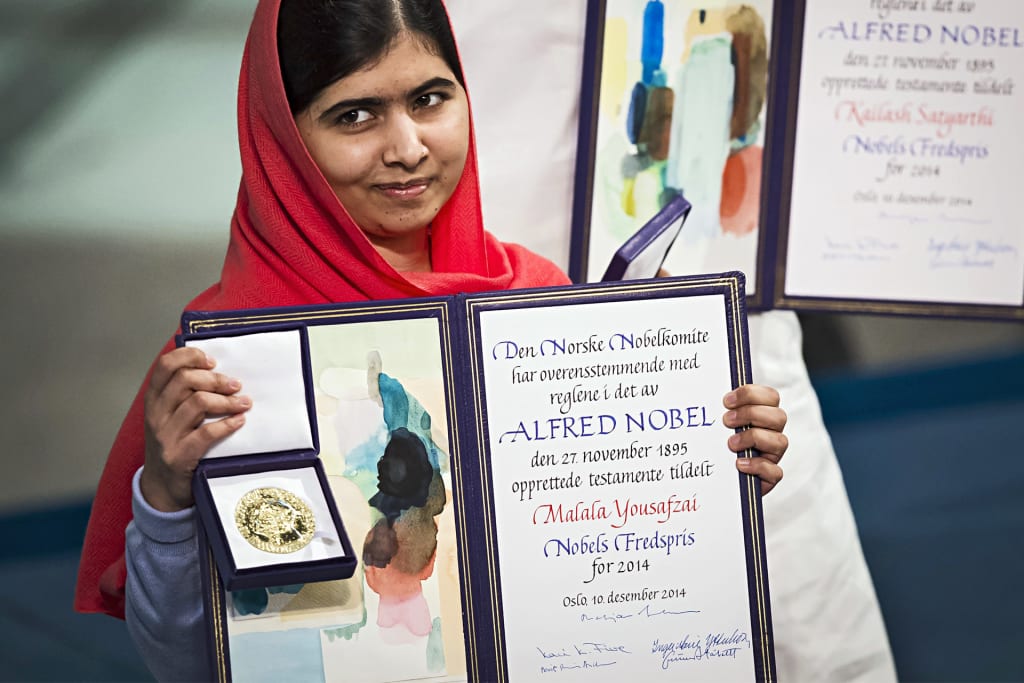
Malala Yousafzai, a young girl from Pakistan’s Swat Valley, became a global symbol of courage, education, and peace. She is best known for standing up against the Taliban to defend girls’ right to education. Her struggle and bravery not only inspired millions around the world but also earned her the Nobel Peace Prize in 2014, making her the youngest Nobel laureate in history. Malala’s story shows how one person’s voice can change the course of history and give hope to countless others.
---
Early Life and Background
Malala Yousafzai was born on July 12, 1997, in Mingora, Swat Valley, Pakistan. Her father, Ziauddin Yousafzai, was a teacher and an education activist who ran a school for girls. He encouraged Malala to pursue her education and express her thoughts freely. Growing up in an environment that valued learning, Malala developed a deep love for books and knowledge from an early age.
However, the peaceful Swat Valley changed dramatically when the Taliban, a militant extremist group, took control of the region in 2008–2009. They imposed strict Islamic laws and banned girls from attending school. Many schools were destroyed, and fear spread across the valley. But Malala refused to remain silent. Even as a child, she believed education was every child’s right.
---
Malala’s Activism and the Attack
In 2009, at the age of 11, Malala began writing a blog for BBC Urdu under a fake name, “Gul Makai.” Through her writings, she described the hardships faced by her and other girls living under Taliban rule and expressed her determination to continue studying despite the dangers. Her words gained attention nationally and internationally.
Malala soon became a well-known voice for girls’ education. However, her activism made her a target. On October 9, 2012, while returning home from school, she was shot in the head by a Taliban gunman who wanted to silence her. The attack shocked the entire world. Fortunately, Malala survived after being airlifted to Birmingham, United Kingdom, for advanced medical treatment.
Her recovery was nothing short of miraculous. Instead of being afraid, Malala emerged stronger and more determined to continue her mission. She once said,
> “They thought the bullets would silence us, but they failed. Weakness, fear, and hopelessness died. Strength, power, and courage were born.”
---
The Nobel Peace Prize
On October 10, 2014, the Norwegian Nobel Committee announced that Malala Yousafzai and Kailash Satyarthi, an Indian child rights activist, had been jointly awarded the Nobel Peace Prize. The official reason for the award was:
> “For their struggle against the suppression of children and young people and for the right of all children to education.”
At just 17 years old, Malala became the youngest-ever Nobel laureate. The award ceremony took place on December 10, 2014, in Oslo, Norway. During her Nobel Lecture, Malala spoke with grace and confidence, dedicating her prize to all the “voiceless children” who long for education and peace. Her words moved the audience and reaffirmed her commitment to making education accessible to every child.
---
Life After the Nobel Prize
Following the Nobel Prize, Malala continued her global campaign for education. She co-founded the Malala Fund, a non-profit organization that supports education projects for girls in developing countries like Pakistan, Afghanistan, Nigeria, and Kenya. Through this fund, she has helped build schools and provided scholarships for young girls.
In 2013, Malala published her autobiography titled “I Am Malala: The Girl Who Stood Up for Education and Was Shot by the Taliban.” The book became an international bestseller and inspired millions worldwide. She also addressed the United Nations, where she emphasized the power of education by saying,
> “One child, one teacher, one book, and one pen can change the world.”
In 2020, Malala graduated from Oxford University, United Kingdom, with a degree in Philosophy, Politics, and Economics (PPE) — fulfilling her dream of completing her education.
---
Legacy and Impact
Malala Yousafzai’s life is a story of incredible courage and perseverance. Despite facing violence and threats, she chose peace over revenge and education over fear. Her journey has inspired countless people, especially young girls, to pursue education and stand up for their rights. She remains a powerful symbol of hope, equality, and the belief that education is the most powerful weapon to change the world.
Through her activism, Malala continues to remind the world that age, gender, or background should never limit a person’s ability to make a difference. Her legacy will live on as a shining example of bravery, compassion, and the transformative power of education.
About the Creator
Day 4 of Quitting
If this is how sobriety feels, maybe it’s better to go through life a little buzzed… this, along with other hits like, I want to kill myself, I wish I was dead, and I’m going to throw myself off a bridge have been the only thoughts on rotation these past few days. I promise myself that if, in a month, I still feel like this (‘this’ meaning despondent, full of rage, and simultaneously numb) I can go back to smoking. Until mid-February though? Nicotine is off the table.
By sleepy drafts5 days ago in Longevity


Comments
There are no comments for this story
Be the first to respond and start the conversation.