
Mad As Hatters, Smart As Whips
Half a Dozen Crazy Scientists the World Owes a Thank-You

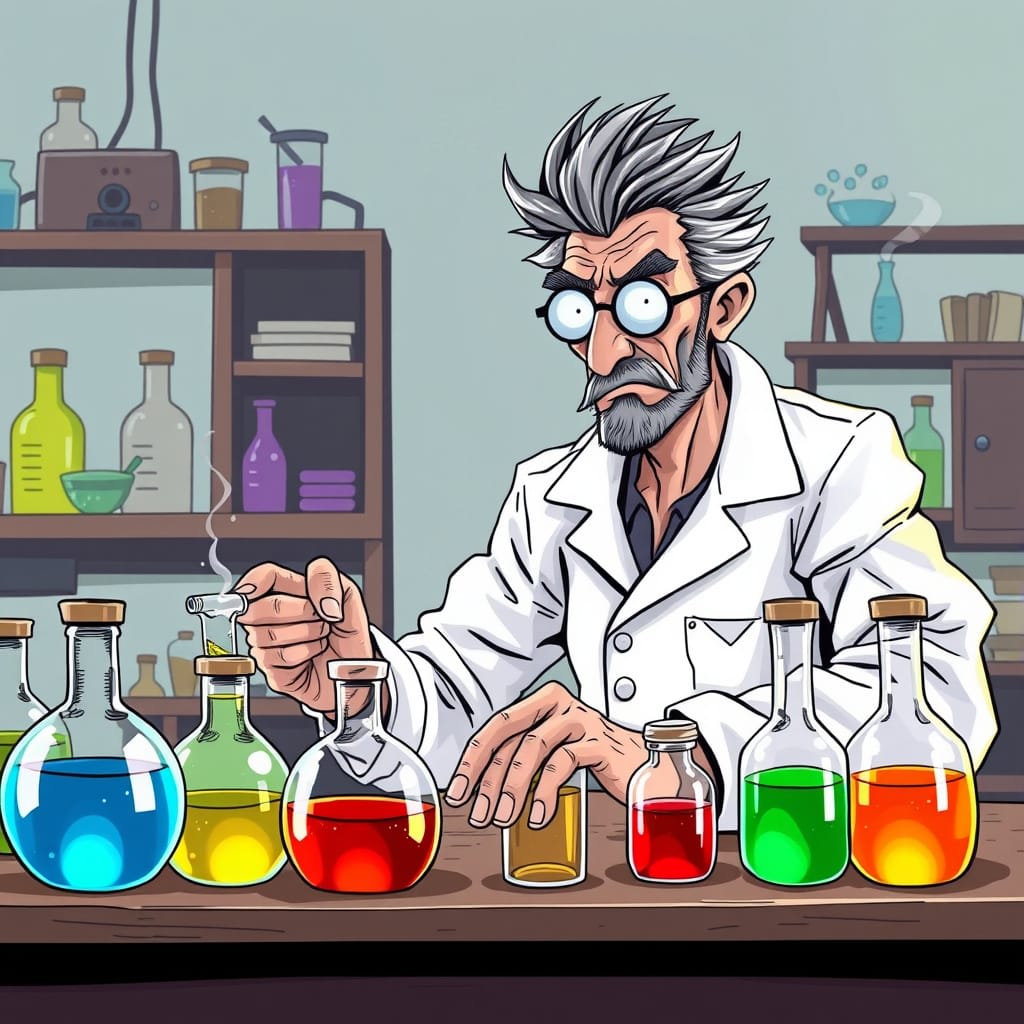
When I think of mad scientists, Dr. Jekyll and Mr. Hyde, or Frankenstein, they immediately come to mind. The world needs mad scientists. They stretch the boundaries by asking, "What if?" and pursuing the answer with what seems to be mad experiments.
Traditional scientists often seem methodical and, yes, a bit dorky. They become so engrossed in their work that they forget about the real world. Many scientific discoveries come from careful planning and years of hard work. I spent eleven years researching many things. I looked into makeup brushes, koala poo, sheep's wool, and flies.
History showcases scientists who ran daring experiments or suggested bold ideas based on intuition. They didn't lack planning. Their final experiments or "mad" actions would "shock the pants off a kangaroo," as we say in Australia.
Here are six crazy scientists to whom the world owes a big thank-you.
1. Edward Jenner
Jenner was a British doctor who developed the world's first vaccine for smallpox. Known as the "Angel of Death," it is no longer familiar these days. They reported the last case in 1977. Researchers estimate it killed 300 to 500 million people in the 20th century.
It is the only disease that humanity has successfully eradicated so far. Jenner was an English doctor. People thought he was mad for his harsh methods. He used pus from a smallpox blister to create a cure.
A brilliant experiment with no moral inhibitions. Jenner's vision resulted in a pleasing outcome. He did not have extensive knowledge of viruses. Without the moral inhibitions to prevent him, he performed his experiment. This led to an effective vaccine against a deadly disease. It also opened the door for other vaccines. These vaccines have saved millions from serious and deadly diseases.
The words "Vaccination" and "Vaccine" come from the Latin word "Vacca," which means cow. This honors Jenner's work.
2. Isaac Newton
Newton is one of the legendary scientists of all time. He was seen as eccentric and showed many signs of what we now call bipolar disorder.
He is best known for his work on gravitation and the famous story of the apple falling from a tree. He spent long spells staring at the sun. He came up with a brilliant idea to stare at the sun and then poke his eyeball with a bodkin - a large needle - to test how it affected his vision. (Now that is crazy!)
Newton, like other great achievers and thinkers, slept for just two to four hours a day. This group includes inventors like Nikola Tesla and Thomas Edison. It also features leaders such as Winston Churchill and Thomas Jefferson.
3. Evan Kane
Kane was an American surgeon in Pennsylvania, USA. As the Head of Surgery, he felt the weight of some patients' suffering. Many could not have surgery due to high anesthesia risks.
He wanted to prove that a local anaesthetic was as good as, but safer than, general anaesthetics. So, at a time when he had acute appendicitis, he performed an appendectomy on himself. Propped up on an operating table with a pillow, he did just that.
Ten years later, he calmly operated on himself again. This time, removing a hernia.
4. Francis Crick
The father of DNA. Everybody knows about DNA; it is the genetic basis of all living creatures. Crick, with his partner James Watson, discovered the structure of DNA.
A brilliant scientist, Crick was also regarded by many as "crazy." After studying DNA, he strongly backed one of the oddest pseudoscientific theories around. The idea of "directed panspermia" suggests that aliens intentionally seeded life on Earth.
Must be something about geneticists. Crick's partner, Watson, also had his crazy theories. He thought Africans were not as intelligent as white people. He also believed that women scientists were more challenging to work with than their male counterparts.
5. Nikola Tesla
Tesla, a Serbian-American inventor and engineer, discovered the rotating magnetic field. This invention is key to most alternating-current machinery. He also developed the three-phase system of electric power transmission. Tesla started his career with Thomas Edison, but they clashed. Then, he set up his own lab, where he invented the Tesla coil, still used in modern-day TVs and radios.
He lit 200 lamps without wires from 40 km (25 miles) away. He also created man-made lightning, making flashes that measured 41 metres (135 feet). At one time, he was certain he had received signals from another planet. Tesla claimed he could split the Earth like an apple. He also said he invented a death ray that could destroy 10,000 airplanes at 400 km (250 miles). (Maybe he wasn't so crazy after all!).
Tesla was obsessive-compulsive. He obsessed over the number three and had an extreme aversion to touching human hair. Worst of all, he believed he had fallen in love with a pigeon, who in turn was deeply in love with him.
Yes, if you are wondering, they named the Tesla motor car after Nikola Tesla.
6. Barry Marshall
I worked as a microbiologist for a drug company in Perth, Australia. They made a product based on Professor Barry Marshall's work. He believed a particular bacterium caused stomach ulcers.
To prove it, he took bacterial samples from a sick patient and drank them in a "brew." Afterward, Marshall became sick with bloating, decreased appetite, and eventual vomiting. His work proved the association and later led to the development of a cure using antibiotics.
The company I worked for made diagnostic kits that detect stomach ulcers. They did this in close partnership with Professor Marshall. He and his colleague, Robin Warren, received the Nobel Prize in 2005.
Many believe Albert Einstein is the ultimate 'mad' scientist, but that's not true. He may look the part, but he isn't seen that way. Eccentric, yes; revolutionary thinker, absolutely.
These six individuals all share a couple of things in common. They have made significant contributions to the world as we know it today. It is hard to imagine how things would be if they had not done so.
Each of them showed behaviors that seemed odd or irrational in their way. Perhaps it's just part of the territory.
There is a hint of craziness in all of us if we look hard enough.
Till next time,
Calvin
About the Creator
Calvin London
I write fiction, non-fiction and poetry about all things weird and wonderful, past and present. Life is full of different things to spark your imagination. All you have to do is embrace it - join me on my journey.
Reader insights
Outstanding
Excellent work. Looking forward to reading more!
Top insights
Excellent storytelling
Original narrative & well developed characters
Expert insights and opinions
Arguments were carefully researched and presented
Eye opening
Niche topic & fresh perspectives
Heartfelt and relatable
The story invoked strong personal emotions
On-point and relevant
Writing reflected the title & theme
Keep reading
More stories from Calvin London and writers in Humans and other communities.



Comments (4)
I’ve learned a few things in your story that I didn’t know. As always your articles and stories are very engaging, Thank you Calvin 😀
I’ve almost heard and read about all of them, especially Newton and Nikola Tesla. I read about Barry Marshall for the first time, truly, they were incredible scientists. Thank you for sharing, sir.
Beautiful so many names you forget ♦️♦️♦️♦️
It’s crazy to think that I’ve only been introduced to Newton, Tesla, and Sir Winston Curchill through my books till now. This was actually really informative for people who’re interested in science … I loved reading Francis Crick here!! 🤝🏼😊😊