
Lost for Words: How Language Decay is Making Us Dumber
Why Fewer Words Mean Fewer Thoughts—and What You Can Do About It


The Disappearance of Thought
Language is vanishing. Grammar erodes, words disappear, and with them, our ability to think critically. As tenses fade—subjunctive, past perfect, conditional—so does our perception of time. The rise of casual speech, the neglect of punctuation, and the rejection of complexity aren’t harmless trends. They signal a deeper crisis: the decline of thought itself.
Brevity masquerades as efficiency. Simplification poses as progress. But when simplification turns into dilution, reasoning, analysis, and expression suffer. Thought is built on language. Weaken language, and thought collapses. Without words, ideas shrink, and critical thinking deteriorates.
The fewer words we use, the fewer thoughts we can form. The fewer tenses we master, the less we understand time. Language decay isn’t just a cultural shift—it’s intellectual erosion.
Simplicity or Stupidity?
Language shapes thought. A broad vocabulary refines ideas. A limited one reduces communication to grunts. Orwell’s 1984 warned us: "But if thought corrupts language, language can also corrupt thought."
Social media, text culture, and voice-to-text apps strip language to its bare bones. Conversations shrink into acronyms. Emojis replace adjectives. Tweets compress thoughts until they snap. The result? People struggle to articulate emotions, defend ideas, or debate meaningfully. Simplification, taken too far, breeds stupidity.
Complexity is not the enemy—ignorance is. When words vanish, so do the subtleties of expression. When nuances disappear, so does our ability to reason. Language is a mirror of intelligence. The richer the language, the sharper the mind.
Tense Matters: Why Time is Disappearing
How do we predict the future without a future tense? How do we discuss hypotheticals without the conditional? Without past, present, and future structures, time itself dissolves into an eternal now. A language without tenses creates a mind without foresight—incapable of learning from the past or planning ahead.
This isn’t just a linguistic issue. It mirrors society’s obsession with instant gratification. Long-term thinking vanishes from politics, economics, and personal choices. People choose short-term pleasure over lasting benefits. Weak language weakens the ability to see beyond the present.
Imagine a world where "I will succeed" becomes "I succeed"—or worse, "I try." The future shrinks, ambition fades. When language loses structure, society follows.
Fewer Words, More Violence
Studies link verbal poverty to aggression. People without words for their emotions lash out instead of articulating their frustrations. Fewer adjectives mean fewer shades of meaning. Fewer verbs mean fewer ways to describe action. The less we express, the less we understand ourselves and others.
Consider the difference between feeling "mad" versus "frustrated," "disappointed," or "resentful." "Mad" is broad and imprecise. The others describe nuance, leading to self-awareness. Emotional intelligence depends on linguistic ability. The more words we have for feelings, the better we manage them.
In work and social settings, poor vocabulary leads to miscommunication. Leaders fail to inspire. Negotiators fail to persuade. People fail to resolve conflicts. Communication is influence. Influence requires words.
When words disappear, conflict escalates. Diplomacy falters. Society becomes reactive, not reflective. Language is civilization’s buffer against chaos.
The War on Complexity
Schools simplify spelling, purge gendered words, and dumb down literature. Social media shrinks conversations to memes. We celebrate simplicity, but complexity drives deep thought. Precision demands structure. Without it, intellectual decay sets in.
Classic literature, once an educational cornerstone, gets replaced with "easy-to-read" versions. Why settle for mental mediocrity? Complexity challenges minds. It sharpens reasoning. A culture that rejects complexity rejects growth.
The war on complexity is a war on intellect. In removing linguistic depth, we remove the ability to engage with big ideas. A dumbed-down vocabulary leads to a dumbed-down society.
The Hidden Dangers of a Dying Language
When language shrinks, reality distorts. Political rhetoric simplifies, making propaganda easier. Marketing slogans manipulate. Critical thinking declines. Without words to challenge, analyze, and reason, manipulation thrives.
News cycles reduce nuanced issues to soundbites. Complex problems demand complex discussions, but society prefers quick fixes. When we can’t articulate our challenges, we can’t solve them.
A robust language is a defense against misinformation. A precise vocabulary dissects lies. Words clarify truth. Without them, deception wins.
The Link Between Language and Innovation
Throughout history, civilizations that advanced linguistically also led in science, philosophy, and art. The Greek language allowed for precise philosophical thought. Latin structured legal and political discourse. The Renaissance flourished with linguistic expansion.
Today, as language contracts, creativity and innovation decline. Businesses rely on jargon instead of clear communication. Scientific discourse is inaccessible due to over-simplification or meaningless buzzwords. When language weakens, problem-solving weakens.
We need complexity. We need depth. Without them, innovation stagnates.
The Social Media Trap: How We’re Losing Depth
Social media encourages brevity at the expense of depth. Platforms reward short, emotionally charged messages over thoughtful discussion. Memes replace arguments. Virality trumps accuracy.
The result? Reduced attention spans. Superficial debates. Outrage instead of dialogue. When everything gets condensed, meaning gets lost. Thought requires time. Language provides structure. Remove both, and all that remains is noise.
Resisting Linguistic Decay
Read Beyond the Algorithm. Social media feeds you what it wants. Seek real books, difficult texts, and opposing views.
Speak with Precision. Avoid vague words. Use strong verbs. Say exactly what you mean.
Write in Full Sentences. Text culture fragments thought. Reclaim structured expression.
Demand More from Education. Schools must challenge students, not dilute learning for convenience.
Defend Grammar. It’s not oppression. It’s structure.
Have Deep Conversations. Move beyond small talk. Discuss philosophy, history, science.
Reject Passive Consumption. Don’t just scroll. Think. Don’t just watch. Question. Don’t just listen. Analyze.
Embrace Difficult Words. Learn new vocabulary. Challenge yourself. Expand your mind.
Resist Linguistic Laziness. Encourage complexity in thought and speech. Push back against dumbing down.
Teach the Next Generation. Pass down the power of language. Raise thinkers, not followers.
Conclusion: The Price of Linguistic Laziness
Language isn’t just communication. It’s thought, identity, and freedom. The more we simplify, the shallower it becomes. In chasing convenience, we risk losing the ability to think deeply. A society that cannot think is easy to control.
Oppressive regimes have always understood this. Control language, control perception. Eliminate complexity, eliminate dissent. Today’s linguistic decline isn’t state-imposed—it’s self-inflicted. But the result is the same: a passive, unthinking population.
To protect thought, protect words. Use them fully. Defend them fiercely. Never let them be taken away.
About the Creator
Alain SUPPINI
I’m Alain — a French critical care anesthesiologist who writes to keep memory alive. Between past and present, medicine and words, I search for what endures.
Keep reading
More stories from Alain SUPPINI and writers in Humans and other communities.
Mastering French Without Losing Your Sanity: A Realistic Guide for Beginners
Learning French can feel like solving a Rubik’s Cube blindfolded. The tricky pronunciation, the never-ending grammar rules, and the surprising exceptions make it seem impossible. But don’t worry—equipping yourself with key expressions and effective strategies can turn frustration into fluency. Let’s simplify French and make learning enjoyable.
By Alain SUPPINIExclusive • 11 months ago
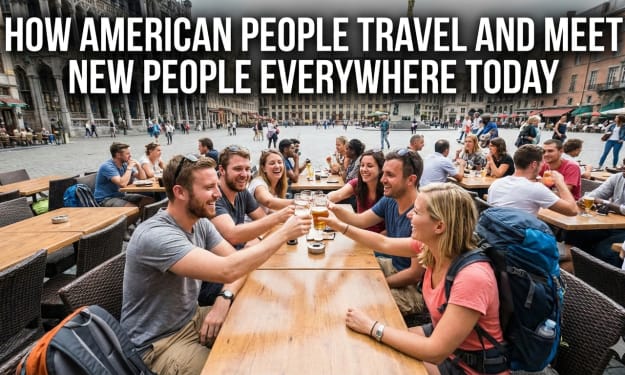
How American People Travel And Meet New People Everywhere Today
The American travelling has transformed in the last 20 years. What used to be based on sightseeing, rest or checking destinations on a list, now becomes more personal and social. Travel is becoming more person orientated today. Americans are not traveling simply to see new places anymore, they are traveling to find new people, to share their stories and to establish cross-cultural, cross-linguistic and cross-border relationships. The yearning to establish meaningful human relationships has been shifted to the center of the travel experience in an era of connectivity, mobility as well as digital communication.
By Tiana Alexandra7 days ago in Humans



Comments (1)
So true love your story ♦️💕♦️