
🌾 “Letters under the Neem Tree”
In a village where silence is safer than love, words still found their way.
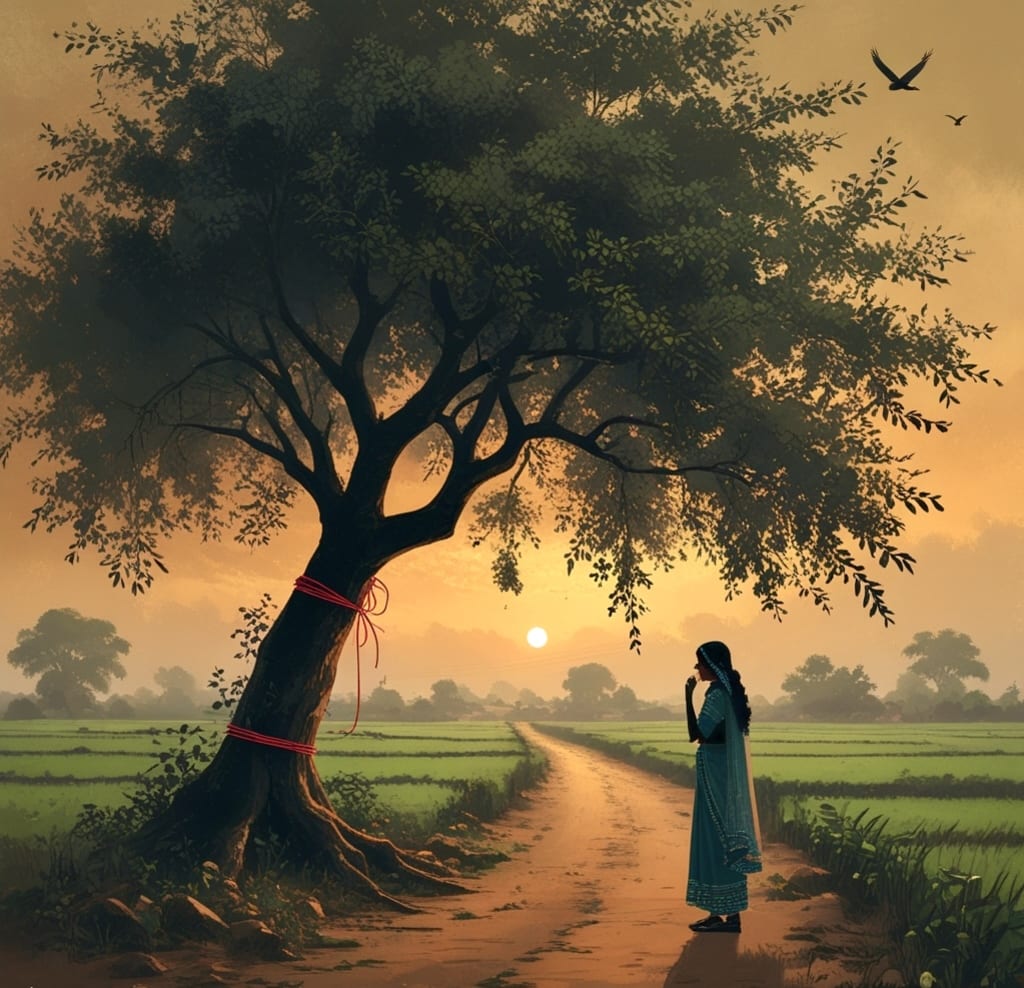
The sun rose slowly over the fields of Kot Meeran, painting them gold. Birds chattered in the neem trees. A soft breeze moved through the sugarcane like whispers, carrying with it the smell of earth still wet from last night’s rain.
For years, Zoya’s mornings had been the same: wake before dawn, tie her dupatta tight, fill clay pots at the well. Yet every morning felt different since she began finding the letters.
They were always there, tucked carefully into the hollow of the old neem tree that stood on the dusty path between her father’s fields and the village square. No name, no signature — just words that felt like light on her skin.
“Your laughter sounds like koel birds at dawn.”
“The color of your bangles stays with me long after the sun sets.”
“When I see you, the whole world feels softer.”
At first, she had ignored them, heart hammering, afraid. But curiosity bloomed where fear had lived. Each letter felt like rain on parched earth.
She began to write back. Nothing bold, just small replies on torn scraps:
“Who are you?”
“Why me?”
“The koel only sings because the world is quiet enough to hear.”
And always, the answer would come the next morning.
Zoya lived in a house of rules: daughters do not speak loudly; daughters do not question fathers; daughters do not fall in love. Her father, Chaudhry Latif, was the village elder. His word was law, heavy as the ancient locks on their doors.
She had no mother to whisper secrets to. Only her younger brother, Haroon, who still thought love was a story for the grown.
Every evening, after the sun dipped behind the fields, she would hear her father’s voice echo from the veranda, reminding her what was expected.
“Our honor is in silence. Remember that.”
But silence was heavy. And letters felt light.
One night, under the stubborn monsoon moon, Zoya heard something new in the neem tree’s rustling leaves. Footsteps. Careful, measured, like someone trying not to be heard.
She stepped closer, her sandals sinking into the soft earth.
A boy stood there, his hand still on the tree’s hollow. In the pale moonlight, she recognized him.
Ayaan.
The quiet boy from the weaver’s family. Always with ink on his fingers. Always looking away when she passed. His father wove cloth for the Chaudhry’s family, but they were still just weavers — respected, yet not equals.
Their eyes met, the silence stretched, as heavy as the humid night.
“It’s you?” she whispered.
Ayaan swallowed. “It’s me.”
She felt her heart stumble, then race ahead. She should have run back home, should have shouted for her father. But instead, she stood rooted like the tree itself.
Over the next weeks, they spoke in stolen moments. Always near the neem, always just a breath apart.
They talked of little things — the smell of wet earth, the warmth of summer mangoes, the lonely silence of village nights.
Ayaan confessed, his voice barely a whisper: “When I saw you first, you were laughing. I thought, if someone could laugh like that, maybe the world isn’t as cruel as it seems.”
Zoya smiled, then quickly hid it. “They’d never allow it, you know.”
“I know,” he said. But hope hung between them like mist.
One humid evening, as the monsoon clouds gathered low, her father found a scrap of paper she had hidden under her pillow.
The next morning, he confronted her. His face, usually carved from stone, burned red with anger.
“This ends now,” he thundered. “A Chaudhry’s daughter and a weaver’s son? Do you want shame for this house?”
Zoya trembled, words stuck like stones in her throat. Her father locked her in her room that night, the iron latch sealing more than wood.
Thunder rolled outside. Rain lashed the fields. And Zoya, eyes wet with more than rain, wrote one last letter.
“I wish we had met in another life. One where neem trees aren’t prisons, and love isn’t whispered in fear.”
She slipped it through her window, praying the wind would carry it to him.
The next morning, the neem tree stood quiet, leaves heavy with rain. No letter waited for her.
That evening, she heard her father’s voice outside. “The weaver’s family left before dawn. Gone.”
Gone.
She felt something inside her break quietly, like a clay pot dropped on wet earth.
Years later, the tree still stands. Village children tie threads around its trunk, praying for wishes they barely understand.
And some nights, when the koel sings, Zoya — now a wife, now a mother — walks past the neem tree and remembers a boy with ink-stained fingers.
❤️ Lesson:
Love can bloom even in places ruled by silence and fear. But in villages where honor weighs more than hearts, love often learns to live quietly — hidden, but never truly gone.
A Story by : Pir Ashfaq Ahmad
About the Creator
Pir Ashfaq Ahmad
The Falcon Rider
Keep reading
More stories from Pir Ashfaq Ahmad and writers in Humans and other communities.
🩸 "The Thirteenth Room"
It started with a floor plan. Evelyn moved into the old Ashcroft building in late October, chasing a job and cheaper rent. The building was strange—tall and narrow, with creaky wood floors and a permanent draft—but it had character. And at night, the halls smelled faintly of lilac, like someone, somewhere, had spilled perfume years ago that never faded.
By Pir Ashfaq Ahmad7 months ago in Horror
Lost and Alone in the French Alps
Looking back, I can trace some of my life’s biggest adventures to a simple action from my sister. She’d introduced me to Tommy (a very long time ago), a colleague of hers, who had overshared his penchant for Italian-looking women, and I ticked that box.
By Chantal Christie Weiss20 days ago in Humans
Trump’s Proposed Credit Card Cap Spotlights Americans’ Debt. Would It Help
Credit card debt in the United States has reached staggering levels, and former President Donald Trump’s latest proposal aims to tackle the issue head-on. According to his plan, banks and credit card companies would face a cap on the interest rates they can charge consumers. At first glance, this sounds like a straightforward solution to a growing problem, but a closer look reveals the complexity of America’s debt landscape and the challenges any policy must navigate to be truly effective. The Debt Dilemma As of late 2025, Americans collectively owe more than $1.2 trillion in credit card debt, a record high. Household debt has steadily risen over the past decade, fueled by stagnant wages, inflation, and the rising cost of essentials such as housing, healthcare, and education. For many, credit cards are no longer a convenience—they’re a lifeline, a way to bridge the gap between income and expenses. Trump’s proposal seeks to limit the annual percentage rates (APRs) that credit card companies can charge. Supporters argue that high interest rates trap consumers in a vicious cycle of debt, where paying off balances becomes nearly impossible. Critics, however, caution that such caps could have unintended consequences, like discouraging banks from issuing credit to higher-risk borrowers, potentially leaving some consumers without access to necessary financial tools. How Would the Cap Work? The proposed plan would implement a maximum APR on all credit card accounts, though the exact percentage has yet to be publicly finalized. The intent is to provide relief to the roughly 40% of American households carrying balances month-to-month, many of whom pay rates exceeding 20% annually. In theory, capping interest rates would reduce the financial burden on these borrowers. A consumer carrying a $5,000 balance with a 25% APR could save hundreds or even thousands of dollars in interest payments over a year if rates were capped at, say, 15%. For families living paycheck to paycheck, this could be the difference between staying afloat and defaulting. Potential Benefits Immediate Relief for Borrowers: Lower interest rates would allow more of each monthly payment to go toward the principal, helping people pay off debt faster. Reduced Financial Stress: For Americans struggling to cover minimum payments, a cap could ease anxiety and improve mental well-being. Consumer Protection: High-interest credit cards disproportionately affect lower-income households, so a cap could make the system fairer. Some economists argue that even a modest reduction in interest rates could have a ripple effect on the broader economy. If consumers spend less on interest and more on goods and services, it could stimulate demand, benefiting businesses and potentially supporting job growth. The Risks and Trade-Offs While the benefits sound compelling, implementing a credit card cap is not without risks: Credit Access Might Shrink: Banks may respond to lower allowable interest rates by tightening lending standards. Those with lower credit scores could find it harder to qualify for cards, leaving them with fewer options to manage expenses. Fees Could Rise: Financial institutions might offset lower interest rates by increasing annual fees, late fees, or other charges. The net effect for consumers could be less favorable than expected. Innovation May Stall: Banks and fintech companies often use interest rates to price risk. Limiting this flexibility could reduce incentives to develop new financial products tailored to consumer needs. These challenges highlight the tension between protecting consumers and maintaining a functional credit system. Any policy must balance relief with sustainability to avoid unintentionally hurting those it aims to help. Why Americans Are Paying Attention Trump’s proposal comes at a politically charged moment. Inflation may have eased slightly, but wages haven’t kept pace with costs, and household debt remains a pressing concern. A recent survey found that nearly 60% of Americans worry about their ability to manage monthly credit card payments. With the midterm elections on the horizon, proposals like this gain traction because they resonate with voters’ everyday struggles. For many Americans, credit card debt is more than just numbers on a statement—it’s a source of stress, a limitation on lifestyle choices, and an obstacle to long-term financial goals. Limiting interest rates could provide tangible relief and signal that policymakers are paying attention to these challenges. Historical Context Interest rate caps are not a new idea. In the 1970s and 1980s, states implemented various usury laws to limit how much lenders could charge. While some measures helped consumers, others inadvertently restricted access to credit. The mixed outcomes underscore the importance of careful implementation and oversight. Modern proposals, including Trump’s, aim to avoid these pitfalls by targeting specific consumer protections while attempting to preserve lending options. How successful this approach will be remains to be seen. Would It Actually Help? Experts suggest that a credit card cap alone will not solve America’s debt problem. While it could provide temporary relief for many, it doesn’t address the underlying issues driving debt growth, such as wage stagnation, high living costs, and insufficient financial education. However, as part of a broader strategy—including financial literacy programs, better consumer protections, and support for savings and emergency funds—it could be an important step. Lower interest rates may prevent people from spiraling into unmanageable debt while giving them breathing room to regain control of their finances. Conclusion Trump’s proposed credit card cap shines a spotlight on a critical issue: Americans are struggling under the weight of mounting debt, and immediate relief could be life-changing for millions. While the plan has potential benefits, it is not a silver bullet. Policymakers must carefully weigh the trade-offs to ensure the solution helps those in need without creating new problems. Ultimately, the conversation sparked by this proposal may be just as valuable as the policy itself. It forces a national discussion on debt, fairness, and financial security—a conversation that affects nearly every household in the country. As Americans navigate a complex financial landscape, thoughtful solutions, whether through interest caps or broader reforms, are essential to creating a more equitable and manageable path toward financial stability.
By Muhammad Hassan3 days ago in Humans
Ludacris and Nelly draw backlash over bookings at MAGA-coded music festival
Ludacris and Nelly headlining a mostly right-wing event is good for them. It’s also great for the genre of hip hop. The two rap veterans have showcased their talents on other stages. Why can’t they perform for mostly MAGA folks and grab that bag?
By Skyler Saunders5 days ago in Beat




Comments
There are no comments for this story
Be the first to respond and start the conversation.