
Layla and Majnun: A Love That Burned Through the Desert
The universe has never experienced such love, nor will it ever again.
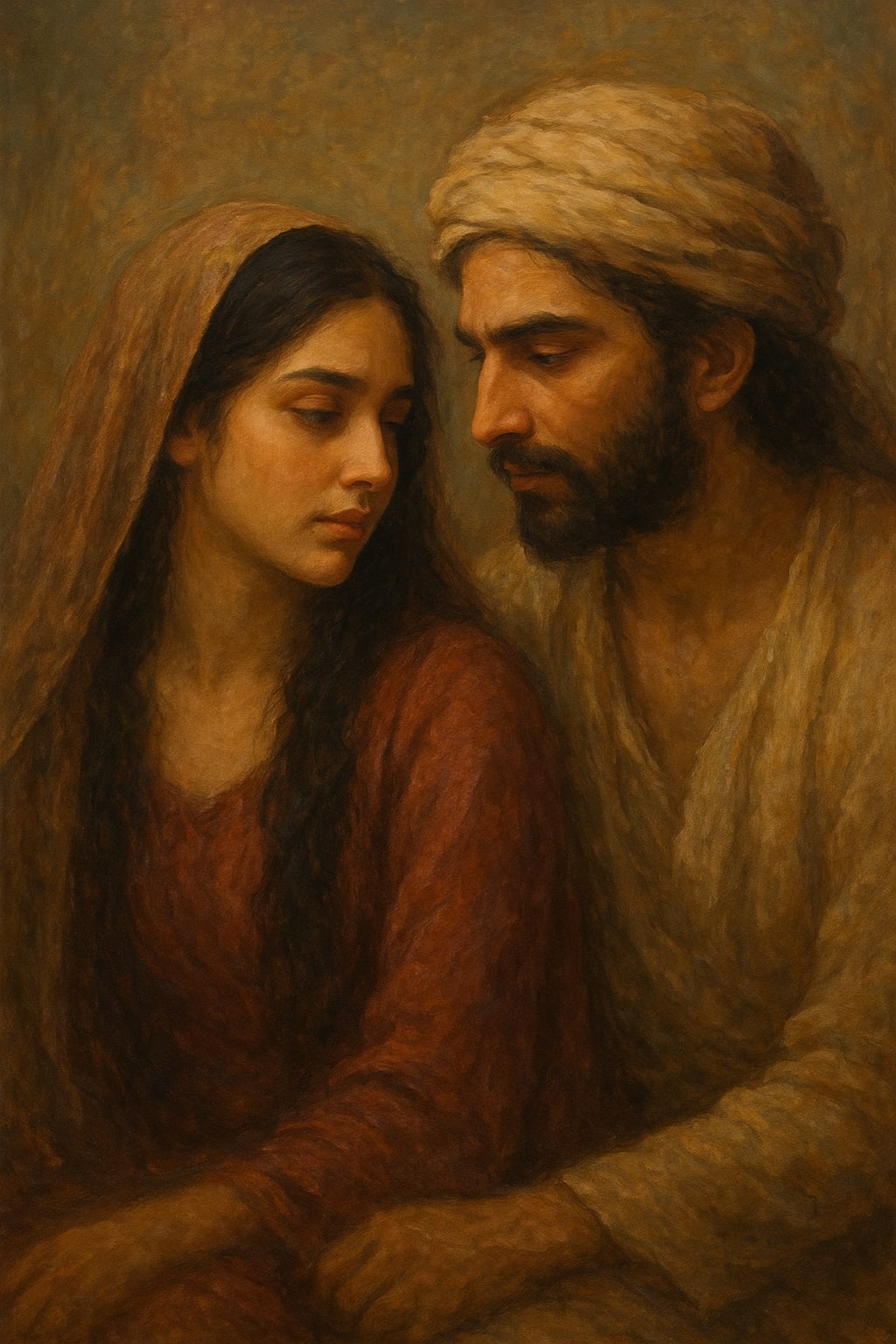
Prologue: The Desert Holds Their Names
The desert has no memory, and yet, it remembers everything.
It remembers the footprints of caravans that vanished centuries ago. It remembers the songs of poets carried away by the wind. It remembers the cries of lovers who dared to whisper their secrets into the stars.
And among all its memories, one story rises above the rest—a story sung by wandering minstrels, etched into the hearts of generations. The story of Layla and Majnun.
Not merely a tale of forbidden love, but of devotion so fierce it shattered the boundaries of reason, leaving behind a legend that outlived its lovers.
Chapter One: The Boy Who Spoke in Poems
In the tribe of Banu ‘Amir, a boy was born—Qays ibn al-Mulawwah. From the beginning, he was different.
While other children played with bows and chased goats through the sand, Qays sat apart, listening. He heard the rustle of palm leaves as if they carried secrets. He watched the shifting dunes as though they were letters written by God’s invisible hand. And he spoke in verses when other children spoke in plain words.
His father, though proud, often shook his head. “Poetry will not guard a tribe. Poetry will not fill a stomach.”
But Qays could not stop. His heart was a well of words that overflowed without warning.
When he was old enough, Qays was sent to school with the other children of the tribe. There, amid tablets and ink, he saw her.
Layla al-Aamiriya.
She was radiant, though she tried to hide her laughter behind her hand. Her eyes were dark, as if the night sky had poured itself into them. Something in her face unsettled him—an unspoken truth he could not name.
The first time their eyes met, Qays felt a tremor run through him. He lowered his gaze, but the image of her smile remained in his mind, glowing like a coal he could not put out.
And thus, a single glance began a fire that would consume them both.
Chapter Two: Whispers in the Wind
Qays and Layla grew side by side in the schoolyard. At first, their bond was innocent. They exchanged verses under their breath, tiny sparks hidden beneath the silence of lessons.
One afternoon, as the sun dipped low, Qays whispered:
“Layla, if the desert wind carried my words, would you hear them?”
She lowered her eyes, smiling faintly. “The wind always brings me your words, Qays. Even when you are silent.”
That night, Qays carved her name into the bark of a tree and recited to himself:
“The stars are bright, but none so bright
as the name that burns within me: Layla.”
But love, in their world, was dangerous.
Layla’s family noticed the glances, the whispers, the way Qays’s poems seemed to carry her name like a hidden flame. Her father’s face hardened.
“This boy is not for you,” he told her. “He sings too loudly. Love is not sung in public. Love is not yours to choose—it belongs to your family, your tribe, your honor.”
And just like that, a wall rose between them.
Chapter Three: The Birth of Majnun
When Qays was forbidden from seeing Layla, his heart could not bear it. He wandered the desert alone, his body restless, his lips always whispering her name.
His companions begged him to return. “Qays, you will die out here.”
But he only replied, “If death comes while I whisper her name, it will be sweeter than life without her.”
He stopped eating. He stopped sleeping. His hair grew wild, his eyes burned with fever, and verses fell from his mouth like water from a broken jar.
People began to call him Majnun—the madman.
He did not resist the name. Instead, he embraced it.
“Yes, I am Majnun. For Layla has bewitched me, and I no longer belong to myself.”
Chapter Four: Layla’s Prison
Layla’s world was no less cruel. Her father confined her to the family tent, forbidding her from even hearing Majnun’s poetry.
But love cannot be bound by walls. In the quiet of the night, she pressed her face into her pillow, whispering his name. She wrote secret verses, though she dared not let anyone read them:
“My body is trapped,
but my soul runs free with him.
This cage is made of ropes and law,
but love is a flame without chains.”
When she refused every suitor, her father grew impatient. Finally, a wealthy noble named Ibn Salam asked for her hand. Her father accepted.
On her wedding night, Layla wept so bitterly that Ibn Salam realized her heart belonged elsewhere. Wounded in his pride, he vowed never to touch her.
She became his wife only in name, her soul still belonging wholly to Majnun.
Chapter Five: Majnun Among the Wild Beasts
Majnun abandoned human company and lived in the wilderness.
Shepherds who passed by saw him surrounded by gazelles and wolves, who treated him as one of their own. Birds perched on his shoulders as he recited verses to the stars.
“Oh moon,” he cried one night, “you rise every night and see her face. How cruel you are, to see what I cannot!”
Minstrels carried his poetry from camp to camp. Across Arabia and beyond, people recited the verses of the mad lover. His words became famous, yet he himself grew thinner, weaker, consumed by the fire within him.
“They sing of my poems,” he muttered, “but they do not see that every verse is a wound, every word a drop of my blood.”
Chapter Six: A Meeting in the Night
One night, destiny bent its rules.
Layla, veiled and trembling, stole away from her camp. She found Majnun under the silver light of the moon, his body frail, his eyes burning.
“Majnun,” she whispered.
He turned, stunned. “Layla…”
For a long moment, they stared at one another. He longed to reach for her, to hold her face, but he did not. For he knew their love had become something beyond flesh.
“Do you suffer as I suffer?” he asked.
She nodded, tears streaking her cheeks. “Every breath without you is a knife.”
Their words ended there. In silence, they understood that their love was not meant for this world.
At last, she turned and vanished into the dark, leaving Majnun collapsed upon the sand, whispering her name until dawn.
Chapter Seven: The Last Bloom of Layla
Years passed. Ibn Salam, Layla’s husband, fell ill and died. For the first time, she was free.
But time had already stolen too much from her. The years of grief had weakened her body. Her family still refused to give her to Majnun, and the sorrow hollowed her soul.
On her final night, she lay pale upon her bed, her hands trembling.
“Majnun…” she whispered, her voice fading. “Majnun…”
And with his name on her lips, she passed into silence.
Chapter Eight: The Death of Majnun
When Majnun heard the news, he wailed so loudly that shepherds swore the earth itself shook.
He wandered to her grave, fell upon the soil, and pressed his face to it.
“Here lies my heart,” he whispered. “Here lies my life.”
For days he refused food and water. His lips recited her name until his breath grew shallow.
And one dawn, they found him lifeless upon her grave, his face serene at last.
The tribes buried him beside her. From their graves grew two trees whose branches reached for each other until they intertwined.
Epilogue: What Remains
Layla and Majnun never united in life, yet in death their love became eternal.
Poets sang of them not merely as lovers, but as symbols of devotion so pure that it crossed into the divine. Majnun’s madness was not madness—it was vision. It was the soul’s thirst for unity, for something greater than itself.
For love is not always about possession. Sometimes it is about surrender. Sometimes it is about burning so brightly that even death cannot dim the flame.
And so the desert remembers. When the wind howls at night, some say it still carries his verses:
“Layla… Layla… Layla…”
About the Creator
Keep reading
More stories from noor ul amin and writers in Humans and other communities.
The Scent of Rain and Distant Melodies
Ancient-looking stone structures and vibrant foliage line the path. The man is wearing a deep red sweater and jeans, while the woman has a flowing blue skirt and a dark top. Their backs are to the viewer, emphasizing their shared journey into the heart of a place that feels both timeless and full of untold stories. Mist hangs in the air, hinting at a recent rain.
By noor ul amin5 months ago in Humans
Amber Glenn’s Quiet Rise Through Pressure, Pain, and Perseverance
Amber Glenn is not the loudest name in figure skating, but her presence lingers long after she leaves the ice. Her career has been shaped by moments of promise, heartbreak, resilience, and steady growth that rarely follows a straight line. For years, she stood on the edge of major breakthroughs while carrying pressure few could see. Amber Glenn’s story is not about overnight success. It is about staying when leaving would have been easier. It is about learning to trust her body again, believing in her place in the sport, and showing up even when the spotlight felt heavy. To understand Amber Glenn today, you have to look beyond scores and medals and into the quiet determination that defines her journey.
By Muqadas khan5 days ago in Humans


Comments
There are no comments for this story
Be the first to respond and start the conversation.