
Kohaku
An Inspirational Story about a Search for Meaning

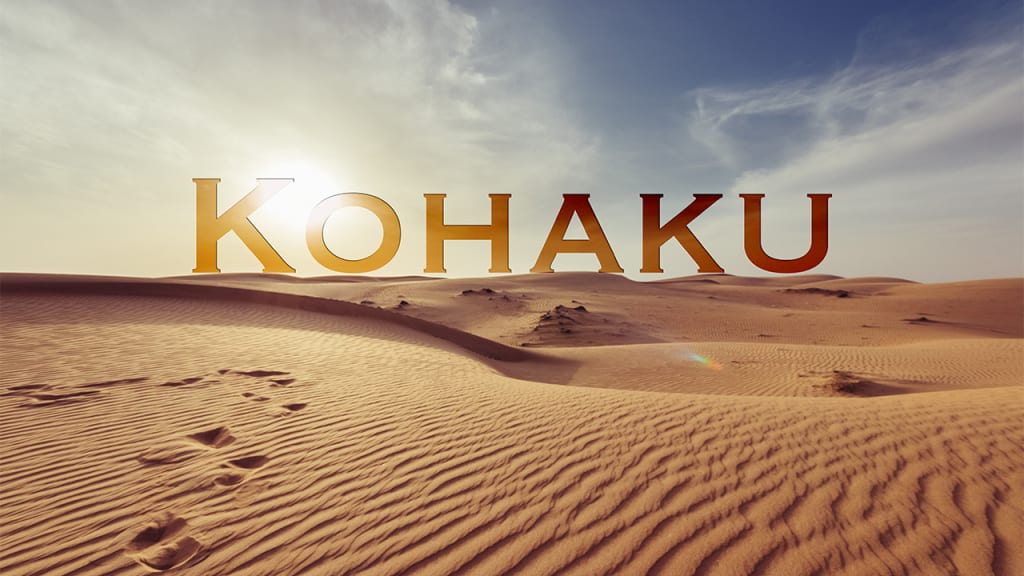
As the sun climbed over the peaks of the Samaa Mountains in the distance, its rays began shining through the cracks of the old barn, waking the boy as a gentle reminder that it was time for morning prayer. He woke with a burst of energy and sprinted down to the shore where he would wash before prayer. He stopped for a moment, his reflection in the water peering back at him.
“Happy birthday Abdirashid,” his reflection spoke to him as if it were his dearest friend.
Abdirashid was a poor boy, left on his own after his mother died three years earlier. He found work helping a local widow with her farm. As payment he was promised a share of the fruits and vegetables and was allowed to sleep in the old barn on the edge of the property. It was a simple life, but his mother taught him to always appreciate what life had given him, no matter how small.
Looking into the water, he reminisced about his mother. He thought back to the story of how she found him, left alone in the desert as a baby. She was an older woman who never married, and she was too sick to work. The little money she had went toward Abdirashid’s education. With his love for reading, he learned many useful skills by borrowing books from the school’s small library. Though his life was simple, he felt it had great meaning. His mother always told him that every life had purpose.
He wiped his wet hands over his face, then prayed patiently. Pulling an orange from his bag, he slid under a shaded tree and glanced out at the sea thinking to himself, “The perfect start to my thirteenth birthday.”
Soon Abdirashid noticed something wash up on the shore. He wiped away the wet sand and pried open a small case. Inside was an old, black notebook with most of the pages worn away or ripped out. He dropped the case and opened the small notebook to find a single phrase written inside. He had no idea what it meant, but he felt a connection to the words as he brushed his finger across the withered parchment. The phrase was written in an ancient text, said to only be understood by royalty. Abdirashid didn’t know much about royal culture, but he once read that they used a foreign language to pass on the secret wisdom of the ancient rulers. What he did know was that the nearest king lived over 300 miles away.
The boy looked down at the case, now lying broken on the ground. It must have had another compartment that he hadn’t noticed because under the broken pieces was scattered a large sum of money. His stomach turned as he counted it. Pushing the money into his bag, he rushed to the school library in the small village. Roughly 20,000 dollars, he thought briefly about what he might do with it. It wasn’t enough to make him rich, but it certainly would provide a better lifestyle than he ever knew. Immediately his mind went back to the notebook, gripped tightly under his arm as he skimmed through every book he could find on the ancient language.
Each book led to the same conclusion; this mysterious language was never taught outside the royal lineage. He figured the only way to discover it’s meaning was to ask the king himself. For once he felt a distinct purpose. Anyone else might have disregarded the old notebook and continued on with the money, but Abdirashid’s curiosity and hunger for knowledge ate away at him. Perhaps he could pay the king to translate the text, he thought, while grabbing his bag full of money and supplies. Abdirashid knew he would have to travel several days to reach the king. He would journey around the Samaa Mountains, beyond many villages, through Kayiyb Forest, and across the desert before reaching the royal city.
After walking all day, Abdirashid made it to the mountains. He looked up in amazement as they disappeared into the sky. He knew his journey was only beginning and he pulled out the notebook knowing it would restore his ambition to continue on. He felt a strange connection to the words as he brushed his finger across them once again.
His intent focus was broken by the sound of a man’s voice.
“Come on you lousy mule!” the man shouted as he kicked the stubborn equine that refused to get up.
Abdirashid walked over to see if he could help.
“If I may ask sir, what’s the problem with your mule?”
“The dumb thing won’t get up,” he responded irritated.
Abdirashid noticed its long hooves beginning to curl over.
“When was the last time you trimmed his hooves?” he asked, realizing the mule’s discomfort.
“Trimmed his hooves?” The man responded, sounding like he had never heard a stranger idea. “I just got him a few months ago from a friend, but I’m beginning to feel like it’s more of a burden than a gift.”
Abdirashid pulled a knife from his bag and began chipping away at the excess of the hooves.
“Equines hooves grow out just like the fingernails of a human. In the wild they get filed down naturally by traveling on rough ground, but when kept in a stable they should be trimmed regularly, or they’ll cause the mammal to have sore feet.” Abdirashid was quoting something he once read about caring for horses.
After trimming the mule’s hooves, he assisted it to its feet. It took a few steps seeming to notice the relief. Amazed, the man thanked him with food and shelter for the night and refilled his canteen with water for his travels.
Abdirashid continued his journey at dawn. Passing several villages, he finally made it to Kayiyb Forest by sundown. He was nearly halfway through the gloomy forest when he found a lonely girl crying.
“Do you need help?” he asked graciously.
“I ran away from home thinking I could survive on my own, but I can’t even make it out of this scary forest,” she replied.
He invited the girl with him, turning back toward the village. She told him the story of her parents’ harsh discipline, though Abdirashid thought it sounded more like good guidance from loving parents. Next, she listened to his story, and the girl realized that she missed her parents deeply. Exiting the forest, they heard a crowd of villagers calling out to the girl earnestly. Her parents raced toward her and pulled her close in great relief.
“We hired everyone we could to help look for you!” The dad exclaimed.
“We are so glad you’re okay,” said the mother warmly.
Abdirashid rested overnight then progressed through the forest the next morning. Finally, he looked out at the sand covered hills of the desert as far as his eyes could see. He reached into his bag, feeling the notebook, and he started through the desert with comfort of knowing he was pursuing something greater than himself.
After hours of walking, it seemed the sun was beaming hotter. Abdirashid tipped his canteen up, letting the last drop of water touch his lips. The end of the desert wasn’t anywhere in sight. He struggled on as long as he could until he felt his body getting weaker. Suddenly he collapsed to the ground unconscious.
“It’s so awfully hot,” a traveler cried to her companion as they made their way up a steep desert hill.
“All you do is complain,” he moaned back, stumbling along the sand.
“At least I can keep my balance,” teased the young woman.
“Well, it would help if I didn’t have to listen to you complain the whole way. I should have left you behind…” the man paused, noticing Abdirashid lying on the ground ahead.
“We have to help him,” the man said, while he cooled the boy’s face with water and refilled his canteen.
The man looked over to his female companion. She was rummaging through the boy’s bag in a look of disbelief. She pulled out the small notebook and flipped through it.
“Just a few empty pages,” she sighed, dropping it to the ground. “But take a look at this,” she insisted, aiming the bag full of money toward the man.
“We can’t steal this boy’s money and leave him to die,” he responded, knowing exactly what his friend was thinking.
Abdirashid was regaining consciousness.
“He’ll be fine,” the woman said convincingly. “We’ve refilled his water and he’s waking up. Let’s just get out of here,” she begged, pulling the man along.
Now gathering himself, Abdirashid looked around frantically for his bag. His heart sank as he realized it was gone. Noticing the notebook on the ground, he picked it up and opened to the single page with text. He felt comfort as he realized his journey wasn’t over yet.
Escaping the desert, Abdirashid looked out at the royal city. He was hungry, his clothes were worn, and his money was gone, but he felt immense gratitude as he held the notebook close to his chest. He arrived at the castle, unsure of how he would convince the king to translate the text without anything to offer. Though somehow, he felt assurance that this was his purpose.
Approaching a guard outside, Abdirashid spoke confidently, “I have come to see the king,” he proclaimed.
“What business does a filthy beggar have with the king?” the guard scoffed.
“I have come to ask him to translate this ancient text.”
The guard fumbled through the notebook.
“Good try kid, but I can see that it’s empty.” He tossed it back at the boy.
Abdirashid opened the book and pointed it to the guard. The guard looked in amazement as the text now came to life on the page. He grabbed the boy and pulled him into the castle. Abdirashid was bewildered.
“Show the king!” The guard shouted.
Without hesitation Abdirashid opened the notebook. The king froze in disbelief as he read the words aloud. Abdirashid still had no idea what it meant, but it was the most beautiful language he ever heard.
“Who is your father?” the king asked curiously.
“I have no father,” Abdirashid replied, beginning to tell the story of being found in the desert.
“Dear boy,” the king took off his robe and placed it over Abdirashid’s shoulders. “You are a prince, stolen from our castle as an infant. We thought we would never see you again.”
Unsure if he believed what he was being told, Abdirashid remembered the purpose of his journey.
“I must know the meaning of this text,” he begged. “I believe it has something to do with my purpose.”
“This text can only be seen when in the hands of royalty!” the king exclaimed. “You are from the lineage of our ancient ruler. You are my son,” he said with a tear in his eye.
“What does it mean?” asked Abdirashid, still focused on the notebook.
“We call this phrase Kohaku. It is one of our codes to live by, passed down from the wisdom of the ancient ruler. It means, ‘Struggle is destiny, perseverance is choice.”
Abdirashid thought for a moment. Now realizing he was a royal prince, left to die in the desert as a baby, but found by a woman and raised as her own child. He understood that without his experience these words would mean nothing. He thought back to those he encountered along his journey; the man, ungrateful for his mule because he did not know how to care for it. The girl, ungrateful for her parents, because she did not appreciate their discipline. The thieves in the desert, ungrateful for their companionship that helped them along their way. Abdirashid understood that he could have allowed his struggles to overcome him, but he persevered. He appreciated his journey by allowing it to mold him into the young man he was only just becoming.
About the Creator
Zach Brunotte
Whether I am writing poetry, song lyrics, stories, or nonfiction, my hope is that the power of my words can inspire positive change. I have a BS in Counseling and I am passionate about culture, equality, mental health, and self development.
Keep reading
More stories from writers in Humans and other communities.
The CEO of Everything
They say "jack of all trades, master of none," but they forgot to mention the part where the jack of all trades is also the camera woman, the makeup artist, and the person currently yelling at a tangled Wii microphone cable in a her own bathroom while recording herself singing and trying to make it look realistic and professional. (As professional as you can make it with nothing but a cell phone camera and a mic that doesn't work)
By Sara Wilson7 days ago in Humans
Caught Yourself Saying "You Let" Your Partner Do Things? Yeah, That's Not Normal.
There was a stack of makeup in front of me. I had just been on a shopping spree, spending my hard-earned money at one of my favourite beauty stores. The stack was huge, I give him that. But it wasn't any fan of beauty or skincare wouldn't appreciate.
By Ellen Frances5 days ago in Humans
🅼🅸🅳🅽🅸🅶🅷🆃 🆂🅽🅰🅲🅺🆂
"It's 10 in Tuscon! We all know what that means... It's Time for Midnight Snacks with your man, Gerald Gee! Ready to spend the night together? Me too! I'm full of snacks and can't wait to regurgitate them all back into your hungry ears. Crack a brew! Pop some corn! Anything to get ready for one hell of a show where the talk maybe cheap but the words cut deep...
By Lamar Wigginsa day ago in Fiction




Comments
There are no comments for this story
Be the first to respond and start the conversation.