
Kintsugi
Mending that which is broken
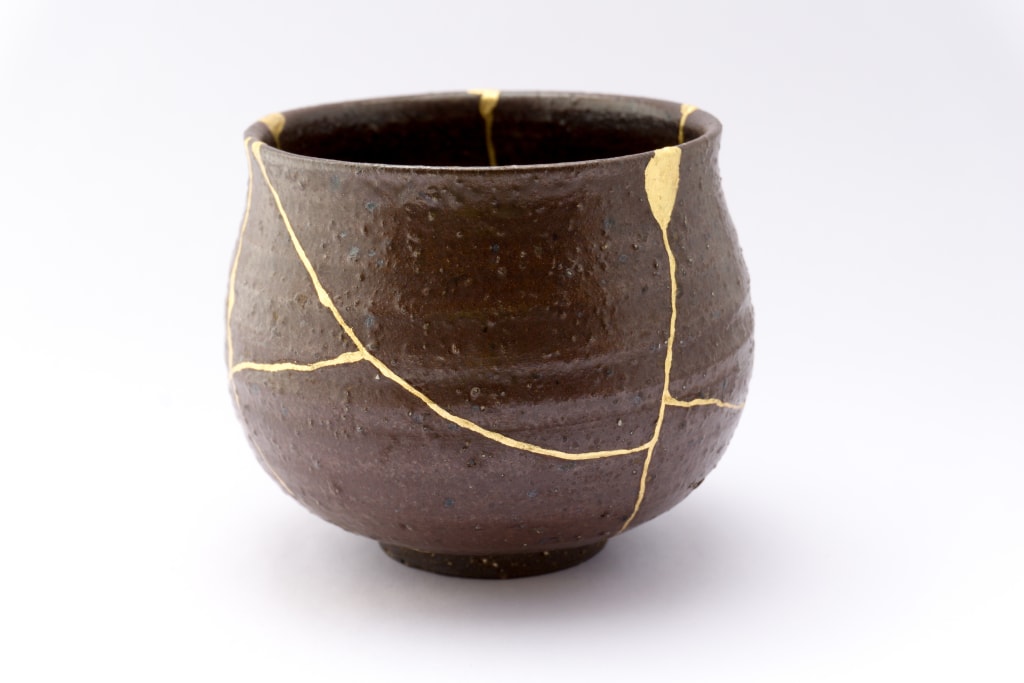
Peace meant that Samurai had succeeded in their duties, but were now obsolete. Peace meant we had to conduct our warfare in the shadows, in order for the peace to remain. Whenever the letters came for an assignment, I walked through this part of the village to get to town. It was the quiet road, laid for the farmers carrying their crops to market. I made a habit of pausing to watch an old woman at work. For years, she pieced together broken things until they held a new beauty. A strange letter arrived one night. I burned it and I set out as dawn eased over the world. The dirt road crunched quietly under my feet. I was surprised to find her hut already lit by the amber glow of lanterns in the soft blue morning.
Kintsugi. I finally remembered what is was called. A crisp breeze slipped past, the last remaining cherry blossom petals fluttered down like fractured butterflies, stark white in the shadowless morning. The old woman carefully polished the gold lacquered seams of a once broken bowl. It was earthy and unglazed, the gold cracks glimmered under the lantern light. Despite her concentration, her face remained placid. The only indication of strain showed as she set the bowl down; her stained fingers trembled as they drew away. As always, I stopped to watch.
She looked up at me with a modest smile. Like a ghost, her beauty hid beneath the weathered skin. Her kimono was simple but well kept, her hair wrapped ornately. I watched her sweep loose gold from the bowl, her long fingers held the brush with an odd refinement. A gentry air embraced her that she was never fully able to subdue. She set the brush down on her table, with the care of one tending to a baby bird, and wiped her hands on her apron.
“Sit, I will teach you.” She waved me over as she leaned down to gather a small broken pot.
I turned to face her, but didn’t approach. She glanced back, her smile faded. Her dark eyes flickered over the long sword at my hip before drifting up to meet my gaze. The breeze carried the smell of dewy grass and the heady brine of the sea past us. She reformed her smile, offering the pot out to me.
“This one will be yours.”
I took a seat across from her at her table. She placed the pot before me. It was the color of her eyes, a deep yet warm sable.
“Sometimes, for us to make something stronger, one must break it further.”
I picked up the pot. A tiny tea pot that fit just in the palm of my hand. At first glance, it appeared whole, but when you looked deeper you could see a fissure splitting it from top to bottom. Whole, but obsolete.
She handed me a cloth and hammer. With a firm nod she said “Your blow must be purposeful, but with softness.
The sound of the hammer strike rang through the air with finality. The cloth felt like a lead weight as I lifted it and I was filled with a strangely reverent satisfaction as I stared at the deflated ceramic pot.
The old woman pushed a brush towards me. “Your seams must be tidy for the bonds to form securely.”
She watched my every move, pointing out faults without losing her amicable smile.
The midday sun warmed the ocean breeze. She showed me how to bond the broken pieces together. We sat sipping tea as we waited for the bonds to dry. The day passed as I carefully painted the Urushi over the crack, then polished the gold powder into it. I held up the mended pot with wonder. The gold lines glimmered against the deep brown in the pastel light of evening.
“And now you know how to mend what has been shattered.” She wiped her hands on her apron. I felt the weariness in her voice spread over me, filling each vein with dread.
I turned to look out at the last rays of sunlight, gilding the sea beyond the thatched roofs of the villagers’ homes. The name on the letter had belonged to a person who had been hidden for decades. A name that had belonged to a royal house. Her gentle smile tensed with sorrow.
“Every day you passed by, I wondered if it would be the day you’d stop for me.” She stood up and removed her apron.
I watched her put her tools away. After a pause, she set the unglazed bowl in the center of her table. With careful hands, she packed my tea pot into a box, wrapped it in soft cloth and closed the lid. She handed it to me with a slight bow. I took it with a nod.
We walked slowly towards the sea, she didn’t look back at her hut.
I could usually piece together the lives of my assignments. As I watched her piecing together broken ceramics, both ugly and ornate, I couldn’t help but puzzle over her. The manners of prominence, the posture of high stature. But a warmth found in the common folk. A serenity that that came from laboring over a mastered craft. Maybe a merchant’s wife? A geisha who bought her freedom?
We stared out over the quiet waves as the sky faded from orange to pale plum.
But the name put the final piece together. Her past had a grand palace, and gold statues guarding the gates. The gates have since been shattered, the palace burned, the statues ground to dust. That night, decades ago, there was a face of a man, his eyes wide and wet as he shoved a young princess through the back guard gate. I had been the last to see his face, and the last to see the plum and gold dress of a princess vanish into the night like smoke. A smoke that held the secrets of a dynasty.
Decades later, a name had been written, and her fingers were stained from gold dust. She closed her eyes and nodded. I set the box down in the sand and turned to her. My hand gripped the Tsuka of my sword.
I would be the last to see her face.
“Your blow must be purposeful, but with softness.” She turned to me with a smile. A smile filled with warmth and grace.
I hadn’t noticed all the fissures that had formed, until this hammer had fallen and I crumbled to pieces. A tear rolled down my cheek, catching the final light of the setting sun. Her final masterpiece.
About the Creator
Keep reading
More stories from Madison DeCook and writers in Humans and other communities.
The Angry Man in Your House
"If you grow up with an angry man in your house, there will always be an angry man in your house" This statement has caused plenty of controversy online, people say its a statement that blames victims while also undermining those who break traumatic cycles to form health relationships... but if I'm honest now that I'm in my 30s it makes more sense to me than ever, and I'd argue that its not just about fathers and uncles.
By S. A. Crawford5 days ago in Humans
The Sweetness of Waiting: A Story of Patience
By Hazrat Umer "Indeed, with hardship [will come] ease." (Quran 94:6) Life. It’s a journey, isn't it? Sometimes it’s a smooth, open road under a bright sky. Other times, it’s a rocky path through a dark forest, where every step is a struggle. We all face these struggles. Business losses, sickness, family problems, or simply the long wait for something we deeply desire. In these moments, there’s one word, one powerful concept, that often comes to mind: Patience. We are told, "The fruit of patience is sweet." But oh, how difficult it is to believe that when you are in the middle of a storm.
By Hazrat Umer2 days ago in Humans




Comments
There are no comments for this story
Be the first to respond and start the conversation.