

“Jeremy Ranchers”
My father was both a farmer and a test pilot, two passions reflecting the full range of wonder from the soil to the sky. His father had spent most of life working tenant farms in Ohio during the Great Depression, so Dad determined to share with his children both the rooted life of farming as well as the beauty of travel. My oldest brother, Jim, and I are separated in age by over 20 years. In spite of the age differences -- Jim’s birth signified the beginning of the baby boom and mine coincided with the closing Apollo missions -- our family of six was bound together by a love of the outdoors. The National Parks made it possible for my dad to share with us the full range of this marvelous country, not only for us but for the next generation.
When I was just starting first grade, my oldest brother was celebrating the birth of his first son, the first grandchild. Almost 30 years later, my youngest was born, grandchild number 14. Having a nephew old enough to be a younger brother turned out to be one of the best parts of growing up in a large family. When I learned that pandemic restrictions had given our National Parks a much-needed reprieve from the impact of crowds, I began plotting a trip west. I wanted my youngest son to encounter the magnitude of Rocky Mountain National Park. I entered a request for passes on two consecutive days to coincide with my 50th birthday. Fortunately, my oldest nephew had settled near Denver and was willing to meet up with us and lead us around the park.
There seemed to be no question of motivation during those early years. When the road called, we went. When Dad charted the next trip, it meant a break from chores on the farm like hoeing corn, picking beans, digging fence-posts or mucking the horse stalls. A trip to a National Park meant a trip to another world, where skies were bigger and exotic animals leapt off the pages of the latest National Geographic. With Mom’s help, we might convince Dad to take an excursion to someplace featured in a movie set, like Craters of the Moon in Idaho or Devil’s Tower in Wyoming.
From the 1950s until the 1980s, Mom and Dad would load our ever-evolving family into one of a series of rigs: the green station wagon with Nomad trailer, then a wood-paneled wagon with an Airstream in tow, and finally a self-contained Ford Xplorer conversion van. Dad was always behind the wheel, covering the countless miles between nearby Assateague Island to the Redwood Forests of California. Dad was always behind the Argus camera as well, snapping family photos of us from Acadia on the Northeast coast of Maine to the swampy Everglades of Florida. Truth be told, many of the pictures were of his favorite subject, the historical marker. Dad would follow the markers to the peaks and valleys of our family history, from Antietam to the Battle of Little Big Horn. He wanted to impress on us the history of this land, back to Lewis and Clark’s expedition and the revolutionary figures celebrated in our National Monuments. He would lead us further back to instill in us a proper sense of humility in the history of humankind: to those ages when the cliff dwellings of New Mexico smelled of maize and wood fires, to those aeons past when the land of the prairies lined the ocean floor.
Vacation to a National Park meant more than traveling to a new place; it was about taking that place back home with you. Once I had witnessed the Colorado River winding through the Grand Canyon, the stream through our farm was transformed. Once I had walked under the New River Bridge, laying a plank across that stream became a major feat of engineering. Once I had heard echoes in Mammoth Cave, spaces inside my soul opened up that I would never have thought possible. And nothing opened my mind like the sheer magnificent scale of the Western United States.
Jeremy and I tackled the western side of the park on day one, hiking to Granite Falls alongside Big Meadow. As I had hoped, Jeremy learned why the word ‘grandeur” is so fitting for the Rockies. Everything in the scale of the Rockies surprised him, from the distances we hiked to the size of the falls, the coolness of the water and the vastness of the meadow.
We made plans to meet up with my nephew, Jason, and his two sons on day two to tour the eastern side of the park. After a hearty breakfast of hubcap pancakes in Idaho Springs, Jeremy and I pulled into Beaver Meadows Visitor Center. We piled into Jason’s SUV along with his young sons, aged ten and seven. Jackson, the older of the two, helped survey the views from a few locations before we settled on Bear Lake as our starting point for the day. We decided to hike the trail along a string of three mountain lakes leading west toward Flattop Mountain and Hallett Peak. Bodhi, Jason’s youngest, was full of energy after being cooped up in the shuttle. He proceeded to circle Bear Lake in like a mountain goat, jumping up rocks on either side of the trail in serpentine fashion to maximize the experience. I wondered how this might affect his ability to tackle the remaining miles of the hike.
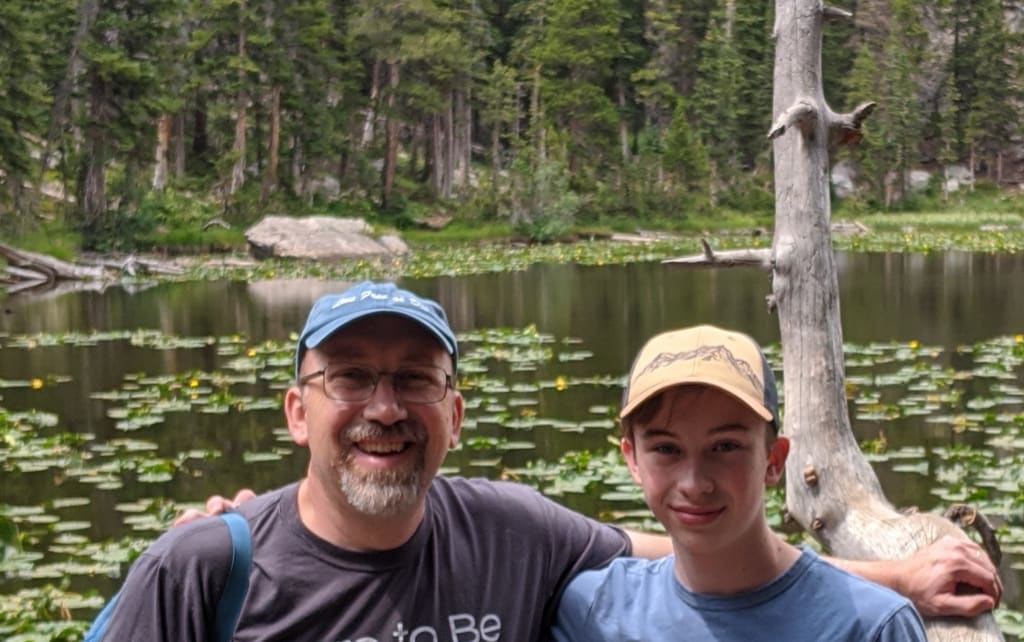
Sure enough, by the time we arrived at Nymph Lake, Jason’s kids were beginning to flag. Lily pads covered the surface of the lake and trees surrounded the shore, but I have learned from 25 years of parenting myself that young kids are not much taken in by scenery. Thankfully, we had brought along some snacks that we got from a candy store in Golden. The hard candies were originally made on the Harmsen ranch, first in their barn, then in a nearby plant that was eventually bought out by the Hershey company. (I also figured the kids could care less about the candy’s history.) I did a quick count and proposed a motivation: one candy for the first lake (immediately dispensed), two candies upon reaching the second lake and three candies each for when we would reach the third and final lake.
As motivations go, it was a little on the stingy side, but it seemed to work. The hike up from Nymph Lake to Dream Lake meant tackling some steep terrain, but the promise of sugar helped move the youngest ones along. Somewhere along the way, my great nephews took to calling the candies “Jeremy Ranchers” after their cousin. Technically, he is their first cousin, once removed, but no one named Alexa was along with us to field such questions.
Dream Lake was even more amazing than Nymph Lake. It looked like scenery from a Hollywood set, with streams flowing out from under evergreen trees and mountain flowers in bloom. Jeremy counted out two more pieces of candy to each cousin and we headed up over some boulders to the lake itself. A level path ran along Dream Lake, a long stretch of clear stillness where mountain trout could be seen swimming alongside us. Even to a generation raised on high definition gaming and electric scooters, the pace of the hike and the magic of the mountains were beginning to take hold.
After tackling the stone steps etched in the trail ahead, we stopped and ate a picnic lunch, careful to avoid the excessively friendly chipmunks. My son dunked his head in the stream to cool down while I peeled off my boots and socks and let the living water wash my feet. I found my way up to a rugged old limber pine, its twisted bare trunk keeping watch over the valley below. Just beyond the ridge was Emerald Lake.
We called the kids together for pictures and their final disbursement of candy, then staked out spots on the rock outcropping above the bowl of the mountain lake. Jason pointed out where he had been hiking the previous weekend and where he and his father had trekked high up along the ridgeline in years past, along the Dragon’s Tail. Visitors to the park from all over the world were taking in the scene, some even daring to test the glacier-fed water. In those moments, it was easy to forget that we were in the middle of a world-wide pandemic. Instead, we could enjoy the gift of family gathered here in one place, along with people from all around the globe.
As I surveyed this scene, it was natural for my thoughts to turn to Dad, living on in my memory.The farm where my dad was born is somewhere beneath the waterline of a reservoir in Ohio. Our family farm in central Maryland has become a housing development. But we can still share Rocky Mountain National Park with the next generation. We can still plan trips to Cadillac Mountain or dream of going back some day to Old Faithful. Even when money is tight or time is limited, we make our way to Fort McHenry, a favorite for our oldest son who does not have the ability to climb and hike. Benjamin loves hearing the Naval Academy Men’s chorus sing the National Anthem as the window of the visitor center reveals the Stars and Stripes still flying over the ramparts.
During a long and blessed life, Dad instilled in his children and their children an enduring appreciation for nature and a deep respect for the diversity of people who live alongside us. His was a humble patriotism, mindful of the gifts to be found in this land, tempered by an acknowledgment that we live under broad skies. When given the opportunity, Dad would remind me of his favorite hymn:
“This is my home, the country where my heart is... but other hearts in other lands are beating with hopes and dreams as true and high as mine. My country’s skies are bluer than the ocean and sunlight beams on cloverleaf and pine, but other lands have sunlight too and clover and skies are everywhere as blue as mine.” (This is My Song, Lloyd Stone, 1934).
Each season brings changes into our lives, with joys specific to each seedtime and harvest, and some sweetness to sustain us along the way. Over the years, we develop a sense of perspective, of our fragile place in this enduring world. We discover the wonder we receive by pressing on and also by stopping to take in that which comes to us purely by grace. Perhaps this was my father’s motivation all along, to introduce us to the wideness of the world, so that we would appreciate the treasures that make us richer when we share them with others.
About the Creator
J W Knopf
JW enjoys travel, singing, hiking, ice cream and being around water. Favorite reading and writing subjects include philosophy, theology, spiritual well-being, history, biography, political theory, mental health and disability issues.
My First Time Skiing and I Got Lost, Alone, in the French Alps
Looking back, I can trace some of my life’s biggest adventures to a simple action from my sister. She’d introduced me to Tommy (a very long time ago), a colleague of hers, who had overshared his penchant for Italian-looking women, and I ticked that box.
By Chantal Christie Weissa day ago in Humans


Comments
There are no comments for this story
Be the first to respond and start the conversation.