
I’m Deaf And I Can Hear Your Ignorance. Let’s Fix That!
This week is deaf awareness week, and let’s debunk some deaf stereotypes.


“You can’t be deaf, you just heard what I said”
One of the most common misconceptions about deaf people is that we can’t hear anything. While for some of us that is completely true, a large percentage of us have some degree of residual hearing. There are 4 levels of hearing loss: mild, moderate, severe, and profound. Even those with some degree of profound hearing loss might be able to hear something if it’s loud enough. At the opposite end of that spectrum, those with mild hearing loss will hear much more, but their hearing loss still interferes with their day to day life. For me, in a quiet room, I can hear that you’re talking to me, but I cannot hear what you’re saying to me. So here I will rely on my hearing aids to give you a boost, and lipreading too.
“You’re not deaf, you’re hard of hearing.”
That’s not 6, it’s two threes. Hard of Hearing, deaf, and Deaf are not functioning labels, they have nothing to do with your level of hearing loss. Identity labels like these are not diagnoses. You don’t get diagnosed as any of these, you get diagnosed with hearing loss. There are people with mild hearing loss that use deaf, and there are people with profound hearing loss who prefer hard of hearing. The labels we choose to use to describe our hearing loss are our personal preference. Hearing people don’t get a say in how we describe our hearing loss. In my opinion, when I used Hard of Hearing, people would spend more time asking me what the difference between deaf and Hard of Hearing was, and acting like I didn’t need adjustments.
“If you’re deaf, why aren’t you using sign language?”
Good question, why aren’t you using sign language? Let me guess, you never learned it? Cool, until last year, I hadn’t either. Sign languages aren’t typically taught in schools like other languages are. In the UK there have been many campaigns to allow British Sign Language as a language option for GCSEs, and this is finally being developed with Signature. However, it’s unclear whether all schools will be required to offer the option to study BSL, or whether it will be offered on a voluntary basis. Learning BSL outside of a school setting can be expensive. Initial courses that offer an introductory level of understanding and vocabulary start relatively affordable, but after that the price jumps. BSL 1- the first course on your way to fluency, sits around £500, with subsequent courses increasing more in price with each level. Even people who are born deaf might not be enrolled in BSL lessons by their families- this is called oralism. The favouring of oral speech and listening, instead of sign languages. Like any languages, if we want to use it, we have to learn it at some point, and it’s not always affordable for us.
Furthermore, if only deaf people used sign language, how would we communicate with hearing people? Interpreters can be expensive, and there aren’t enough of them to follow around every deaf person in their day to day lives on the off chance we come across someone who can’t sign that we need to talk to. The cost of interpreters can be absorbed by companies if you’re using them for an appointment with them, but if they’re for your own personal use, you have to cover the cost. Being an interpreter is a career, and a career that you have invested a great deal of time, money, and study to be able to do properly, and they absolutely deserve to be paid accordingly. They are a valuable resource for medical appointments, job interviews, public events, court hearings, universities, schools, etc.
“Being deaf means you can’t talk, because you can’t hear what to say”
As we discussed earlier, every deaf person is different, and most of us have some degree of residual hearing. Sometimes that residual hearing allows us to hear ourselves talk to some degree, so we may learn that way. Some deaf people were born hearing, and later acquired a hearing loss. These people likely learnt to speak when they could hear everything, and then retained the muscle memory when they lost some or all of their hearing. Some deaf people can speak, but choose not to regardless of whether they can hear themselves or not. Some deaf people can speak even though they can’t hear what to say. Speech isn’t totally reliant on hearing. Think of speaking in a nightclub. Can you really hear yourself speak over the club noises? Do you speak anyway? Do you think what’s coming out of your mouth is any less clear?
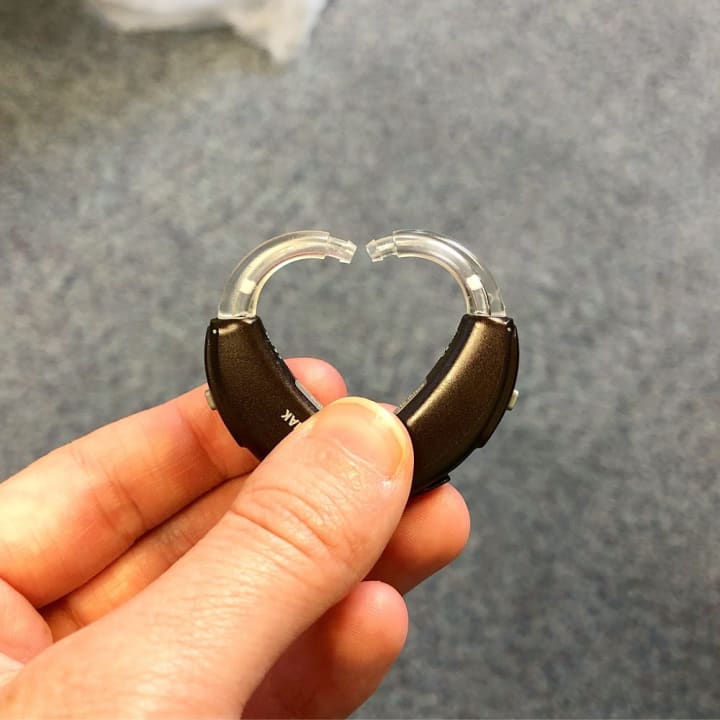
“If you’re deaf, why do you wear hearing aids?”
My simple answer personally, is because you don’t know how to communicate with me without them. Whether that’s signing, or alternative communication, hearing people appear to have this sense of panic when meeting a deaf person and assume that they can’t communicate with us. Last year I made a video talking about all the different ways you can communicate with deaf people when you don’t know sign, but in reality, a lot of people are so used to speaking and being spoken to, that the idea of writing something down instead makes them uncomfortable. My hearing aids don’t make me less deaf, they just boost the volume specific speech sounds that I wouldn’t hear otherwise, so that I can understand more of the speech that’s going on around me, but not all speech. With my hearing aids in I still can’t hear 100% of the words. More like 50%. The rest is lipreading, context, and other visual cues. Similarly, with cochlear implants, they don’t give 100% hearing, and a lot of processing has to go on to fully understand conversations.
“Just turn your hearing aids up”
They don’t work like that. Some hearing aids have a volume control, but those are limited to a set volume as to not further damage our hearing. Even the loudest volume a hearing aid is capable of producing doesn’t guarantee that we will hear every speech sound of every word and not need you to repeat things. And remember, hearing aids aren’t appropriate for all deaf people, and not all deaf people want hearing aids, and even if we have them, we don’t wear them all the time. So telling someone without a hearing aid to turn it up is just… Not helpful, to put it kindly.
“Omg you’re deaf? Read my lips! *obnoxiously mouths something*”
Can we agree, reader, to never do this. Not all deaf people are masters at lipreading, and you show a fundamental misunderstanding of how lipreading works. Less than 50% of the English language can be “lipread”, syllables like “ma” “ba” and “pa” all look identical when lipread with no volume, which brings me on to my next point. Lipreading requires some level of volume. Lipreading compliments the sounds that we hear, it does not and cannot replace it. And lipreading only really works when you are speaking as you normally would. Often when you mouth things with no voice to challenge deaf people, you over pronounce the words and distort the shape of your mouth, which we are not used to seeing in our every day lives, so no we won’t be able to lipread it. The phrase you mouth also usually has no context behind it, which further confuses things. You are also assuming that we can see your lips, which leads me to…
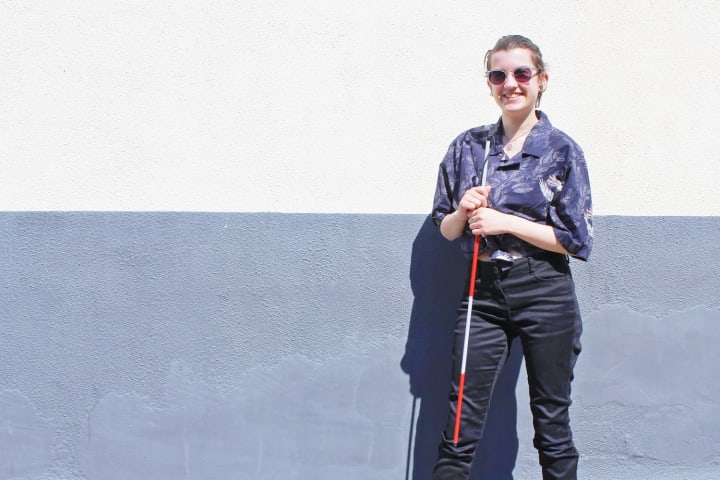
“Are your other senses heightened?”
Mine? No. I’m deafblind, so I can’t see perfectly either. There seems to be this pattern of thought that one sensory loss is bad, two is an enigma. But deafblindness is surprisingly common, and a lot of people fit on the deafblind spectrum despite not perhaps using that label. Deafblindness covers anyone who has a hearing loss and a sight loss or visual impairment that impacts your mobility, communication, and access to information. Visual impairments, no matter how mild, may impact your ability to read, lipread, and see sign language, and you might not be able to fill in those gaps with more audio. This might be worse in certain lighting setting like at night if you have poor night vision, or in bright spaces if you have photosensitivity.
In contrast, there are studies that suggest that people who were born profoundly deaf have better peripheral vision, and this is a commonly reported phenomena in the deaf community. But it doesn’t mean that our actual vision is super human, we just use vision a bit differently and the brain adapts to that. Everyone experiences their senses differently, regardless of any sensory loss.
If you've ever said any of these things, it doesn't make you a bad person.
I hope this article has helpful dispel some misconceptions and stigma around deafness, and has helped you understand the depth and diversity of our community! This week is about being raising awareness of deafness, and what it actually is. So be mindful of the deaf awareness content that you share, and if it perpetuates any of these stereotypes, don’t share it.
Happy deaf awareness week!
About the Creator
Max Fisher
Max is a DeafBlind, Queer, and Disabled activist living in Cambridge, UK. They are non-binary, live with chronic pain, and (literally) see the world very differently. They are a passionate scientist.
Instagram: @Ouch_mouse
Keep reading
More stories from Max Fisher and writers in Humans and other communities.
Why I No Longer Sell on Amazon
When I published my first book in 2011, I used Lulu. At the time, it was one of the few print-on-demand options that allowed authors to retain control over content, pricing, and distribution. Over the years, I explored other publishing routes, including limited digital placement on Amazon Kindle, but I remained consistent with Lulu for physical books. As of this writing, I am still evaluating whether those remaining Kindle titles will stay available.
By Dr. Mozelle Martin | Ink Profilerabout 18 hours ago in Humans



Comments
There are no comments for this story
Be the first to respond and start the conversation.