
I Didn’t Read Her! I Felt Her
A professor, a student, and a quiet storm of words that blurred the line between intellect and intimacy


I’ve read a lifetime of words, but hers… hers made me pause.
In all my years of teaching literature, I had encountered brilliance, arrogance, and desperation in students’ essays but not reverence. Not longing. Not ache. Until her.
Her name was Lena Ahsan. I first saw it typed cleanly at the top of a midterm paper: “On The Quiet Grief in Emily Dickinson’s Solitude.” The title struck me. Not because of what it said, but how it said it, as if the writer herself knew what quiet grief truly meant. By the third paragraph, I had stopped reading like a professor. I was reading like a man.
She never spoke in class. Not out of fear or shyness! no, hers was a purposeful silence. The kind that wasn’t trying to hide, but trying not to interfere. She sat at the back, sometimes without even a notebook, her gaze often lost in the window rather than the board. And yet… when she submitted her essays, it was as if the air in the room shifted.
Her second piece “The Sound of Waiting” broke me.
It was about nothing and everything. A woman waiting for someone who wouldn’t return. A woman who knew he wouldn’t, and still set the table each evening as if he might. I don’t know if it was fiction, metaphor, or confession. But it sat with me long after I finished reading.
One night, I found myself alone in my office past 10. The campus was quiet, draped in winter’s breath. I opened her essay again not for grading, not for notes, but to reread a single line:
“Some absences are louder than presence. They demand to be heard by what they leave behind.”
I closed the file and leaned back in my chair. A strange tightness pulled at my chest, the same kind I used to feel when I still believed in poetry.
It wasn’t love. Not at first.
It was recognition. Of pain. Of beauty. Of a mind that thought in shadows and silence, the way mine did once, before lectures, before tenure, before a divorce dulled the edges of everything.
Weeks passed. She kept submitting work that challenged me emotionally in ways I couldn’t explain. She never lingered after class. Never asked for recommendations. Never smiled politely. And still, I couldn’t stop looking for her.
One day, she came to my office. No appointment. No excuse.
She knocked, barely audible. “I just came to drop something off,” she said.
It was an envelope- a story, handwritten. Her handwriting was delicate but precise, like she was afraid of wasting ink.
“Is this for class?” I asked.
“No,” she said, her eyes meeting mine for the first time. “It’s just something I thought you might like to read.”
That night, I read it at home, slowly, as if it would vanish after each page.
It wasn’t a love story, but it was.
It was about two people who never touched. Never spoke their truth. Yet felt each other in every silence, every book, every room they once shared. And in the final paragraph, she wrote:
“He never told her he loved her. But he taught her how to read between lines so well, she never needed him to.”
It took me five minutes to breathe again.
I didn’t contact her. I didn’t know how to or whether I should.
But the following week, I left a note on her graded essay. Just a line.
“Some things don’t need to be spoken to be understood.”
She never acknowledged it. But her next piece was titled, “The Things We Never Say.”
I once read that real connections are not made through eyes or words, but through recognition. When one soul sees itself in another, not because they are the same, but because they are equally unfinished.
She never told me her story. I never asked.
I graded her work. She continued to hand it in. Our conversations lived in the spaces between words. The pauses. The phrasing. The pieces she chose to write and the ones she never submitted at all.
She graduated a year later. No formal goodbye. No letter. But in the last assignment she handed me, she wrote this on the back of the final page:
“Thank you for not asking me who I was! and letting me answer in ink.”
I still teach literature. I still grade papers. But every now and then, I open a locked drawer in my desk where her stories sit quietly, untouched, breathing softly through yellowing pages.
And when students ask me why I teach, I tell them:
“Because once, I didn’t read someone! I felt them. And that was enough.”
About the Creator
Mian Suhaib Amin
Advocate by profession, writer by passion. I simplify legal concepts, share stories, and raise voices through meaningful words.
Keep reading
More stories from Mian Suhaib Amin and writers in Humans and other communities.
Why I Chose Divorce! Even When the Law Was on My Side to Stay
I Fought for Others, But Ignored My Own Pain I’ve stood in courtrooms, voice steady, fighting for women who felt like they had no one else. I’ve quoted laws, cited precedents, and watched clients breathe again after winning battles they thought were impossible.
By Mian Suhaib Amin8 months ago in Humans
A Historic Declaration
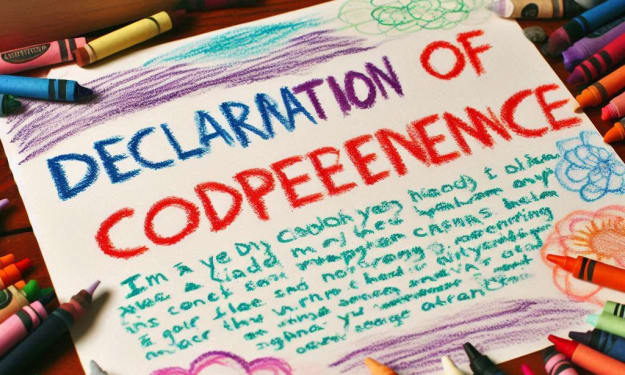
We the People of the Husbands of the United States of America, in Order to form a more perfect Union, and I mean you...with me...establish Justice, insure domestic Tranquility, provide for the common defence, promote the general Welfare, and secure the Blessings of Liberty to ourselves, after Puberty, do ordain and establish this Declaration of Co-Dependence.
By Gerard DiLeo6 days ago in Humans
The Quiet Violence of Merit
We like to believe in merit. We say the word as if it were a clean equation: work hard, get results. Study longer, rise higher. Try again, succeed eventually. Merit promises fairness without sentimentality. It offers order. It tells us that outcomes are earned.
By Ajan Lori Abei5 days ago in Humans
Review of 'Man on the Run'
My wife and I saw Man on the Run, a nearly 2-hour documentary on Amazon Prime, about Wings, Paul McCartney's group that flew around the world from shortly after The Beatles broke up in early 1970 to shortly after John Lennon was murdered at the end of 1980, making a Beatles reunion forever impossible.
By Paul Levinson4 days ago in Beat



Comments
There are no comments for this story
Be the first to respond and start the conversation.