
Hypnotherapy, stress and IBS
How your brain and gut interact

It’s common knowledge that stress contributes to Irritable Bowel Syndrome (IBS), with symptoms such as abdominal pain, bloating, diarrhoea, and constipation making navigating daily life a challenge for many. But what does “stress” actually mean on a practical level?
Do we just need to chill out, or is there something deeper at play?
What lies behind the stress?
The underlying mechanism lies in our Enteric Nervous System (ENS), a complex network of nerves that governs the digestive tract. When we experience stress, the ENS becomes hypersensitive, overreacting to even minor triggers, leading to a cascade of IBS symptoms. This is part of what many gut health specialists call the “Gut-brain axis”.
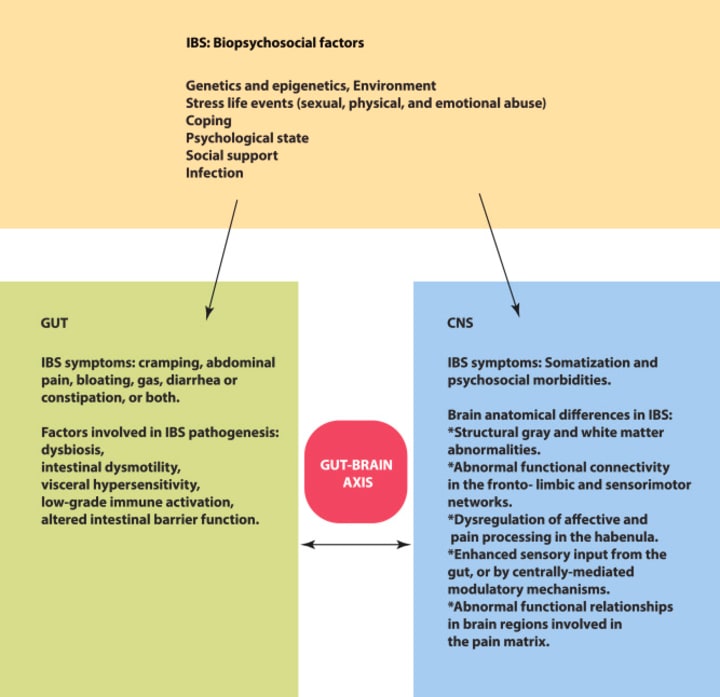
In the diagram below, taken from a study into the effects of hypnotherapy on IBS, you can see how “biopsychosocial factors”, meaning a combination of biological and environmental factors, all contribute to IBS.
These factors dysregulate both the Central Nervous System and your gut, leading to the symptoms we group into the term “Irritable Bowel Syndrome”. While removing one of these factors, such as physical abuse, may help reduce your symptoms, it often isn’t as simple as just removing you from your stressor, as downstream changes have already taken place.
Some of these changes are outlined in the blue box, bottom right, which calls the changes “somatization and psychosocial morbidities”. This idea can simplified by just calling it “changes in your brain and body” due to the initial response to your environment.
One really important takeaway here is that stress isn’t just “stress” in the common use of the term, but “stressors”, meaning infections, lifestyle, life events, genetics, toxins and so on.
The study cited above suggests that stress-induced implicit memories create long-lasting imprints of stressful experiences, which linger in your Enteric Nervous System and can actually alter the expression of your genes. Your environment impacting gene expression in this way is called epigenetics.
Using hypnotherapy to target Implicit Stress Memories: A New Path to IBS Relief
Hypnotherapy has emerged as a promising psychological treatment for Irritable Bowel Syndrome (IBS) since the groundbreaking study by Whorwell et al. in 1984. Subsequent research has reinforced the efficacy of hypnosis in alleviating IBS symptoms, prompting a surge of interest in this holistic approach.
Key Findings
- Comprehensive Improvement with Gut-Focused Hypnotherapy (GFH)
- Studies have consistently shown that Gut-Focused Hypnotherapy (GFH) not only targets primary IBS symptoms but also addresses other symptoms such as anxiety, and depression.
- GFH is associated with enhancements in overall quality of life and cognitive function.
- Effectiveness in Children:
- Hypnotherapy demonstrates particular effectiveness in treating IBS in children, offering a viable therapeutic option for this demographic.
Innovative Approaches – Skype Hypnotherapy
Research by Hasan et al. suggests that Skype hypnotherapy can produce significant improvements comparable to traditional face-to-face treatment. This finding opens up new avenues for accessible and convenient treatment options.
Cost-Effectiveness – Hypnotherapy with CD vs. Therapist Sessions
Rutten et al.’s randomized controlled trial indicates that hypnotherapy with CD-recorded self-exercises at home is comparable to therapist-led hypnotherapy in terms of cost-effectiveness.
Microbial Composition and Gut-Hypnotherapy
A study by Peter et al. explores the impact of Gut-Hypnotherapy (GHT) on the microbial composition of IBS patients. While small changes were observed, the primary benefits of GHT were associated with central nervous impact, suggesting modulations in the brain-gut axis.
Quality of Life Improvements
Shahbazi et al.’s research indicates that adding hypnotherapy to standard medical treatment significantly contributes to improving quality of life, reducing pain and fatigue, and addressing psychiatric disorders in treatment-resistant IBS patients.
Optimal Session Frequency
Hasan et al.’s extensive study on GFH found that six sessions of hypnotherapy were as effective as 12 sessions in improving IBS symptoms. However, the study emphasizes the need for long-term follow-up data to determine the persistence of these effects.
If your gut condition is leading to fatigue or pain, check out this free guide to recovery.
About the Creator
Keep reading
More stories from writers in Humans and other communities.
When True Love Never Questions Your Soul
“And she’s going to learn that this life will hit you, hard, in the face, wait for you to get back up, just so it can kick you in the stomach but getting the wind knocked out of you is the only way to remind your lungs how much they like the taste of air.” — Sarah Kay’s Poem — If I Should Have a Daughter
By Chantal Christie Weiss5 days ago in Humans
The Hidden Valentine part three
Some nights are never meant to be remembered. They carve themselves into the mind, replaying without mercy, resurfacing when you least expect them. They become the dividing line between who you were—and who you are forced to become.
By Ahmed aldeabella4 days ago in Humans
The Pride Flag and the Diversion
For nearly a decade, the LGBTQIA Pride Flag rippled in the wind at Christopher Park, a kaleidoscope of color staked into the soil of America’s first national monument to LGBTQIA+ liberation. That flag came down this week. Federal officials, citing new guidance from the Trump Administration, silently lowered the rainbow flag from its pole across the street from the Stonewall Inn. The birthplace of the modern gay rights movement now flies only the United States flag.
By Tim Carmichael2 days ago in Pride
If You Write A Book, Don’t Tell Anyone
There are days when I’m grateful Amazon doesn’t tell me specifically who has bought my book and who hasn’t. If they did, I would be heartbroken when I read the list and noticed all the important names in my life were not on my list of customers.
By Ellen Frances5 days ago in Writers




Comments
There are no comments for this story
Be the first to respond and start the conversation.