

The man with the gun is always the bad guy. That’s at least one thing I learned from a childhood of Disney film education, in which the bad guy shoots Bambi’s mother, nearly wrecks the friendship between the fox and the hound, and mercilessly attacks Pocahontas’s people. The man with the gun is not the hero. Not when he shoot downs defenseless humans and animals in cold blood. Cold blood.
The muzzle doesn’t feel cold in my hands though, weighing between them as I continue down a path I probably should have abandoned at the start of this mission. My feet move with caution over the red and brown flecked forest floor, crunching fallen leaves and small twigs. I’m not used to moving in silence, and each snap sounds as loud as a bone cracking and vibrating through the trees, reminding me of my intruding presence. As if the trees can see right through my camouflage sweatshirt and unshared agenda. I’ve tread these trails a thousands times before, and only now do I feel that I’m a stranger, an intruder. Noisy and alarming. I’ve never hunted before.
...
My father used to hunt with his brother. That was before he married my mother, a radically vegan hippie who didn’t believe in killing for any reason. When he hunted, Dad had respected the lives of the animals he had taken as part of life’s connected circle; he fulfilled his part in consuming their strength while they fulfilled theirs in becoming a part of him and a part of the earth, just as he would become one day. I saw some element of beauty in it when he spoke that way the first time he brought me to the woods with him, for observing rather than sport. He wanted me to understand the world he came from. He had grown up hunting and never questioned the justice in the matter. I considered his perspective as very much in line with Mufasa’s explanation of the circle of life, though the guns seemed to upset the balance of fairness. I wanted to agree with him, this father whom I viewed as godlike in his wisdom and character, but I couldn’t fathom the place of guns and deliberate death in the peace of nature. I was raised in a world of princesses, nature hikes, and dinners free from animal products. Mom, now less of a hippie but still the same vegan, nature loving spirit, instilled in me a deep respect for life and an intense fear for the oppressors of it.
I remember a scene of my parents at a dinner gathering with a few other couples standing around the porch table, fingers laced around the stems of wine glasses. An old pal of my father’s brought up the subject of hunting, questioning my mother’s stance on it. She commented on the lack of justice in animal slaughter, the displaced balance in the fact that we killed them far more often than a wild creature killed a human. Where was the fairness in killing for sport, for fuel when we could fulfill those needs through other mediums? My father, good-natured and humorous as always, perhaps a few drinks in, had joked that perhaps killing superfluously was man’s special talent. The cheetahs had their speed, the dogs their sense of smell, the dolphins both intelligence and speed in the water. We had this: killing. My mother had smiled knowingly, kissed him lightly just above his beard stubble, and instructed him sternly to abandon all such jokes in the future. I had considered her perspective the superior one in the matter, wandering back to the other children at the gathering with the conviction that my mother’s sense of justice and non-violence was without blemish. I couldn’t understand then how my father could love hunting and still love my mother.
Despite the differences in their views of hunting, no doubt a result of their upbringings, both my parents had a profound respect for life. They saw beauty in the worth of all things great and small in the natural world and viewed themselves as occupying an inextricable place in all of it. This shared love for nature and wild things was the love that morphed into their love for each other in the first years of their acquaintance. They had met in the woods. My father, trekking along with his fishing gear, had arrived to his favorite secluded lake to find my mother, face hidden behind her camera, totally absorbed in her view. He had watched her watch the water, the reflection of trees and sky, the changing leaves, until she finally focused on him and they watched each other for an infinite moment. He always said it was love at first sight. She needed convincing. He committed to the hunt.
Their appreciation for the beauty of the place brought them together and initiated a bond that grew into a relationship before evolving into a mutual love for each other and the natural world. My father’s family upbringing as a fisher and hunter complicated the initial stages of their romance, but he had been willing to hang up his gun for her. He kept it for the sentimental value it carried as a gift handed down from his father, but that was all I ever knew it to be in my life. He never took it to the woods with me.
When we went to the woods, we went as learners rather than hunters. He told me the names of each tree, the different types of pine, and the history of the birds. He taught me to read the ages of the trees by the rings in their wood. He showed me which plants I could eat and which to avoid. He knew the forest and its life like his own. I could never whistle a bird song like he did though. His pursed lips transformed him into feathered thing, while my own attempts produced spitting air. He’d laugh, “It’s probably genetic. Your mom can’t either.” I guess it was meant to make me feel better of it just wasn’t in my blood to be a warbler. So I just listened to his songs, melodies that floated up into the trees and wove his sounds into those of the forest creatures as if he were one of them.
I think that’s why they loved each other, Mom and Dad: they both had the nature gene. Dad with his knowing and singing. Mom with her healing and growing. On summer evenings her hands smelled of basil leaves from gathering the greens in her garden. She walked among her plants like a nymph
How could you be one with something, somewhere and yet have it hurt you, end you?
...
I’ve never killed before. Not on purpose at least. I was haunted for a good week when an innocent chipmunk met his end beneath the relentless rubber of Dad’s truck tires. I felt somehow responsible for his death since I had watched the creature hesitate on the side of the road and dart out just as we sped by. I don’t know if his soul went to animal heaven or just floats about the earth. I’ve always believed that animals (which I learned were named from the Latin animus for spirit) had souls and felt the truths we did: love, fear, joy, anger, hatred. I felt a spirituality we shared as beings in the same nature do. I’ve never felt the need to hurt, and I never knew the thirst for blood would come so naturally to my mouth.
But death is a curious thing. It changes things. What should be a stranger in my hands, hard and metallic, weighs right. Like it was always meant to be there.
As I tread through the woods, I remember this one afternoon in late August of last year when we were driving home from a trip to my mother’s parents’ home in Rangely, Maine, Dad at the wheel of the famiy Suburban, Mom beside him, leaning into the console to be closer to his body. I sat right in the middle of the back seat, intently focused on the two of them and our conversation. I can still hear Dad’s explanation of the rationale behind carrots’ accreditation for good sight.
“Apparently the Germans fell for it, to some extent at least. Sources say they started feeding more carrots to their flyers. Crazy that people still say that eating carrots improves eyesight. My own old man used to tell me I’d never need glasses if I kept eating those carrots”
“Oh?” Mom feigned surprise, “I didn’t realize you ate anything other than chicken nuggets and mac ‘n cheese as a young child.”
“I’ll have you know I had an exquisite palate even in my youth,” Dad responded, speaking in a feigned and pretty awful accent that made me laugh. I’d probably laugh at about anything Dad said when he tried to be funny.
For a 12-year old, I was more in love with my parents than any of my peers. Mom and Dad were my world, my everything. I thrived on their love for each other and me and the world. I drank in their every action, word and look like ambrosia. As I sat there between and behind them, I knew only our world, the one in which love ruled all as given and received by each of the inhabitants.
That world met a jolting halt when our car entered an easy highway turn and surfaced to a full grown male moose stagnant in the right lane. That night collected the souls of that fated moose, our Subaru windshield, my mother, my father, and my sanity. The EMTs who rushed to the scene collected my faltering body and crippled soul. I entered blackness...
and returned to the world in fragments. First my body, then my mind, perhaps then my heart. My senses registered my new world as I woke in my hospital room. White walls. Sickening sweet smell. Cotton blanket weight on my body. Monitor beep. Plastic cords in my arms. Heavy weight over my left side. Cold. Oh, so cold. As my eyes adjusted to the light, my mind caught up with me. The car, Mom’s scream, the crash. And I was alone.
The days and weeks following were a blur. As the only survivor, I knew only an overwhelming sense of guilt and the insanity of vengeance. I hated myself and the world who had taken my parents from me. My father who respected and valued all life and my mother who loved living creatures so much that she abstained from consuming animal products. Why those two?
My mother’s sister took me in - very religious woman who found solace in prayer and tried to give me the same solace. The guilt and thirst for revenge that lived in my mind drowned out any will to refuse her, so I let her take me to prayer services, churches and things like that. I don’t remember most of them. I spent the time I sat in church pews lost in the helplessness of wanting to but not being able to do anything. Things changed though.
At Sunday service a few weeks ago, the second reading was from Exodus. Certain words woke me up: “Eye for eye, tooth for tooth, hand for hand, foot for foot.” I remembered my mother’s words about the justice in killing, the fact that we killed them more than they killed us.
“An eye for an eye, a tooth for a tooth.”
A soul for a soul. A life for a life.
One moose had died. Both my parents had been killed. My mind reached a conclusion and formed a plan.
…
As I near Moose Pond, I move more slowly, more cautiously. My mind has cleared the grey from my judgment and sees only black and white, good and evil, wronger and wronged. I intend to reset the balance in this scheme of justice and in my life.
I hear only my breathe, surprisingly even despite my pounding heart, and the twinging snaps of twigs under my sneakers.
For what seems like minutes our eyes stay like that, locked. And I see eyes that shockingly look like and are human eyes. They have soul beneath them. They have feeling. I wonder how much of a person this creature is compared to me? Are we the same? Do we have the same rights to live, to breathe, to love and to be? The thoughts don’t align with my grief’s intent, so my hands falter with my weapon. Suddenly, a movement in the brush startles me from my reverie.
A young moose, a mere calf, stilts toward his mother on spindly legs. She moves protectively in front of the child. Our eyes remain locked.
I raise the gun in my arms and let out a single shot that echoes off every tree in radius.
The mother and child have darted off into the dense woods before I even lower my eyes from the sky to where I’ve shot to the ground where they stood.
My boots revisit their initial steps all the way to the gate. My mind cannot fathom the force who lived there for a time. I don’t think I can explain how my eyes are different from the eyes of my own mother or the moose mother.
The orange sign on the left as I step over the exit gate reads NO HUNTING. It says nothing about revenge or forgiveness.
About the Creator
Keep reading
More stories from Deirdre Anna and writers in Humans and other communities.
A Pachelbel Canon Night
When I was writing my first book, the world around me was asleep, and I was awake in the wonder of the light. Every guidance was in the nuance of the living form. I had a house then and not much else, but I had a room for which to grow and live, and everything else was a beam of light to see by. I lived in prayer, in meditation, and there was no radical transformation. It was more of a sifting and taking it all in.
By Canuck Scriber Lisa Lachapelle18 days ago in Humans
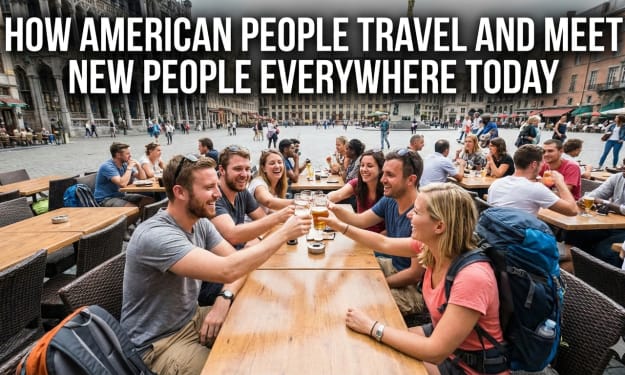
How American People Travel And Meet New People Everywhere Today
The American travelling has transformed in the last 20 years. What used to be based on sightseeing, rest or checking destinations on a list, now becomes more personal and social. Travel is becoming more person orientated today. Americans are not traveling simply to see new places anymore, they are traveling to find new people, to share their stories and to establish cross-cultural, cross-linguistic and cross-border relationships. The yearning to establish meaningful human relationships has been shifted to the center of the travel experience in an era of connectivity, mobility as well as digital communication.
By Tiana Alexandra6 days ago in Humans
Bruce Lee and The God of War: Kuan Ti
It starts with love.. The Power to the God Of War and Wealth Walk into a Chinese restaurant (even in Oklahoma, USA), a Chinese police station, a kung fu martial arts studio or even a Chinese temple and you often see a red faced warrior holding a heavy quan-do (spear like weapon).
By WILD WAYNE : The Dragon King5 days ago in Chapters



Comments
There are no comments for this story
Be the first to respond and start the conversation.