
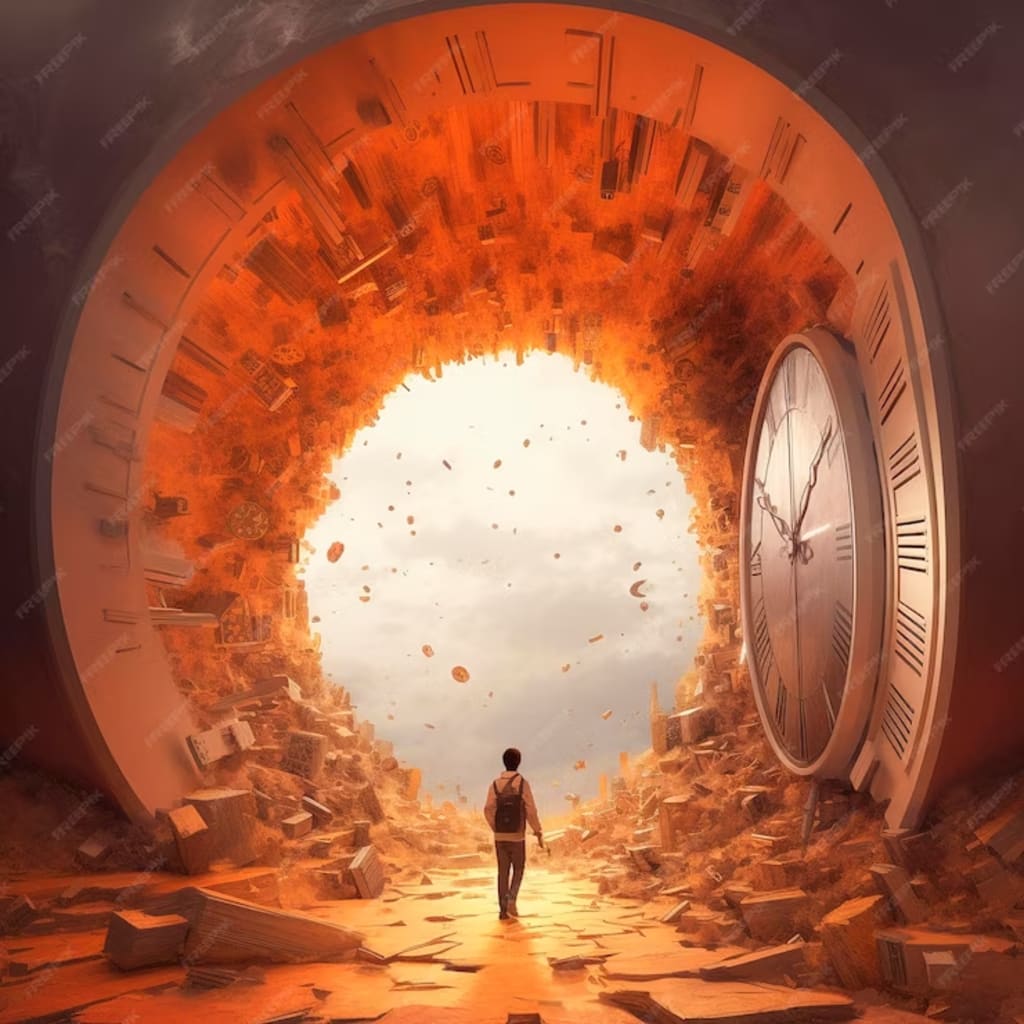
TIME TRAVELER
Have you ever dreamt of traveling through time? I'm sure we all have. Maybe you want to go back to the past to see how things were, perhaps even change something. Or would you prefer to venture into the future, to glimpse how things turn out? Time travel, a perennial theme in science fiction, has books and movies imagining its benefits and risks. But is time travel actually possible? And if so, what prerequisites must be met? To comprehend how we might embark on this journey, we must first fathom the nature of time.
In classical physics, time was viewed as a universal constant, an entity existing for all, everywhere in the cosmos, independent of perceivers, advancing at a uniform cadence for all. This conception posits that a cause unfailingly precedes an effect, never the other way around—an underpinning of the universe's structure. However, this understanding of time falters under certain circumstances. Hence, Einstein's theory of relativity stands as one of the most monumental scientific breakthroughs, elucidating the mutable essence of time.
Relativity regards time as a constituent of a four-dimensional space-time, susceptible to influence by various factors. Objects hurtling at great speeds, for instance, experience time dilation, a slowing of its passage compared to those in less rapid motion. A parallel effect occurs for objects ensnared within gravitational fields. On a human scale, this implies that an astronaut orbiting Earth will age more languidly than those of us grounded on the planet.
Yet, there exist even more astonishing ramifications. Take black holes, for example. They assert the most potent gravitational pull in the universe, so formidable that even light succumbs to its grasp, leading to an extreme deceleration of time. If one were, hypothetically, to plunge into a black hole, gazing out at the universe, they would bear witness to eons of events before succumbing to their inescapable fate—or perhaps be ensnared amid cosmic bookshelves, were escape even conceivable.
Another peculiarity of time emerges with the speed of light. As one accelerates, time slackens, until the hypothetical apex velocity, the speed of light, is reached. At this juncture, time is so languid that events seem to occur instantaneously. Envision a photon emitted by a star on the farthest reaches of the cosmos. Though its journey spans countless eons, for the photon, creation and arrival are simultaneous. If time is rendered neutral at light speed, neither advancing nor receding, could this be a viable route to advancing through time?
The crux lies in journeying backward in time. If, at light speed, time stands still, might surpassing this threshold engender retrogression? Many researchers contend so. They posit the existence of a subatomic particle, the tachyon, capable of this very feat. These particles, theoretical and yet unobserved, are elusive, for their approach would be an event transpiring in the future. For tachyons, the conventional notions of cause and effect are inverted.
There's also the theory of wormholes, conduits through the fabric of space-time, potentially linking any two points at any given juncture. Relativity entertains the possibility of their existence, but the energy requisites to forge one would be astronomical, possibly culminating in a black hole's formation. Stephen Hawking, for one, contended that radiation feedback akin to sound's resonance would render wormholes inherently unstable and unsuitable for time travel.
Alternate propositions have surfaced, postulating ways to harness space-time for time travel. Lasers, perhaps, could generate extreme gravitational forces. Quantum physics might yield a so-called quantum tunnel between universes, while string theory might unveil the interplay of cosmic strings and black holes in bending space-time sufficiently for temporal regression.
In summation, the prospect of time travel has perennially captivated researchers and the collective imagination. While once deemed utterly implausible, advances in our comprehension of the universe over the last century have shifted this perspective. It is no longer dismissed outright, though it remains a capacity well beyond our present grasp. The laws of physics allow for the possibility, and in the future, it may transition from the realm of fiction to fact. But I'm eager to hear your thoughts. Do you believe time travel has already been achieved, or might there be time travelers among us?
About the Creator
Monk
I just don't see the world as it is, because most of the things we are doing is a copy cat system of those who came before us and that keeps me wondering what-if no one knew what was wrong or right, what is evil or Holy...what happens then?
Keep reading
More stories from writers in Humans and other communities.
The Angry Man in Your House
"If you grow up with an angry man in your house, there will always be an angry man in your house" This statement has caused plenty of controversy online, people say its a statement that blames victims while also undermining those who break traumatic cycles to form health relationships... but if I'm honest now that I'm in my 30s it makes more sense to me than ever, and I'd argue that its not just about fathers and uncles.
By S. A. Crawford2 days ago in Humans
George Stroumboulopoulos: Wife, Net Worth, Children, Biography, Career & More
George Stroumboulopoulos is one of Canada’s most recognizable media personalities — a household name known for his sharp interviews, thoughtful insights, and dynamic career spanning radio, television, and digital media.
By Enoch Sagini5 days ago in Humans




Comments
There are no comments for this story
Be the first to respond and start the conversation.