
Human Beyond Borders
How Empathy Survives Where Peace Does Not

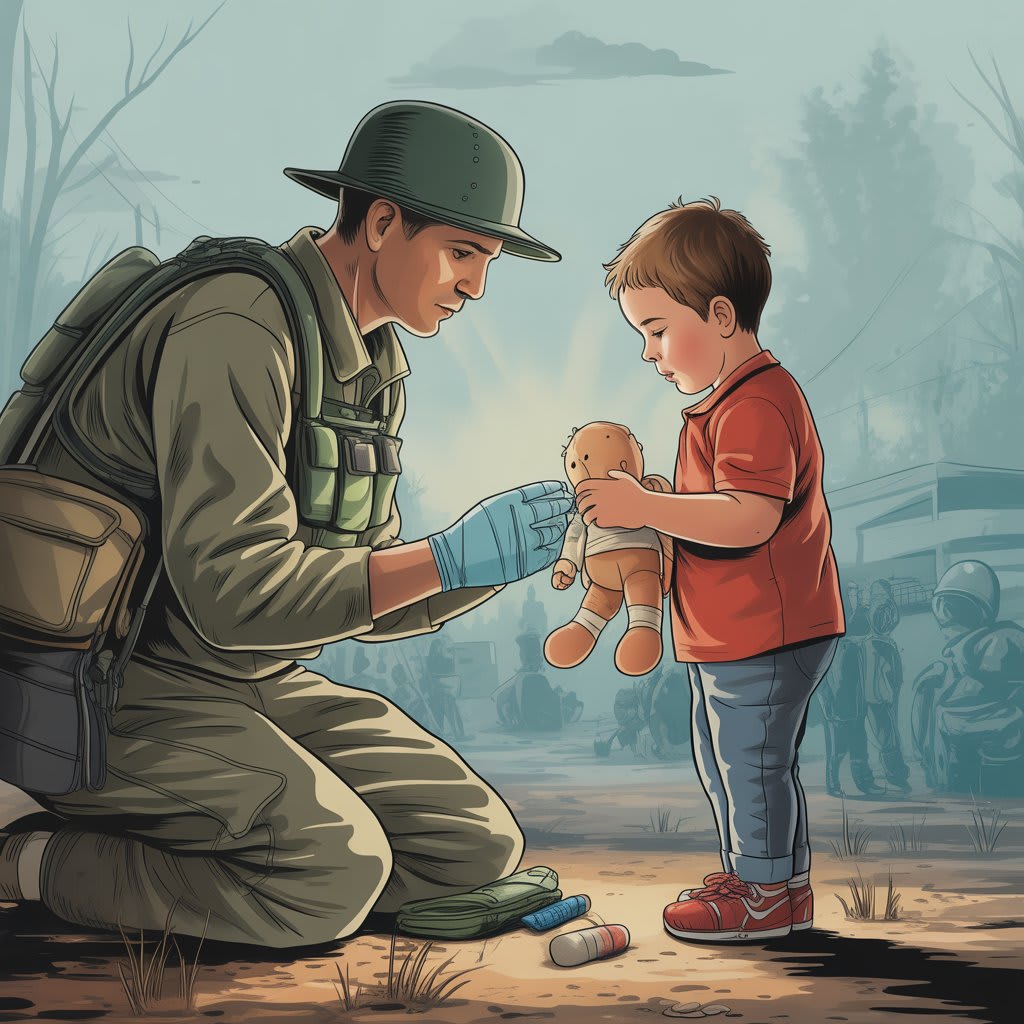
In a world increasingly defined by conflict, division, and fear, stories of compassion often go unheard. Yet, it is in the heart of war zones — amidst collapsed buildings, distant gunfire, and dust-covered streets — that some of the most profound examples of human kindness emerge. These acts, often small and unnoticed, are reminders that even when nations clash and ideologies divide, the human spirit remains unbreakable. Compassion, it seems, knows no borders.
A Universal Language of Care
War strips people of their homes, families, and futures — but it cannot always strip them of their humanity. In Syria, a paramedic rushes into a bombed neighborhood not knowing if another airstrike will follow. In Gaza, a nurse stays behind to tend to the wounded even as evacuation orders ring through the hospital hallways. In Ukraine, volunteers open their homes to displaced strangers, offering hot meals and warm beds to those with nowhere else to go.
These acts, though carried out under extreme pressure, are not performed for recognition or reward. They are carried out because someone, somewhere, believes that no life is worth less than another — regardless of nationality, race, or religion.
When the Enemy is a Fellow Human
One of the most striking examples of this humanity came during the Syrian Civil War. In 2017, a photo of a White Helmet volunteer pulling a baby from rubble circulated around the globe. Covered in dust and bleeding from the head, the child was still alive. The man who saved him was not a soldier or a politician. He was a former builder who had trained himself in emergency rescue. He later said, “That day, I didn't see a religion. I didn’t see a side. I only saw a life.”
These moments challenge us. They reveal that beneath every uniform, behind every barricade, and across every dividing line, there are people capable of extraordinary compassion — people who refuse to be defined by the roles conflict assigns to them.

Aid Workers on the Frontlines
Humanitarian aid workers play a vital role in delivering compassion across borders, often risking their lives to reach those in need. Doctors Without Borders (Médecins Sans Frontières), the International Red Cross, and countless other organizations enter war zones where others fear to go. They bring not only medical aid and supplies, but dignity, hope, and a human connection.
In Yemen, where civil war has devastated the country for nearly a decade, aid workers have braved bombings and roadblocks to deliver lifesaving vaccines and food. In Sudan, during the recent internal conflict, volunteers carried injured civilians on makeshift stretchers for miles to reach medical help. Many of these helpers are locals — teachers, farmers, and students who set aside their personal safety to serve others.

The Power of Small Gestures
Not every act of compassion is heroic in scale. Sometimes, it’s the small gestures that echo the loudest. A child in Afghanistan shares his only piece of bread with a hungry friend. A soldier in Ukraine helps an elderly woman cross a destroyed street. A Palestinian father builds a swing from scrap metal to give displaced children a moment of joy amidst the rubble.
These are not random acts of kindness. They are deliberate choices in the face of fear, hatred, and despair. They are the essence of what it means to be human.
The Role of Technology and Social Media
In modern conflicts, technology has played an unexpected role in spreading stories of compassion. Social media has given voice to those who might otherwise go unheard. A viral video of an Israeli and Palestinian medical team working together to save a child. A livestream of volunteers in Syria creating underground schools for displaced children. A photograph of Ukrainian civilians rescuing abandoned pets from war-torn cities.
These digital testaments don’t just tell stories — they build bridges. They remind us that people on the other side of a border are not so different. They cry the same, love the same, and hope the same.
Beyond Politics, Beyond War
What do these acts of compassion mean in the broader context of war? They tell us that while governments may fail, and peace agreements may collapse, the individual has the power to act. Compassion in a war zone is more than a feeling — it’s resistance. It is the resistance against dehumanization, against fear, and against silence.
When we honor these acts, we honor a version of humanity that refuses to be caged by politics or nationality. We honor the refugee who teaches children in a tented camp. We honor the doctor who uses candlelight to perform surgery during a blackout. We honor the journalist who risks everything to share these truths with the world.
What We Can Learn
The stories from war zones serve not only to inspire but to challenge. They ask us: what borders exist in our own hearts? Whom do we choose to help, and whom do we ignore? Where do we draw lines, and why?
True compassion doesn't require a crisis — but it does require courage. And while not all of us will find ourselves in a war zone, all of us will find ourselves near someone in pain, in need, or in fear. It is in those moments that the spirit of “Human Beyond Borders” truly comes alive.
Conclusion
In a world fractured by violence and ideology, compassion is the quiet revolution. It is the hand that reaches out in the darkest moments and says, “You are not alone.” As we navigate an uncertain future, may we carry these stories with us — not as distant tales of heroism, but as calls to action. Let us be borderless in our empathy, tireless in our humanity, and fearless in our compassion
About the Creator
Malik Rohail Khan
A curious writer crafting thoughts on life, lessons, and leaps of faith. I write to connect, inspire, and reflect the little things that shape big changes. I believe words shape the world—let’s write something that matters.
Keep reading
More stories from Malik Rohail Khan and writers in Humans and other communities.
Humanity as a Religion
Introduction: In every era of history, people have sought something sacred to guide their lives. For many, that sacred element has been religion, offering answers about meaning, morality, and the destiny of humankind. Yet, as much as religions have brought comfort and community, they have also sometimes divided humanity into competing groups. What if there could be a faith that belongs to no one tradition yet includes everyone? A faith without borders, rituals, or dogmas, but one rooted in the essence of our shared existence. That faith could be called Humanity as a Religion, with love and respect as its central commandments.
By Malik Rohail Khan4 months ago in Humans


Comments
There are no comments for this story
Be the first to respond and start the conversation.