
How to Fold a Broken Heart
Lessons in Letting Go, One Fold at a Time

The first thing Clara did when she found the letter was sit on the kitchen floor, still in her office clothes, purse slung over her shoulder, as if movement might make the words vanish. But the words had weight—written in David’s familiar, looping handwriting. Not cruel, not cold. Just final.
*"I don't know when we stopped being us. But I can't find the pieces anymore."*
It wasn’t the kind of letter that asked for a reply. It wasn’t even left where someone would find it in time to argue. It had simply been placed on the counter beside a half-empty mug and a folded napkin—the quiet artifacts of goodbye.
The apartment was still full of him. His scent in the closet. His laughter embedded in the couch cushions. His favorite records on the shelf. But something had shifted. Something had folded itself into a shape she couldn’t yet understand.
She spent the first few days unmoored. Meals became cereal, and sleep was a game of pretending to rest. Her phone sat silently, almost respectfully. Friends reached out. She didn’t reach back.
Then one morning, as sunlight filtered through the curtains in soft slices, Clara noticed the origami crane on the windowsill. David had made it months ago on a rainy Sunday afternoon while they drank coffee and watched documentaries they weren’t really paying attention to. He had always been good at folding—paper, situations, emotions. She remembered teasing him about it.
"You're always folding things instead of facing them."
He had laughed. “Better to fold than tear.”
Now, Clara picked up the crane. The paper was a little faded from the sun. But it still held its shape. Balanced. Delicate. Intact. And that’s when the idea came to her.
If you could fold a crane from paper, maybe you could fold something heavier. Maybe you could fold a feeling. A memory. A heart.
She pulled out a fresh sheet of paper—crisp, white, and empty—and wrote down the first memory that ached: *"The night he told me he loved me under the streetlamp on 5th Avenue."* She read it once, let it sting, then folded the paper into a square. Then again. And again. Each crease a soft rebellion against the chaos. She didn’t know what she was making, only that the folding gave her something to do with her hands when her heart didn’t know what to do with itself.
Each day she added more.
*A fight in the rain.*
*A dance in the kitchen.*
*The vacation that almost made them whole again.*
She folded them all. Some into birds. Some into flowers. Some into odd, unrecognizable shapes. The table near her window transformed into a tiny paper forest of memories, each one holding something real, something once heavy, now lighter.
Weeks passed this way. Friends slowly returned, invited her out for coffee, for walks, for laughter that didn’t quite sound like hers yet but tried to. She said yes more often. Not always. But enough.
One evening, as autumn began to creep in through the windows, Clara sat at the table with a final piece of paper. She had saved this one. The last memory.
*"The day he left, and I didn’t ask him to stay."*
It hurt more than the others. Not because he left. But because she let him. She had always believed in fighting for love, in writing grand speeches in her mind, in proving worth. But that day… she had simply stood there, letting silence do what her voice could not.
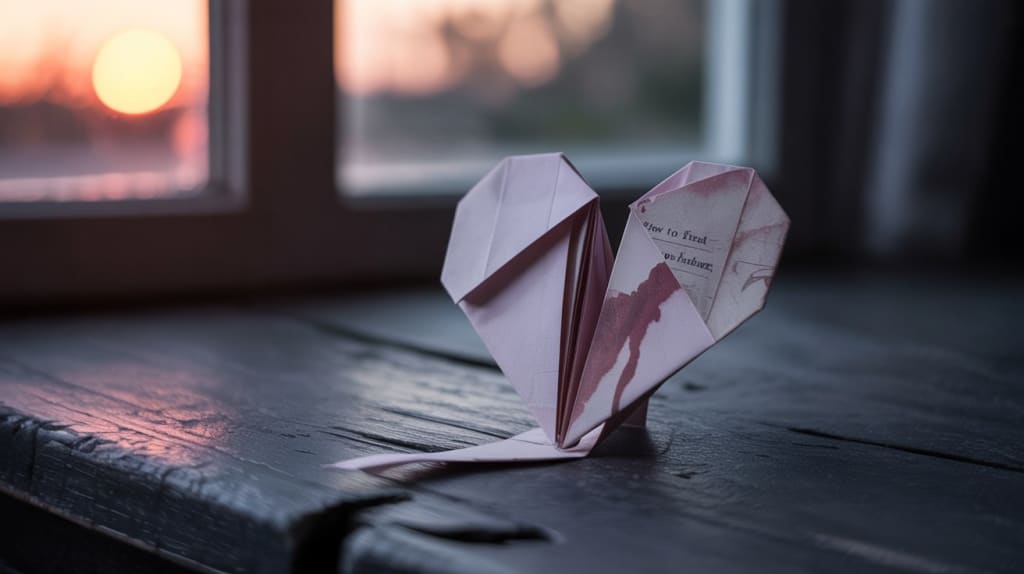
She folded slowly this time. The paper trembled in her hands, but her fingers moved with quiet determination. When the last crease was made, she placed the small heart—simple and imperfect—at the center of the table.
She looked around.
The table was full now. A hundred small paper things, each holding pain, joy, regret, beauty. It looked like art. Like healing. Like surrender.
Clara didn’t feel whole yet. That wasn’t the point. But she no longer felt unraveling. She had, piece by piece, folded her grief into something tangible. Something she could hold and admire, and eventually—let go.
Later that night, she packed the origami in a box. Not to hide them away in the dark, but to honor them. To say: *"You were real. You mattered. And now you're allowed to rest."*
Outside, the moon hung low, watching through the window like an old friend.
Clara stood there, holding the box to her chest, and whispered—not to David, not even to the memory of him, but to herself:
**“This is how you fold a broken heart. One crease at a time.”**
And she meant it.
About the Creator
Jawad Khan
Jawad Khan crafts powerful stories of love, loss, and hope that linger in the heart. Dive into emotional journeys that capture life’s raw beauty and quiet moments you won’t forget.
Keep reading
More stories from Jawad Khan and writers in Humans and other communities.
I Found Home in a Stranger’s Smile
It was the loneliest Tuesday of my life. I had just moved to a new city—one of those decisions you make at 2 a.m. when your heart is too tired of its own story and you’re convinced that a change of scenery might rearrange your soul. I didn’t know anyone here. No friends. No family. Just an apartment that echoed with silence and a city that moved too fast to care.
By Jawad Khan8 months ago in Humans
The Small Woman with a Giant Heart
By Hazrat Umer The true story of how one person led a hundred children across mountains to safety during a war In the history of the world there are many stories of kings and soldiers who won wars but the story of Gladys Aylward is different Gladys was a very simple woman from England who worked as a house maid she did not have much money and she was not very tall or strong she was so small that people often ignored her but inside her small body there was a giant heart and an unbreakable spirit she had a dream to go to a far away land called China to help people who were poor and sick
By Hazrat Umer2 days ago in Humans



Comments
There are no comments for this story
Be the first to respond and start the conversation.