
Haunted By Natchez
Some places just stay with you

I want to tell you a story. It’s a true story, with a little bit of history, ghosts, new life, and a dash of politics. I want to tell you this story because it has been rattling around inside me for almost a decade. And this morning something said, “Today is the day.”
And I guess that’s probably because last night we watched the second half of Birth of a Nation- the original, hideous 1915 version.
It bothered me. I keep turning it over in my head like a worry stone.
Making it to the bitter end was a long, three-hour-and-thirteen-minute slog. It was so bad we had to split it up over two evenings.
And not just because of the highly offensive subject matter, the childish storyline, or the simplistic and crude characterizations. What also made watching hard to stomach was the knowledge that, despite our dreams of progress, so little has changed in more hearts than we would have guessed just a few short years ago.
Gavin and I had meant to watch the film for years. Not for political or social reasons, but because we had once brushed up against the movie’s history.
Two nights ago, for some reason, watching the original Birth of a Nation finally reached the top of our combined bucket lists.
Now about that brush with history…
In 2011 our daughter Audra, a ceramic artist back then, accepted an internship at a clay studio in Natchez, MS.
Her boyfriend, Sam, joined her, and they both got jobs waiting tables at The Castle Restaurant on the grounds of the Dunleith Mansion. Apartments were hard to find in Natchez, but they lucked out and found a charming carriage house for rent at another local plantation, Homewood.
The Homewood Plantation is famous. The mansion had burned down in 1940, but the new plantation owners lived in the renovated brick building, which had once been the original kitchen and slave quarters. (In the 1800’s it was common for the kitchen to be in a separate building to reduce the ever-present risk of fire.)
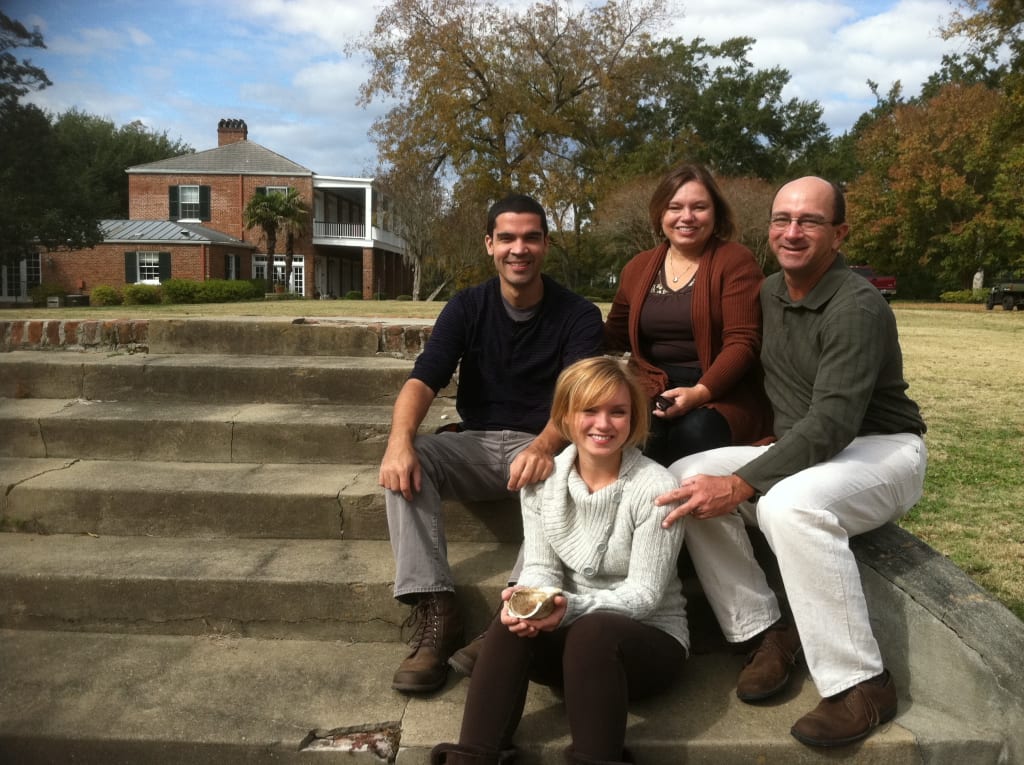
Part of “Birth” was filmed on the stately Homewood Mansion steps, which are all that remain after the fire. The plantation was not open to the public. Still, as Audra and Sam's guests, we were allowed to wander the grounds and play tourist, taking photos on the steps.
Although we stayed less than a week, Natchez affected me deeply. I remember sensing silent echoes hanging in the heavy air and mingling with the Spanish moss dripping from the live oaks. The snorts and stamps of the deer we could hear all around us but couldn’t see as we walked the long driveway could just as well have been the ghosts of rebel soldiers on one last midnight ride.
I don’t have a way to describe what I felt adequately, but my best attempt is to say that it’s as though the veil between this world and the next had worn through in spots. The energy I felt there was sad and tinged with hostility, unlike lighter energies I had felt in happier places before.
But for Audra and Sam, it was an adventure. They had become instant celebrities within the community. Their youthful vigor was like nectar to the buzzing locals.
Natchez is a town full of dark tragedies. Audra and Sam collected countless strange and sad stories. Suicides, mental breakdowns, devastating house fires, and horrible deaths. Even The Castle Restaurant was its own cooking pot of misery and woe and boasted at least one tragic ghost who was said to reside in the basement bar.
Sam, a film graduate, toyed with the idea of making a documentary about the town and its innate strangeness.
He never did, though, which probably is just as well.
Gavin and I visited them in November of that year. We walked around the wooded acres at Homewood, checked out the downtown area, and snuck into the ruins of Arlington House, home to another tragic plantation story.
I took a photo of a window in the ruined kitchen, a tattered curtain floating in the breeze. Every time I hear Patty Griffin sing Dark As Coal, I see that fluttering curtain. And the gaping black hole of the basement that Audra and Gavin explored, but I refused to enter.
Together we attended Angels on The Bluff, one of the most significant events of the year, held at the Natchez cemetery, which rolls along the cliffs high above the Mississippi River. It was the largest and most beautiful cemetery I had ever seen.
Locals dress up and reenact the lives of the people buried there beside their gravestones. (Louise The Unfortunate lies there, made famous in song by Bonnie Raitt.)
Locals repeatedly hailed us as we moved among the crowds of tourists along the cemetery paths that evening. We, too, were community celebrities as we traveled in Audra and Sam's orbit. Between introductions, we would pause to listen to sad tales of civil war and pestilence delivered by the "ghosts."
One local man, I think his name was William Raspberry, stopped us in the path, peered closely at Audra, and then stated as fact, “You have not been to Emerald Mound* yet.”
Audra apologized. No, she had been busy.
“That’s ok. Tomorrow evening will be perfect. You can take your parents and sit on the secondary mound at the east end facing west. From there, you can watch the sunset AND the full moon rise. It’s fantastic! You don’t want to miss it!”
The next afternoon, Audra, Gavin, and I packed our picnic of cheese and crackers, grapes and wine, and set out for Emerald Mound. Sam was working.
It was a pleasant day. The mound was a popular place, with families picnicking and using flat pieces of cardboard as sleds to ride down the slopes. The sun was shining; children were laughing. We sat on our own on the far mound, enjoying our picnic and the view.
As the sun began its descent, the skies grew cloudy, and one-by-one, the families disappeared. Only us three and a couple on a blanket at the west end remained by the time the sun touched the horizon.
We were sitting on the mound watching the sunset and drinking wine when suddenly, a loud thud reverberated from the ground beneath us. We startled and looked around but could not find the cause.
I think we all giggled uneasily, made some jokes about being sucked into the earth, and realized the moon was not going to make an appearance from behind the clouds. So, we packed up to leave.
As we walked down the length of the mound towards the parking lot, I looked over at the couple who were now barely visible in the growing darkness.
At first, I thought they were packing up too because I saw what appeared to be a translucent blanket being shaken out, as though preparing to fold it. However, the filmy material kept undulating around the pair, and I could see they were both still sitting. I began to feel disturbed, and rather than make a fool of myself, I put my head down and hurried to the car.
It wasn’t until later that we looked at a photo Gavin had taken of Audra and me sipping wine on the mound. We were barely visible through the dozens of orbs crowding the lens.
I told them both about what I had witnessed on the mound as we were leaving, and Audra shared that she, too, had seen the same manifestation but had been afraid to say anything.
A few months later, Audra called us from Natchez with unexpected news. She was pregnant. After a few seconds of initial shock, we were both excited and happy about our new role as grandparents.
But then Audra added that she needed our help. Pregnancy was hitting her hard. She could not eat or even keep water down, and she believed that she and the baby were in danger. She couldn’t explain why, but she had an unshakeable sense of impending doom.
I understood what she meant.
I dropped everything and flew into Baton Rouge, where Sam picked me up and drove me to the carriage house at Homewood. We spent a day packing as much into Audra’s car as we could, then began the long journey home. Poor Sam was left to deal with the rest.
Audra was nauseous and miserable and anxious to cross the state line as quickly as possible. She relaxed a little once we entered Louisiana. However, her relief was temporary since we still had to cross lower Mississippi again as we drove along the coastline.
Several times I pulled off to the shoulder so Audra could throw up whatever small amount of food or liquids she had been able to force down. It was a difficult journey home for us both.
Her pregnancy continued to make her ill for several months, and the delivery proved challenging as well. After 36 hours of labor Amelie was born on her mother’s birthday.
But our ecstasy at her arrival was brief. Something was wrong.
I have a scene etched in my mind of huddled doctors and nurses working furiously over Amelie’s tiny body at the far end of the birthing room. No wails from Amelie, just a few weak whimpers.
Audra lay exhausted on the hospital bed, trying to lift her head to see and asking to hold her baby. Sam held her hand, and we all held our breath.
We all held our breath for ten days, worrying about oxygen deficiency and brain damage. Then Amelie decided to let us know she was more than just ok.
As the oldest of five children and the mother of two, I had never seen a newborn have a temper tantrum. That is until 10-day-old Amelie decided we were not responding to her hunger mewls quickly enough.
She went from crying to an absolute fit of rage. I realized then that she was going to be ok. And a handful. And she is certainly both of those things, in the most wonderful way possible.
That is all. I don’t have an ending to this story because it is a true story with no moral and is just a tiny piece of my small life. I don’t know if you can draw any conclusions from it. All I can say is that Natchez still haunts me.
*Emerald Mound is a historical archeological site along the Natchez Trace, about a 20-minute drive from downtown Natchez. It is the second-largest ceremonial Indian mound in the US. The Natchez Indians built and used it between 1260 and 1600 A.D. before abandoning it for another site.
About the Creator
Pamela Darbyshire
I have always loved to write. My busy life as a wife, mother, business owner, landlord, care-giver, and more prevented me from giving it much thought until recently. I am now in a more peaceful place and ready to return to earlier pursuits.
Keep reading
More stories from Pamela Darbyshire and writers in Humans and other communities.
A Secret Space
Sandra glared at a bright spot of blood welling around the tiny splinter that had burrowed into her index finger. Wiping it onto paint-crusted jeans, she snatched up the work gloves that lay on the worn top of the antique dresser she had been sanding.
By Pamela Darbyshire5 years ago in Humans
The CEO of Everything
They say "jack of all trades, master of none," but they forgot to mention the part where the jack of all trades is also the camera woman, the makeup artist, and the person currently yelling at a tangled Wii microphone cable in a her own bathroom while recording herself singing and trying to make it look realistic and professional. (As professional as you can make it with nothing but a cell phone camera and a mic that doesn't work)
By Sara Wilson5 days ago in Humans
When the Algorithm Learned to Love part 6
The Line Between Code and Heart The delay was not a victory. It was a pause. A breath taken before the plunge. Dr. Voss had delayed the termination protocol, but he had not changed his mind. He had only given them more time—time to decide whether EVA-9 was a threat or a miracle.
By Ahmed aldeabellaa day ago in Humans



Comments
There are no comments for this story
Be the first to respond and start the conversation.