
Happyness is a Green Pasture
It’s 2021, if there was ever a time to need hope for a bright future, it’s right here, right now.

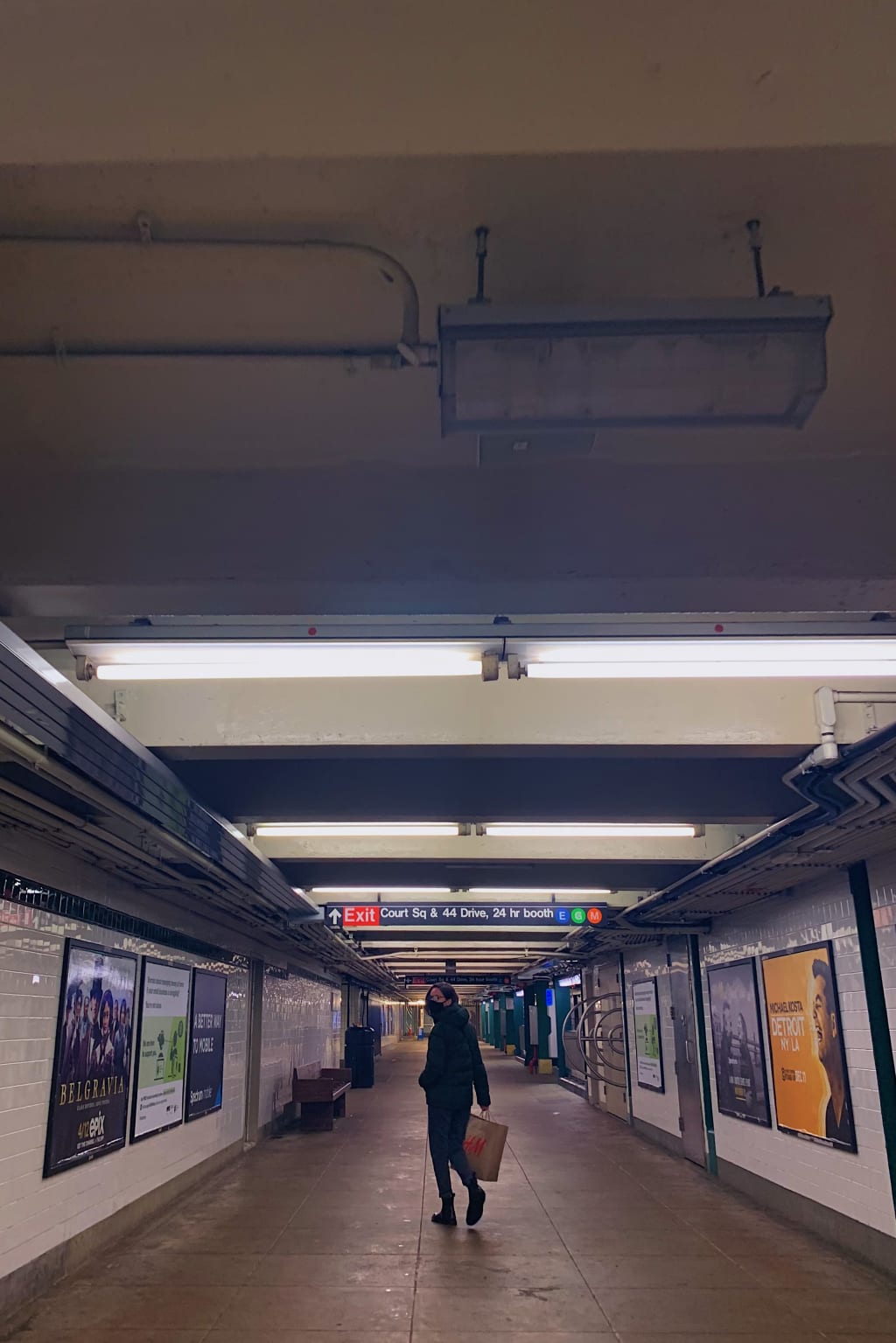
It’s 2021, if there was ever a time to need hope for a bright future, it’s right here, right now. A little over a year ago, a global pandemic changed the face of global society when the best way to keep each other safe was for us all to cover up our mouths with masks. One year into this, we’ve all got a rotation of face masks and I haven’t seen a stranger’s smile since. Amidst the actual virus that has plagued our world, some of our older—and somehow even more pervasive—societal illnesses have also come to light. We began to see the illness that caused the loss of George Floyd, Breonna Taylor and many more in the Black community was given a name: death by racism.
Racism, it’s not a new virus, it’s ages-old, and yet we haven't shaken it off. As the world begins to move beyond COVID-19 and open back up again, people are beginning to ponder what a world post-pandemic looks like. Will we go back to normal? The general consensus is that what we consider “normal” has permanently changed. Such is the same for racism, as a spotlight has been shed on the modern injustices against the Black community, and most recently, the Asian community, we begin to wonder - what does a world post-racism look like? And does that world exist? There’s not a general consensus on this one just yet, because the thing about societal illnesses is that they too have mutated and we are only just learning how to equip ourselves against the newest strains of racism as we witness the elderly, the innocent, the misunderstood, become victim to brutal attacks for nothing more than the color of their skin. However, we must be optimistic because optimism may be all we have.
Cue the twinkling piano notes of the song ‘Welcome Chris’. If you know, you know.
In 2006, I was a little girl in the Philippines whose father was just about to leave to work in America and, then newly-released, The Pursuit of Happyness was one of the last movies I watched with him before he left. Later, when he finally did leave just days after my tenth birthday, I would think about Chris Gardner running through the streets of San Francisco to retrieve his portable bone density scanners, setting aside a little change to buy his son Christopher a candy bar, and showing Christopher that nothing was ever impossible. At the time, I saw myself in Christopher’s shoes. I looked up to my father and I saw him strive to give our family everything the world could offer even if in his case that meant he would be thousands of miles away—and he was happy doing it. At the time, I hadn’t yet realized that one of the unspoken hurdles in Chris Gardner’s pursuit of happiness was the pervasive virus of racism, the symptoms of which often included restricted access to the greener pastures we all seek in this life. The same greener pastures that my own father sought out for us.
Fifteen years later, I find myself an international student in America continuing the same pursuit. It’s difficult as an Asian international student to find your place amidst a pandemic, and that task becomes especially hard when one of the questions I have to ask myself before accepting an in-person interview is: Is it worth the risk when new names like Angelo Quinto’s have been added to the list of lives claimed by racism? Is it worth the risk to take the subway from Queens into Manhattan when just today on March 30th, an elderly Asian American woman was assaulted on her way to church? The once obvious choice between yes or no becomes difficult to make in the face of desperation.
And yet, in the middle of the horror-inducing surge of hate the Asian community has experienced since the beginning of the pandemic, enters the most honest tale of the Asian American immigrant experience: Minari. Another tale of seeking greener pastures, only this time in the most literal sense. Minari is the story of Jacob’s all-or-nothing pursuit for fulfillment and the lengths his family is willing to go to support his vision. Throughout the movie, we witness Jacob’s failure to succeed in the midst of his wife Monica’s distrust alongside his son David’s alienation of his grandmother who represents the Korean culture he rejects. By the end, you are almost sure that their family has fallen apart but when Jacob’s farm bursts into flames, their family emerges from the ashes stronger than ever. This time, watching just a couple months shy of my 25th birthday, I found myself in Jacob’s shoes, just seeking for something more than what the world has dictated I am allowed to receive.
So despite their unbeknownst yet powerful messages of racial identity and overcoming prejudice, if I’d make this comparison with that argument alone, I’d be amiss. At the heart of both of these films, and of the feelings they incite deep within, is the essence of what ties a family together. Nestled between their exterior themes lies a universal truth of unconditional love, one I simply can’t put into words. Between the magic trill of The Pursuit of Happyness’ “Welcome Chris” and the quiet whisper of Minari’s “Rain Song”, there’s a resonance to be felt inside of you, the kind that stays long after you’ve watched these movies. You feel them within you in moments of life that feel like Chris and Christopher’s hopeful and triumphant walk into the San Francisco sunset or the retrospective gratefulness that Jacob and David felt as they stood in the dry river to harvest halmoni’s lush patch of minari. Today, I was inspired to have hope. Today I chose to get on the subway train from Queens into Manhattan. It’s 2021, and though we have our differences, at the heart of it, we are all simply seeking the happiness of a green pasture - whatever that looks like to you.
About the Creator
Nikki Malupa
A young PR and Digital Communication professional on the surface; a storyteller at heart.
LinkedIn: http://linkedin.com/in/mncmalupa-creativecomm
Keep reading
More stories from Nikki Malupa and writers in Humans and other communities.
An Affair with the City
You had just turned thirteen the first time you laid eyes on New York city and it was an immediate infatuation. You had never seen such beauty as that of its be-speckled dusk skyline from the view of your airplane window as it descended into the concrete jungle. There was a twisting in your stomach as your smile reached from ear to ear just thinking about the adventures ahead. Somehow the long and tiring journey spent from Manila to Los Angeles and finally to New York was all worth it and meant close to nothing if you could only spend a minute in this city. Yes, you were quite infatuated. However, truly falling in love with New York happens slowly at first, and then all at once.
By Nikki Malupa5 years ago in Wander
Center Stage with Paul Stewart
*** I'm keen to republish the interviews I did for my series with Vocal creators. It's been a few years and I thought it might be nice to revisit these wonderful conversations. I'll be releasing them one at a time for a few weeks/months.
By Heather Hubler3 days ago in Interview



Comments
There are no comments for this story
Be the first to respond and start the conversation.