
Gordiano Lupi, "Calcio e acciaio"
Bittersweet nostalgia of the past.


“The problem with life is that, even when it never changes, it changes all the time.”
A novel where very little happens, “Football and Steel” by Gordiano Lupi, centered on a Proustian remembrance, a madeleine that refers profusely to the author’s previous book, the beautiful “In search of lost Piombino”. Here too nostalgia is the main figure, it permeates all the pages in an excruciating way.
“Giovanni returned to Piombino to fall ill with memories. When reality is not what we want it to be, we end up taking refuge in the past. “
The author disseminates himself, spreading himself on the various characters, Giovanni in the first place, but also Marco, Gino, Paolo, Paola, who all have the habit of remembering, of not adapting to everyday reality but looking for something else, something that had to to be and has not been, something that can never be again.
“Giovanni finds himself thinking that perhaps he does not miss Cinema Sempione so much, as the taste of days that cannot return, when everything was still uncertainty and discovery of the future, when the images on the big screen were his open eyes dreams. That’s right, like an ice cream still tasted today that does not retain the taste of the past, even if you buy it in the same ice cream parlor of your childhood. It tastes like things that can’t come back. It tastes of regret. “
All the characters have tastes, obsessions, interests that can be traced back to the author, from football, to cinema, to reading, to Cuba, and in them the gap between ideal and real is very strong, the arrow pointing upwards — where the real is always a loser — which is the most typical feature of Romanticism. These are people who “carry the thread of the horizon in their eyes”, because what they possess is never enough, they are not satisfied with the present but languish in regret, in a need that is always unfulfilled, always moved forward or backward.
Giovanni, the protagonist, is a former footballer of national fame who now, at the age of fifty, coaches the Piombino team, the city where he was born and raised and where all his memories are kept. Giovanni is a harsh man because he is fragile, a man who knows the terrible loneliness of those who feel alone in the midst of others, alone while eating a pizza with friends, alone while having sex with a partner with whom he is not in love. Perhaps, paradoxically, he is less alone when he walks without anyone on the cliffs from which he can see the island of Elba, while observing the seagulls in flight, listening to their screech soaked in brackish, touching the fleshy leaves of the Hottentot fig tree thinking about a team to train for a low-level championship. There are memories to keep him company, the faces and voices of the past, but the nostalgia is bittersweet, unbearable. He remembers the time that was, the lost dreams, the loves and, above all, the youth that will never return. Of this he is acutely and painfully aware: the opportunities have vanished, the trains have passed and the days to live are no longer so many.
“I often find myself thinking that we are the protagonists of a story that is ending, confined to a shadowy corner, we live on our past, we cry over our lives.”
Above all, what has been will no longer be and the pain, mixed with excruciating loneliness, is unbearable.
As a child Giovanni lived in a house that was beyond the means of the family, a house where he did not even have a room of his own, but which was interwoven with voices, flavors and memories. There, a few steps away, lived the grandfather, responsible for the fantastic world of Giovanni / Gordiano, for his storytelling ability, for the bad habit of dreaming; there his father dined with his back to the steelwork monster, smoky, gray, smelly, ready to bloody the sky with a false and iron sunset. The horizon of the courtyard was limited but known and loved. It was his horizon.
“At the edge of the horizon the industry, the continuous casting, the blast furnace that burned the ferrous residues and gave an unnatural sunset that colored the sky red at every hour of the day.”
Now Giovanni is in the villa of Salivoli, the one of his dreams as a boy, but everything has lost its flavor, the days spent without the commitment of football are empty, dry, depressing. Time gives value to things, to memories, even to what was not beautiful; all that has been, just because it is no longer there, even the troubles, even the degradation, even the sleepy and motionless province, even the boredom, become desirable, they become the madeleine soaked in tea capable of unleashing an explosion of reminiscences.
There are moments in which the dreams of the past collide with reality and then return to dreams again in the perspective of memory, as on page 55, where the scheme is DREAM> REALITY> DREAM.
“The teacher explained the Punic wars, while outside one began to sense the spring between the brackish tamarisk and the first flowers of the thorny agaves. Giovanni let the fantasy run. The story with all those dates and battles to learn by heart just didn’t interest him. It was a bit like math, after all. He could do without it. Fantasize no, instead. Follow the dreams that flew behind the rays of the sun, imagine the flight of a seagull in the colors of the rainbow, see pirate ships depart from the cliffs overlooking the sea. Those were the really important things. The teacher explained and he wore the clothes of a Roman soldier, gladius in hand, fighting in an immense African plain. He was the centurion Giovanni and participated in the destruction of Carthage. Under the orders of Publio Cornelio Scipione known as the African. Out of school, as always, he encountered reality. There was only his grandfather waiting for him. No Carthaginian general. No Roman consul. Nothing at all. Only the grandfather. “
The dream has no age, it never gives up, it never leaves us alone. It is not true that as you get older you stop wanting, aspiring, fantasizing. This is what fools us, what ensures that Giovanni, powerless to resurrect the past, melancholy, unhappy, sees himself in the young Moroccan promise Tarik, identifying himself in his hopes but also in his nostalgia for his own abandoned country.
“Giovanni has not forgotten. He knows that he must not give up on dreams, in every moment of his life there are some, even when everything seems over. “
Giovanni / Gordiano’s imagination is on fire, unstoppable, nourished by heterogeneous stories and readings, ranging from Carolina Invernizio to the tales of the Grimm brothers, from comics to De Amicis. “Football and steel” is wet by the spray of the waves, crossed by the cries of seabirds, soaked in salt and regret, goes back and forth between past and present, passes from the third to the first person making us plunge into the characters and then come back, like a cormorant that plunges into the sea and then re-emerges. The repetitions follow the flow of a narrative that advances exhausted yet smooth. The terms are everyday, simple, they regain the primitive value they should have, stripping themselves of the abuse and hyperbole, as if they too had gone back in time, to when the football fields were dirt, in the cinema we ate seeds and peanuts instead of popcorn, and the high consisted of chewing the same chewing gum from sunrise to sunset.
“Too many dreams buried in the holes in the courtyard. Too many things impossible to forget. “
Yes, we cannot forget Piombino, we cannot forget the past. And then, in the end, there is the squaring of the circle, or, better, its closure, the loop, the ouroboros. Piombino is not forgotten and becomes “the point of arrival and not the end of the dream”. We go back, the roots are rediscovered, the thread of memory is rewound by enhancing the essential, demystifying it and re-appropriating it in everyday life, looking around us and recovering what is good, finding the future. As long as there is life, as long as Giovanni breathes, he goes on.
“I could not forget the scent of this land that holds all my memories. The cliff in the summer days, the sweaty T-shirt after a football match on an improvised pitch, the bread, butter and jam snack in front of a comic, the bamboo cane uprooted in the street in via Amendola where they now build houses, the palace of the siren and the legends invented by my grandfather, the Canaletto beach with its open-air moat, a smelly and romantic dream of the past. No, I could not forget Piombino. “
About the Creator
Patrizia Poli
Patrizia Poli was born in Livorno in 1961. Writer of fiction and blogger, she published seven novels.
Keep reading
More stories from Patrizia Poli and writers in Humans and other communities.
Men are from Mars, Women from Venus
From the seventies to the nineties there was a flourishing of American self-help manuals: how to strengthen self-esteem, how to understand yourself, how to improve your social performance and relationships with others. There is no lady who hasn’t read “Women Who Love Too Much” by Robin Norwood (in pure seventies awareness style), identifying herself with the pathetic figure hanging on the wire of a telephone that doesn’t ring. We’ve all had at least one look at Wayne Dyer’s “Your Wrong Zones” (1977) or Daniel Goleman’s “Emotional Intelligence”. But there is a text that has beaten all the others and that has remained in the ranking 121 weeks and has sold 50 million copies: “Men are from Mars, Women from Venus”, written in 1993 by John Gray, a psychologist specializing in the study of couple problems.
By Patrizia Poli4 years ago in Humans
A Historic Declaration
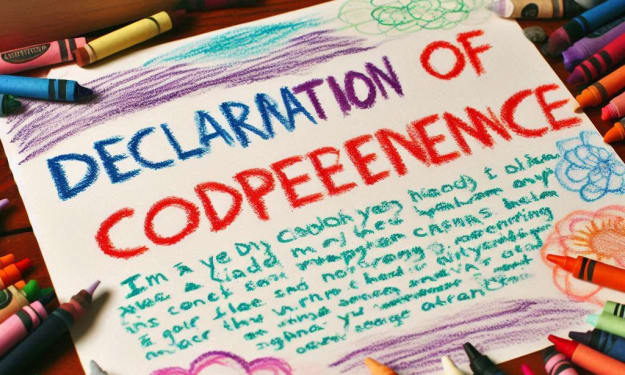
We the People of the Husbands of the United States of America, in Order to form a more perfect Union, and I mean you...with me...establish Justice, insure domestic Tranquility, provide for the common defence, promote the general Welfare, and secure the Blessings of Liberty to ourselves, after Puberty, do ordain and establish this Declaration of Co-Dependence.
By Gerard DiLeo9 days ago in Humans
Lifestyle And Emotional Intelligence Tips For Balancing Love, Intimacy, And Independence
To balance between love and independence, it is essential to have a clear vision of what matters and what does not in a person. EI is highly important in causing a person to identify his or her needs without compromising the relationship. Those that are self-aware will be able to recognize when they require personal space, reflection, or self-care at the same time be emotionally accessible to their partner. Growing sense of identity leads to confidence and less dependency, which results in healthier relations. The realization that intimacy and independence cannot work together but be mutually supporting enables couples to develop a good bond without losing personalities. It is this realization on which sustainable and balanced relationships are built.
By Steve Waugh7 days ago in Humans



Comments
There are no comments for this story
Be the first to respond and start the conversation.