
Franklin, Harry, Henry and Roald:
An untold story of happy days in Chicago
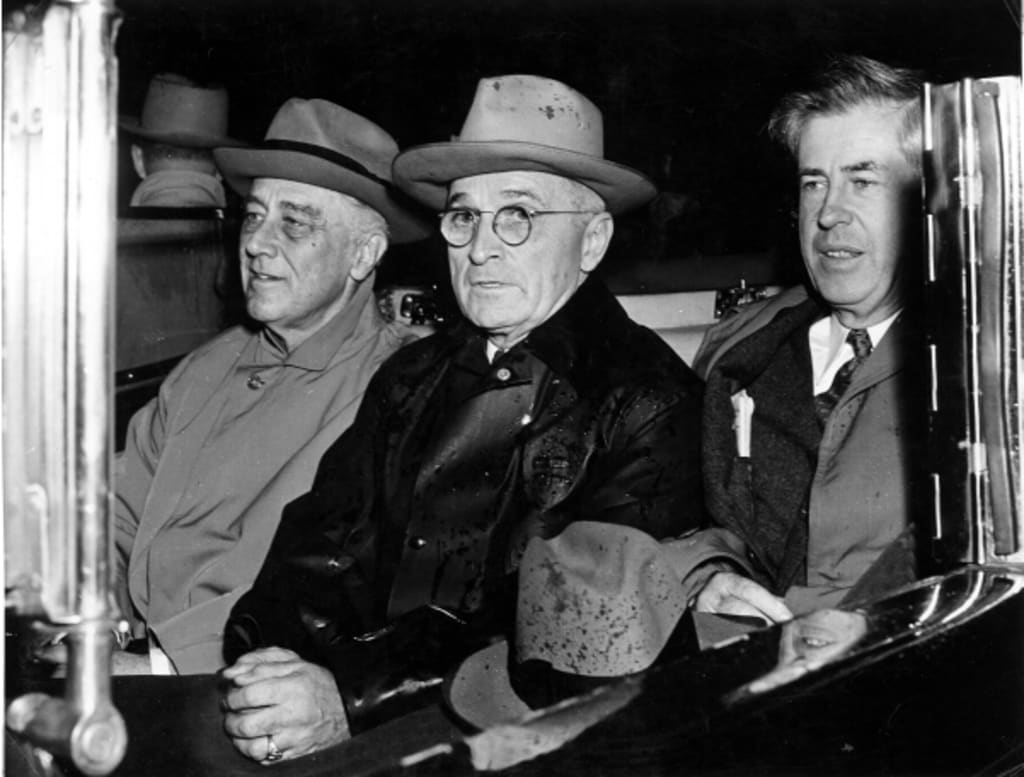
July 19th, 1944
Happy Days are Here Again shouts through the radio in the lab at Los Alamos. General Leslie Grove yawns, and Robert Oppenheimer lights a pipe. He ponders if he’ll become death, the destroyer of Worlds. The Skies Above Are Clear Again pipes through the radio aboard the U.S.S. Appalachian, as Marines wait about to invade Guam. As the Marines play cards, sip coca cola and listen to a radio broadcast from Chicago, the sailors are manning the guns, bombarding the island to prepare the Japanese for American invasion and liberation. Bam. All your cares and troubles are gone. Boom. There’ll be no more from now on… Bang.
Chicago Stadium, Chicago
Odd gatherings, these National Conventions. I’m under the distinct impression that the last eleven years have been a bright, lovely epoch when Happy Days Are always Here Again, and again, and again. Bloody Hell, these optimistic party hacks have some cheek. Blaring that stupid tune on their speakers, time and time again in the convention hall.
Altogether shout it now
There's no one who can doubt it now
So let's tell the world about it now
Happy days are here again
You’d think there wasn’t a war on. Well, Roald Dahl and I knew there was a war on. We were both in the RAF; Roald’s plane crashed in Libya, and my plane was shot down into the Mediterranean on its way to Greece. We both survived, and managed to get plum assignments as “Air Attaches” in America. But perhaps the Americans, particularly the civilians, don’t really understand that there is a war on, and one can’t blame them. They’ve never been blitzed in their own cities. They’ve never had to hide from Luftwaffe bombers in their basements, shelters, underground metro tracks… These civilians are an entire different breed than the civilians back home in London.
Well, the Americans can play whatever music they like while their idealists, pragmatists, politicians, party bosses, business magnates and unionists all converge on this hall and decide to carry signs with their home states written on them; signs with Roosevelt’s name. Roosevelt’s name isn’t the only name on the signs. His Vice President, Henry Wallace had his name on many signs too, but if we succeed in our mission for King, Country and Winston Churchill another chap will have the second place on the ticket. Any chap. Luckily we aren’t alone in our desire to find a new Vice President. I’ll touch on that matter later.
The festivities have commenced a couple of hours ago. A noble statue of a donkey is traveling around the Convention floor. “I say, Roald, what the devil is a donkey doing here?”
“Didn’t you know old boy? It’s the symbol of the Democratic Party.”
“What is the symbol of the Republican Party?”
“The elephant. My word, Jack, you’re a bigger amateur than I expected.”
“Well, I may be green as an air attache but I know about elephants. D’you know, I was first posted in India, around ‘38, and by jove I went hunting atop a beautiful elephant.”
“What was it like?”
“Positively dreadful. There was no point in any of it, you see. Senseless killing, and all the worst chaps egging you on. I bagged a Bengal Tiger and felt terrible the minute my bullet hit the fellow. I was aiming to miss.”
“Tell me, Jack, when you were flying over the Mediterranean, were you aiming to crash the plane?”
“No I was aiming to shoot a Jerry, which was probably why I missed the enemy. It also might be why the pilot eventually missed the clouds, the air, and the land...”
I was unable to complete my thought as a loud horn was being blown by a woman wearing a shiny top hat with stripes and stars. Or is it stars and stripes? Many people are wearing these hats; others wear more normal hats such as fedoras, flat caps, sailor hats, etc. Ah yes, the sailor hats; a few of the people in the Convention Hall aren’t civilians, one must admit.
At the ceiling of the Convention Hall, there were several balloons, closely tied together, waiting to be unfurled when the time was right. Tightly tied you see, to descend at just the right choreographed, seemingly spontaneous moment. Even the best laid plans occasionally pop, as it were; sometimes spontaneity becomes real and genuine to the great consternation of individual choreographers. I was glancing at the ceiling when I heard one of the balloons suddenly go POP! I don’t know if anyone else heard it or noticed it. But by gad it was a tremendously sudden thing, and before I knew what was happening, I was back.
I’m once again flying over the Mediterranean. The Hun is attacking in force. There are two Jerry planes and mine is the only plane fighting for Britain, or in this case, British interests in Greece. I aim to fire at the enemy, I’m the rear gunner aboard a Vultee A-31 Vengeance and I’m shooting away in earnest. The machine guns extend out of the wings; I stop firing as I try to re-aim. There you are, you Nazi bastard, there’s your engine, ah, here we go, blast you. In the course of fifty seconds you’ll hear a hundred blasts from me, and your engine will be aflame. Pe-pe-pe, thud. I had fired three bullets from my first round, unaware of how detrimental the barrage of two planes had been to our little diver. But it was our engine that was aflame, and we were diving at a great velocity. Indeed, from the very beginning of the dive, one sensed that this was not a tactical decision being taken by my pilot; no sir, the thud was too loud, the speed was too great, the smoke from our sides was growing more abundant, and the direction of descent was too bloody random. Nevertheless I ask, “Say, Charlie, did you chose to dive, by any chance?”
“No you dunce! We’re diving to our deaths!” Charlie sat petrified in his seat in the cockpit. For a split second, I feel just as petrified, thinking of Ana and mother and father and… NO sir, one must keep calm and carry on, if one is to live. It may sound like a parody of the British stiff upper lip, but the truth is, it’s a vital survival instinct.
“Right, well you’re the dunce for not getting into a parachute. We’ve got two after all.”
“And freeze in the water?”
“Better than slamming right into it.”
“I say, good point old chap,” but now, as he comes to this realization, we’re only about two hundred and fifty feet above the water. We make a rush to grab the parachutes, and jump.
The Greek coastline is in the distance as I pull and the parachute slows my fall.
Splash.
“Wake up Jack!” Curiously, I’m not getting splashed by the water of Mussolini’s “Italian Lake”. I know this because my face is really the only part of my body that is wet. I open my bleary eyes, and look around, to find myself in a bed, and I’m vaguely recognizing the furniture as belonging to the hotel room in Chicago. Roald’s face is coming into focus. He’s carrying a bucket, naturally.
“You’ve been out for a bloody long time. You fell on the convention floor, and I got a couple delegates to help me carry you here. Since then you’ve been tossing and turning and mumbling about hitting the hun. I abided that, but then you started screaming that you didn’t want to die, a scream far too familiar to me. Besides, it’s morning.”
“My word, Roald, what time is it?”
“It’s high time you got dressed old fellow. And listen to the radio. You need to know what is happening on the Convention Floor.”
Now, you may ask, why are a couple of air attaches worried about what is transpiring at the Democratic National Convention? Well, if you haven’t guessed it, we’re spies. I’m a bit newer to the spy game, to be honest. But Roald isn’t quite so green. In fact, Roald knows his craft; he started spying on the Americans in 1942. Roald Dahl was writing charming stories about goblins on airplanes, and making friends with Walt Disney while pretending to be a British “air attache”. He did all of this while spying on key figures, including Vice President Henry Wallace. Oh, you wouldn’t have guessed that Dahl’s mission was adversarial. They played tennis, you know, Roald and Henry would play tennis like old chums. But you see, Roald and Henry had a mutual friend, Charles E. Marsh (a newspaperman and a powerbroker, whose home in Washington was a gathering place for various New Dealers) who rather injudiciously showed Roald something Henry had written called “Our Job in the Pacific” envisioning a world where Japan is demilitarized, where airlines are under international control, where colonies such as India, Malaya, and Burma gain independence. Roald told me he felt his hairs “stand on his neck” so he claimed that he had to go to the restroom, and he phoned another fellow in the spy ring, and told him he needed to quickly and discreetly pick up the pamphlet, make a copy and return it in thirty minutes. They pulled it off, by gad, and Whitehall was nervous about Henry Wallace ever since. Especially given FDR’s physical frailty.
The radio broadcast from the convention floor is starting up again. “Radio friends, the second day of the 29th Democratic National Convention. The National Broadcasting Company is bringing you again from the Chicago Stadium. This is Dan Brower reporting from the NBC booth overlooking the scene of action as the big day begins. And a big day it certainly promises to be. Today is the day the Democrats in national assembly will affirm their platform and select as their candidate the officer for the country’s highest position. The Convention and the Nation has known for days Franklin D. Roosevelt will be returned as their choice for President of the United States, but as the one thousand one hundred and seventy six delegates file into the red wooden seats of this giant auditorium right now, there’s no clear majority of them who’ve decided, either by direction or their own decision who their choice for Vice President is. The race is still wide open, with Senator Harry Truman, and Alben Barkley, the Majority Leader the leading contenders, and Vice President Henry Wallace still very much in the contest.”
“Perhaps more so than NBC claims,” says Roald. “Still, one does like the sound of it, Truman or Barkley would be much more suitable, and they are in the lead. I say, maybe we should listen in a bit more closely.” “Tonight, the address will be delivered… and the Speech of acceptance is expected by the President of the United States following his nomination for, again, President of the United States by the Democrats in Convention. After that, it is expected that the highly crucial balloting for Vice President will take place. But that all lies strictly within the realm of conjecture, and to give you a clairvoyant view into that I’m going to ask Robert St. John alongside us to appraise the possibilities in the Vice Presidential situation as they stand right now. Mr. St. John.”
“Let’s go,” Roald says.
“Thanks,” St. John says over the radio. “First let me tell you a piece of strictly non-political news caused a great deal of excitement here in the Convention this morning. That bulletin which came in from London that said that Adolf Hitler had been slightly burned and bruised and received a light brain concussion and that a number of his Army and Navy Officers had been injured when an attempt of explosives was made on the life of the Fuhrer…” We excitedly left our room, slapping each other on the back knowing that Hitler was finally getting a taste of his own medicine. If truth is to be told, the broadcasters were right; nothing surprising happened on the Convention Floor that day. FDR was renominated. Oh, well, the Tennessee delegation was resisting a platform plank which guaranteed equal rights based on religion and race; odd that would cause so much controversy. Many of the Southern delegates and politicians were expressing their misgivings about Wallace -- his stance on the Civil Rights issue was far too liberal for them (and much more adamant than the convention plank). This had been known for many years. In the wake of riots in Detroit, Wallace proclaimed that we can’t fight Fascism abroad and condone race riots at home.
The original candidate put up by the more conservative elements of the party was Jimmy Byrnes, Senator from South Carolina. He opposed anti-lynching legislation on the grounds that lynching “keeps the Negro in place.” Byrnes also had a record of Union Busting, so Sidney Hillman, the Labor man with the President’s ear told FDR that Byrnes couldn’t be on the ticket. The compromise candidate seemed to be Harry Truman, and although FDR wrote one letter to the chair of the Convention, Mr. Robert Hannegan, saying that Truman would be the running mate who would cost him the least amount of votes, he also wrote a lukewarm public letter, saying that if he were a delegate, he’d vote for Wallace. This was getting called the “kiss of death” because it was so incredibly lukewarm. The President is meeting with General MacArthur at a Naval Base in California; not going to bat for Wallace. Later that day, after being smoothly renominated, FDR is to make his acceptance speech to the Convention from California, via radio. But first, it’s Henry’s turn. There’s no doubt about it; Wallace is putting up a fight. He’s addressing the Convention right now, “The strength of the Democratic Party has always been the people—plain people like so many of those here in this convention—ordinary folks, farmers, workers, and businessmen along Main Street….The future belongs to those who go down the line unswervingly for the liberal principles of both political democracy and economic democracy regardless of race, color or religion. In a political, educational and economic sense there must be no inferior races. The poll tax must go. Equal educational opportunities must come. The future must bring equal wages for equal work regardless of sex or race.
Roosevelt stands for all this. That is why certain people hate him so…” Wallace is defying those who oppose him and giving them all the more reason to dig in their heels.
“I’m glad we’re dealing with someone who’s so willing to play into our hand.”
“Our hand is to appeal to racial sentiments after fighting against a race based ideology?” I asked Roald.
Later in the same day, Roosevelt addressed the Convention from a Naval Base in California. At the end of the speech, the crowd cheered Roosevelt, but soon enough, the cheers for Roosevelt turned into cheers for Wallace. “We want Wallace!” The crowd demanded. “We want Wallace!”
By jove, the Convention hall is packed. There may be around 1,176 delegates but there are as many as 40,000 people here. There are plenty of Wallace signs. You see the signs by the Iowa delegation, of course, for Henry Wallace is an Iowan. His first position in the Administration was Secretary for Agriculture. Naturally, if the only signs were by the Iowa delegates, Wallace wouldn’t have a chance. “We want Wallace!” “We Want Wallace!”
But one could see plenty of Wallace signs by the delegates from Pennsylvania, Ohio, Massachusetts, Connecticut, California, Florida, Texas, Kansas as my eyes scan the room. Of course, there are also many Truman signs, especially from Missouri, Arkansas, Louisiana, Maine, New Hampshire, Vermont, Montana,and not to mention New York. Some signs aren’t in the major blocs; Kentucky has plenty of signs with Alben Barkley’s name on it. He’s Senate Majority Leader. Tennesee has signs with Prentice Cooper’s name; Alabama has signs saying Bankhead, Illinois has signs with Scott Lucas’s name. These minor favorite son candidates don’t stand any chance of winning and I haven’t made inquiries about any of them, except for Mr. Barkley. The importance of these chaps is that they’ll suck up votes and make it harder to get a majority on the first ballot. Who knows what they’ll tell their delegates to do on the second ballot.
Working in Wallace’s favor, on the other hand, is the fact that there are so many people in the Hall who aren’t supposed to be here. So many people who hadn’t been picked by their local party committees, or local “boss” politicians.
Why should these people be giving Wallace the advantage? Well, it’s partly to do with the fact that depending on which poll you believe, most Democrats who didn’t get to be delegates want Wallace. I didn’t believe this could be the case until a Wallace delegate showed me a newspaper from Florida which published a gallup poll. The Gallup poll showed 65% support for Wallace among Democratic voters, and only 2% support for Truman. Furthermore, the people packing the Convention Hall were union members, the Unions were for Wallace, and the new faces were generally carrying Wallace signs.
“Now look here, Jack Preston, I hope that you aren’t having any misgivings. This is no time for second thoughts. I just got back from a meeting with Robert Hannegan, the splendid chap who’s chairing this Convention, Party Treasurer Edwin Pauley, Flynn, several other of the biggest of the bigwigs. And they’re already planning to adjourn for the day, say all these people here create a fire hazard or something to that effect. Tomorrow they’ll keep these usurping ‘delegates’ out of the hall, and between now and then they’ll be cutting deals the way these chaps like to cut deals every four years… In other words, Jack, we’re almost done with this job. Britain will be safer with someone who’ll be more apt to let the colonies be and take a harder stand against the Soviets once this dreadful war is over.”
“A harder stand against the Soviets?”
“Wallace is even more naive than Franklin about ‘Uncle Joe.’ Stalin’s a bloody tyrant whose army we need to defeat another bloody tyrant, but after the War the West can’t just kowtow to the man…”
“Well look here, Stalin gives me the shivers as much as the next chap, but we can’t go through another war can we?”
“It won’t be a war. We’ll just have to get tougher when this war’s over. And you need to stop asking so many bloody questions. Loose lips sink ships.”
Loose lips sink ships. Well, perhaps if I do my bit to try sinking this particular ship, I might miss the same way I missed the German plane. On the other hand, perhaps I might hit just hard enough to change history. And so I make my way through the jubilant ci/vilians wearing fedoras, flat caps, shiney red white and blue top hats. Some of them are carrying fake corn stalks, in support of the Iowan Vice President. As I reach the Florida delegation, I ask,
“Where’s Senator Pepper?”
“Senator Pepper? Some limey wants to talk to you.” Ungrateful Yank, that bloke was.
“Hello there. Sorry about George over there, he’s a real wise guy. I’m Claude Pepper, U.S. Senator. Pleased to make your..”
“Pleased to meet you too Senator. Sorry to cut you off but this is quite urgent. I heard that Pauley and the bosses plan to adjourn very soon and,” but I was interrupted by the loudspeakers. “IOWAY THAT’S WHERE THE TALL CORN GROWS!” I could see more people with fake corn stalks, more statues of donkeys, more hats, a police officer in the distance, state signs, I’m spinning out as I lose my train of thought.
“They plan to adjourn? Right now? On what grounds?”
“Fire hazard.”
“That’s just like the bastards. Thanks so much.” And the Senator is racing towards the microphone. As he makes his way towards the microphone, Chicago Mayor Kelly is also running like the Dickens. I’m suddenly struck by the fact that the stamina, feet, and ability to move around delegates of two politicians rooting for two other politicians may decide the fate of a country, and the World.
“IOWAY, THAT’s WHERE THE TALL CORN GROWS!” Somebody suddenly shut down the speakers. Who’d have thought that the ability to play some song about corn in some obscure backwater could have so much impact.
Kelly is four feet away from the podium, but Senator Pepper has just grabbed a microphone. “I move that we hold a roll call vote to determine our nominee for Vice President of the United States!”
Samuel Jackson, the presiding convention chair, looks confused. He is glancing at Pepper, and Kelly. Kelly, who doesn’t have the microphone shouts at Jackson. “Remember what we told you about having a Roll Call today?”
“All in favor of a roll call,” Jackson interjects,”Say Aye.”
“AYE!” delegates (and non delegates) drown Jackson out with their shouts. “All opposed say Nay.”
“Nay,” many shout, but not nearly as many, and not nearly as loudly.
“Remember what we told you Jackson!”
“The motion is not passed.” Jackson is just about to pound the podium with his gavel...
“Now listen here Sam,” Claude says, still commanding the microphone, “the Democrats in this Convention just said, quite clearly, that they want a roll call. Why won’t you let them have a roll call?”
“WE WANT A ROLL CALL! WE WANT A ROLL CALL,” the delegates chant.
“This is a fire hazard,” Kelly shouts.
“We want a roll call,” the Senator shouts into the microphone. Claude clearly enjoys being the rabble rouser in the hall, as the chant drowns out the bosses.
“I’m sorry Rob [Hannegan] and Ed [Kelly]. The crowd is too hot. I can’t hold them any longer.”
“Hold them damn you! This is coming directly from the President!”
“How could the President be telling you to shout fire in a crowded hall while he’s meeting with General MacArthur?” Claude asks, as the crowd continues to demand a roll call.
Something within Samuel Jackson snaps. “The motion is passed.” Jackson says, this time knocking his gavel decisively upon the lectern.
One raucous hour later, Wallace pulled it off. He managed to get nominated on the first ballot, and he was pushed over the top to 590 delegates after Pennsylvania abstained from voting until the last, vital second. He needed 589 for a majority. I decided to treat myself to a lovely picture show, which included a Bugs Bunny Cartoon, a Newsreel about some United Nations economic conference in Bretton Woods(which must have been much less entertaining than the Convention; the newsreel about the Convention wasn’t ready yet, apparently) a forgettable b-movie, and then The White Cliffs of Dover which reminded me of life back home in England.
November 1948
I occasionally take the trouble to read the American newspapers. President Wallace is facing an uphill reelection campaign. Strom Thurmond and the Dixiecrats are splitting the Party, and Dewey is looking pretty strong in the polls. In fact there’s much talk over the radio about a Headline in the Chicago Tribune, calling the election for Dewey before the results have come in… I often wonder how history may have gone differently if Truman was President. Would Truman have been derided for not having the courage to drop the atomic bomb, the way that Wallace was, until it came out that the bomb would have been dropped on some obscure Japanese city whose name escapes me on August 6th; three short days before the Soviet Invasion of Manchuria compelled Tojo’s Militarists to stand down? Would Truman have been criticized for being, at best too friendly to the Soviets, (and a red traitor in other circles) the way that Wallace was when he followed through on FDR’s promise to aid the USSR in its Post-War Recovery? I’m blowing on my pipe as I contemplate these and other sundry political matters, such as the future of Clem Attlee’s National Health Service. I do this in a quaint little cottage near Bristol and I suppose that happy days have returned to both sides of the Atlantic. I nearly forgot to tell you, Roald will be coming over at Teatime. He might remind me how lucky I was to avoid a court martial.
Note: This is very nearly what happened. I’m not sure about whether Roald Dahl was present at the Democratic Convention, and as for Jack Preston, well never you mind. Dahl did befriend and spy on Wallace, and he would go onto write the Fantastic Mr. Fox, The BFG,James and the Giant Peach, The Twits, and Charlie and the Chocolate Factory among other great classics.
Sources:
Stone, Oliver. Kucznik, Peter. Graham, Matt. “Chapter 2: Roosevelt, Truman and Wallace.” Untold History of the United States.
Day 2 of the Democratic National Convention. https://archive.org/details/WartimeRadio1944/1944-07-20NbcDemocraticNationalConventionDay2a.mp3
https://news.google.com/newspapers?id=vWkxAAAAIBAJ&sjid=xU4DAAAAIBAJ&pg=7238%2C354247 St. Petersburg Times, Editorial citing Gallup poll. No author.
About the Creator
Keep reading
More stories from Simon Fields and writers in Humans and other communities.
Silent Screams or Ghastly Dreams in the Vacuum of Space:
Nobody can hear a scream in the vacuum of Space, or so they say. Now I’m learning what they don’t say – that even in the middle of this muting vacuum, you can still see a scream. Particularly a scream of mortal terror. And even if you can’t hear a scream out here, if you know the silent shouter well enough you might even be able to feel their scream. If you are, your own sense of empathetic fright may convulse the knot in your stomach; more sharply by virtue of the fact that you cannot hear the scream that you are witnessing. You can see your comrade, your helmet-less friend hurtling past fiery suns and the ghosts of stars, releasing his last burst of oxygen in an eerily quiet scream. Painful though Donovan’s death clearly was, and robbed though it was of the glory of recognition that accrues to most final orations, one thing can be said for the way Donovan O’Malley left our galaxy. O’Malley did not go gently into that good night.
By Simon Fields 3 years ago in Futurism




Comments
There are no comments for this story
Be the first to respond and start the conversation.