
Flipping Pancakes and Rafts—Westwater 1990
Salvaging a Disastrous Trip
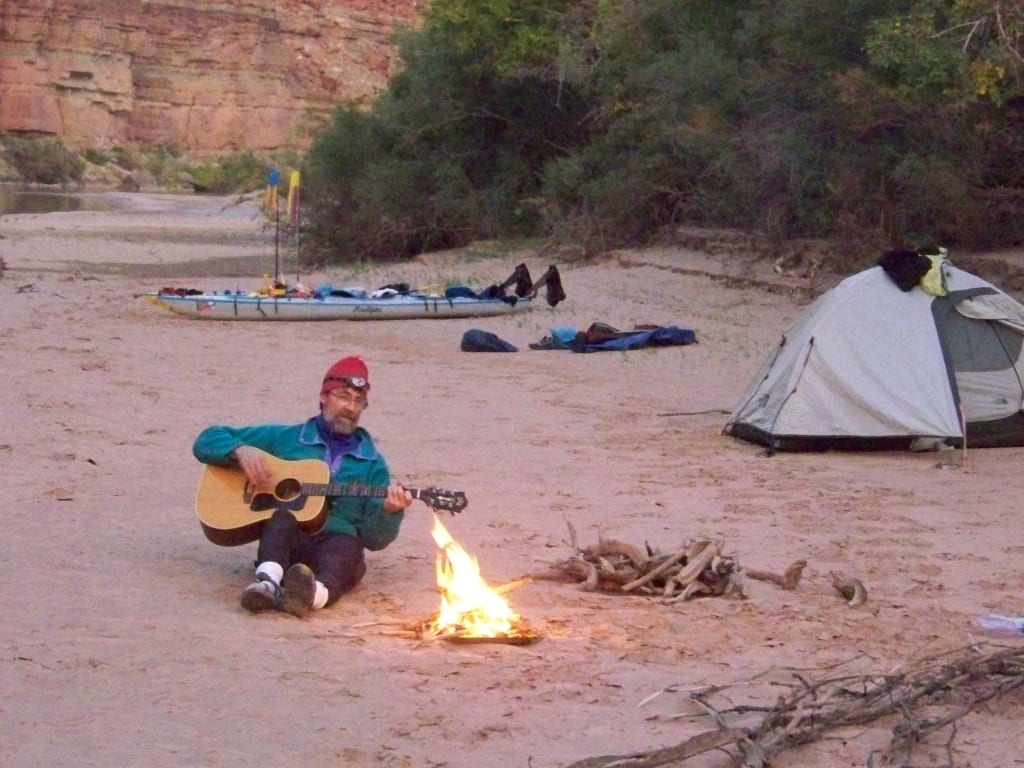
It was near the end of my short but intense river guiding career that Skull Rapid in Westwater Canyon tried to gobble me up. My number was metaphorically drawn by the river gods, my time to flip had come. I would soon be the first of the two types of boatmen, those who have flipped, and those who will. But this trip was unique in many ways. First off, I was carrying not the usual troupe of paying customers, but rather a troupe of paid employees! My boat was the bluegrass band—banjo player, guitar player, mandolin player, and fiddle player. There were four of us. The paying customers were all on the other three boats running the river in front of us. We were the entertainment, much of the food, and oh yes, the booze. We were hired to play music, and I got a little extra for rowing the baggage boat. We were not what one might call the regular guides. The paying customers were a group of wealthy French physicians and their families, out for a dash and splash overnight whitewater trip where in two quick days, seasoned guides are expected to take customers to the very brink of death and danger, pull them back safely, then wine and dine them with gourmet on the river.
As the gear/musician boat, Dan, Christine, Tim and I were designated the sweepers. We would run the rapids last, acting as backup in case anything happened. As it was, everything happened. It just so happened that the Colorado River was pouring through the funnel of Westwater Canyon’s rapids that day at about sixteen thousand cubic feet per second. “The Terrible Teens” the guiding world called it. It was a level at which certain surges sucked everything right into the jaws of the Skull Rapid Hole, and often spit people out into the aptly named sheer walled Room of Doom eddy below it.
Molly, the trip leader, went first. She also flipped first. Nine people swimming. Then the second boat in the line hit the hole. You are not supposed to hit the hole. Every boatman knows that you row like hell away from that hole. But if you do happen into it, the second rule is to hit it head on, not sideways. The second raft went sideways. Eighteen people now swimming. The third boatman, now alarmed at what had happened to boats one and two, managed to give a super human stroke and just barely miss the hole. Then came the musicians. I quickly hollered out, “Look for bobbing heads in the Room of Doom as we go by. If they’re in there, we’ve got to get them out right away. And HANG ON!”
One, two, three, four, five huge oarstrokes—and the river just kept sucking us into the hole. I knew it, my time was up. I knew we were going into that hole. I knew we were probably going to flip. But I also knew that I was not going to hit it sideways. I cranked the oars in a massive scissors stroke, got straight downriver, and prepared to heave a forward stroke hoping to help propel us through the churning mass of water that was three times the size of the boat. As my river career passed before my eyes, I distinctly remember a thought I’d had earlier that day. Big river bags, the ones we’d used for the musical instruments, rarely hold water out when totally submersed. They will keep splashes away just fine, but tip a boat over and leave them underwater for a half an hour and . . . . the second part of the thought was that the combined value of the instruments we were carrying was about three thousand dollars, maybe more. (this was back in the early 1990s) My best friend Dan’s fiddle alone was a priceless family heirloom. Yes, we were paid nicely for the evening concert, but not that nicely. Yes, running a river with instruments was a gamble, but boats did not normally flip. Molly, for instance, the trip leader, had nver flipped in Westwater. Neither had I. And so as my boat slid down the shiny smooth tongue of Skull Rapid I gave a mighty forward heave on the oars. We slammed into the roaring hole. The boat nearly folded, poor Dan punched the front tube and was swallowed by the water. He disappeared into a churning mass of white water, was sucked right over the tube and into the drink. He then slid under the entire length of the boat and was snagged by Tim in the back. Meanwhile we teetered on top of the standing wave. And then, miraculously, we slid over the wave and downriver, upright.
There was no time, however, for gloating. We had passengers to pick up from the chilly waters and two huge heavy boats to flip back over. Molly already had some of her passengers on top of the slippery underside of her boat, but two “bobbers” were rapidly disappearing downriver. I heaved again on the oars and pursued the swimmers, all of us calling to them to swim upstream. We finally plucked them from the drink, but not before they’d run Last Chance Rapid and brushed up against The Magnetic Wall. We finally found a spot and eddied out; we could only wait while the others upstream righted two boats and reloaded passengers. After thirty minutes or so the rest came along. As they bumped up against our boat to reload the two we had retrieved, I was told that everyone was OK. I was also told that the big gas stove and griddle were botyh at the bottom of the river. I didn’t have to be told that the string of waterproof dry bags strung across the duffle of the two flipped boats contained sleeping bags. I surmised that many of them could easily be quite wet by now. Few systems are totally watertight, especially when they are used industrially as day bags on commercial river trips. And indeed, as we discovered later, all the bags were soaked.
Nonetheless, the day was hot and our beautiful campsite located in the last pristine sandy alcove of black rock topped by red sandstone was open for us. The “music” boat pulled in a bit late though. After hearing about the stove, I had decided to stop to pile on a good load of driftwood. It looked like we were going to have to go back to the old fashioned way of cooking, over a campfire. Fortunately, we still had fire pans, wash buckets, and Dutch ovens. All was not lost. But when we unpacked, the customers discovered just how wet all the sleeping bags were. All the Frenchmen were quite grumpy. All the guides upset about flipping. All the musicians just grateful to still have instruments. (Poor Dan, however, did lose his glasses.) And so after helping pitch tents, I was approached by our trip leader who was frowning deeply—too deeply.
“They want to row out tonight, cancel the rest of the trip,” she stated flatly.
“Uh oh,” I said, “The boss isn’t going to like that. They’ll want their money back.” And I thought to myself, I wonder if the musicians will even get paid if that happens!
“I don’t know what to do,” she said, “all the bags are wet, the guests are all still cold even though it’s hot out here, and fixing dinner is going to be a nightmare.”
She was right about the bags. Everyone had strewn sleeping bags from every rock and tree available. The entire site looked like it had been invaded by an army of giant blue and green caterpillars. But there was a warm breeze blowing. I knew the bags would dry out sufficiently for a reasonable summer night’s sleep. I didn’t know if the French sense of humor would dry out however. I looked over at the band members, now unloading our gear and preparing to set up a sleeping spot. Good old Dan had opened the cooler (which was rigged as the seat for the oarsman) and was holding a bottle of Tequila up to the sunlight, evidently looking for the worm. Dan wasn’t much of a drinker, but always had a great sense of humor and curiosity. It gave me an idea.
“Molly,” I said, “as a musician I’ve learned that when the audience is drinking, they don’t notice mistakes as much. Ask the head doctor to think it over again about cutting the trip short, but first set him up with a G & T. Hell, we even have limes. Tell him our guide bags are all dry and we’ll give those out to anyone whose bag does not dry out. We’ll set up the bar and do a little impromptu afternoon bluegrass concert. Then we’ll make a decision. Oh yeah, I got firewood.”
She looked skeptical.
“I gestured towards the bar boat, “What’ll it be? Whiskey Sour, Gin and Tonic, Vodka, Rum? We’ve got it all.”
The concert might have been great, but the bar was fantastic. There was enough liquor in that huge sixty gallon cooler for three times the number of people there—a fact the musicians all bemoaned much of the next morning. And every one of the guests had afternoon cocktails, lots of them. In fact, they became so relaxed that discussion turned to what’s for dinner rather than how far is it to get out of here? And yes, we heard everyone tell their flip adventure numerous times. Cheating death is only meaningful if you can brag about it!!
But while the French guests were relaxing, the guides were arguing. It appears that the long summer’s tensions had been wearing on them, and the flip crisis had tipped things over the edge. Two stomped away upriver, another downriver, and one fumed in a tent. It was getting late, no stove, no guides, just drunk French people and some musicians, all about to get hungry. The horsdoeuvres were consumed.
“Uh oh,” I thought to myself. “I’ve seen this before, hmm, let’s see, a few years back on a summer solstice full moon ride with Tag-A-Long.”
Bonfire time. Despite the heat, I went into guide mode, lit a big driftwood fire on the fire pans and started to prep for an exquisite meal, Chicken cordon bleau, lobster, and some other fancy dish whose name eludes me now. Still no guides. The last thing I heard from their quarter was, “You go cook the #@!$*+^ing dinner!”
Now normally cooking for a trip on the river using wood fires is high adventure all by itself, and difficult. And normally I would be working with a crew who had planned together, made recipes together, and packed together. As musician, and a now slightly tipsy one at that, I was just an add on, not at all part of the trip planning. I only knew what was to be served by perusing the available foods. Dan, Christine, and Tim had never cooked for a group, let alone over an open fire in Dutch ovens. Anyway, I needed time and distraction. I told them to keep playing. I intended to become superhuman. It was, after all, a miracle that no-one had been hurt in the boat flips, and no instruments lost. It was, after all, another miracle that the guests were laughing and having a good time within an hour of wanting to abandon ship. Dinner would just have to be a third miracle. I was thinking this when the miracle truly happened, but not the way I’d expected. One of the French doctors came up and asked if I needed some help!
The French, of course, really know how to cook. I’d always been taught that they practically invented gourmet. Before I knew it, I had eight hands in the kitchen. I was amazed at how adroit they were. They prepared the Lobster like Paris chefs, the cordon bleau like they’d named it.
What a dinner! No professional river guide could have made a better meal. By the time we were cruising on preparation, my job had been reduced to keeping the cooking fire kindled just right for cast iron dutch oven heat. Skilled hands of the surgeons did the rest. And I must give credit to the guides who did come around in time to help find the odds and ends like special spices stashed in hidden corners in the kitchen boxes. And the guides did clean it all up afterwards while the band gave a river concert that lasted until two in the morning with wonderful French voices singing along on every other famous American folk song. It was a night to remember. I am also certain that the dinner was actually so successful because the wealthy guests prepared it themselves. Or maybe it tasted better to them because they had cheated death.
When it was finally time to sleep, all the bags were mostly dry, the night was warm, and the stars shone brightly. The next morning the guides, now substantially repaired, cooked up coffee and a great breakfast. The musicians did a morning concert despite our hangovers, and after a short two hour float on flat water we said our goodbyes. We received a total of $500 in tips, but vastly more important, we had salvaged the trip.
I know my number was up, but I’m really glad I didn’t have to cash in on that trip. It might have been a much different story if the band and the booze had gone in the drink.
About the Creator
Mark Doherty
Mark is a lifelong writer, musician, outdoorsman, and teacher. Mark's work focuses on natural insight, inspiration, and above all, creativity. Mark's website: www.moenkopimemories.org features links to most of his published works.
Keep reading
More stories from Mark Doherty and writers in Humans and other communities.
The Camping-Go-Round
Here we are, in the heart of one of America’s premier national parks. We were lucky enough to score a campsite in a wonderful tents-only campground on Jenny Lake beneath the sweep of the Grand Tetons. It’s the last site available, and the last one on the campground circle, site number 50.
By Mark Doherty8 months ago in Earth
Recovering After Breakup Quickly Requires Self Reflection Positive Lifestyle Choices
The process of getting back on their feet after a break is usually initiated by the first step of accepting the feelings that ensue after a relationship. Most individuals feel depressed, perplexed, angry or disappointed. It is a significant step to healing to allow yourself to experience these feelings instead of pushing them away. Self-reflection makes one realize what he has learnt throughout the relationship and how it influenced his or her expectations. Analyzing the real-life experience in a truthful way, individuals are able to locate the patterns, strengths, and areas of development. The process helps to clear the emotions and avoid unresolved feelings. Tolerance and introspection provide a base to continue further with more confidence and self-knowledge.
By Robert Smith5 days ago in Humans



Comments
There are no comments for this story
Be the first to respond and start the conversation.