
Firewood: It's Not Always Easy
"Before it gets dark, we start a bigger fire for ambiance and warmth. That takes a lot of firewood."

Regardless of your feelings about COVID, the last year has been tumultuous for the world. Kathy and I have for the most part avoided COVID fatigue. We have always spent a lot of time in the woods, but we are doing that differently now. Pre-COVID, we would walk, walk, walk. Recently, my doctor asked me how much exercise I get in a typical week, and I told him I work in the yard, go fishing, and walk about thirty to thirty-five miles a week in mountainous terrain. He told me I was his top patient for exercise. When I got home, I told Kathy. She was proud of me-- and herself because she is right there with me.
Now, we walk and often stay put a long time.
We stay put longer, but we have not been lazy during the pandemic. We are just happily spoiled and COVID hasn't changed that. We usually wake up at about seven, but we like to greet the day slowly. We drink a pot of coffee, talk, see who is fussing on Facebook, listen to music, and all kinds of other good stuff. Kathy usually rolls out of bed about nine-thirty, and I get out of bed about thirty minutes later when breakfast is ready. That is why I enjoy fishing alone; everyone else wants to go fishing in the summer at five in the morning, and I want to go at five in the afternoon. I know you think I should feel bad about that, but I do not. That is the real me. I can be as real as I want to be since Kathy and I are retired, empty nesters. It takes years of experience to wake up in the morning and not worry about meeting anyone’s expectations, but your own.
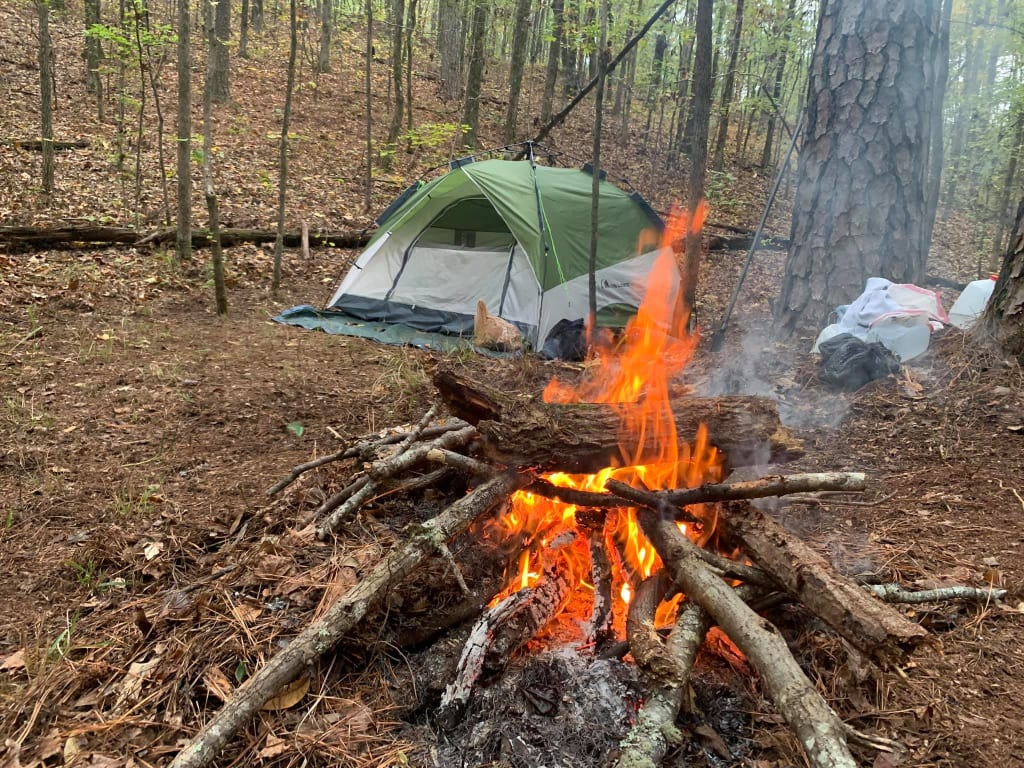
We are on daylight savings time now and it is winter, so it gets dark early. Staying in the woods in the afternoon and into the night lengthens our time outside. We bring food to our campsite or start a fire over our rock-lined grill and cook. Before it gets dark, we start a bigger fire for ambiance and warmth.
That takes a lot of firewood, so we gather wood that has fallen to the ground. That was easy in the beginning, but now we are moving farther and farther away from camp to find more. We will eventually get so far away we might as well bring it in on our truck and carry it to the camp. Or we could begin cutting trees, which we are not going to do.
That realization got us to thinking about how crucial wood would be if we did not have any other way to produce heat and how easy it would be to burn the last piece of wood.
Kathy mentioned reading a book about an old lady who lived by herself; finding firewood was her most difficult challenge.
Native Americans would move their villages when they exhausted resources, but there was always somewhere to move it to. When agricultural development reached the point where the best fertile land was worth keeping, they did not want to move but they still had that option.
That was not the case in Europe. By the time Europeans found the New World, Europe was almost to the point of being deforested. The British were on the verge of freezing to death in the winter. That is one reason why immigrants got on the ships to America and why the American population grew so quickly. Ships began hauling timber from America to Europe. America saved Europe. It probably could not have held its population until coal became an option.
Forests were thick with trees in America, but in just a few decades, the colonists had decimated the forests that they depended on for firewood, and they were forced to begin importing firewood from elsewhere until coal became an option.
This is why I love history. Even gathering firewood can get the mind thinking about things outside our world.
About the Creator
Bill Coleman
Hello! I am a traveler, outdoorsman, and writer.
Keep reading
More stories from Bill Coleman and writers in Humans and other communities.
My Daddy's Friend, Tom
Tom was my father’s closest friend when they both lived on Cedar Street in Powderly, Alabama, in the 1940s. In their late teens, when they were out on the town my father would often drink beer. Tom drank milkshakes; that’s not how I remember him.
By Bill Coleman5 years ago in Humans
I wanted to title this something different, but worried that my chosen title might cause problems entering the United States in the future so this is the new title. It's the greatest title. No one has ever written a title better than this. (All titles unrelated to content).
Let me be honest. I am finding this difficult. Now, I like a challenge, a stretch, a bit of an obstacle course. “Write about the decline of the British Empire in the form of a narrative poem in which your protagonist is an artichoke” I read, and flex my fingers. “Write a haiku to evoke the sensation of sibilance using only the first half of the alphabet.” “Well”, I think to myself, “this should be fun.” But “write about a system that isn’t working”? A system that isn’t working? Now? In 2026? ONE system? My favourite system that isn’t working? The sexiest system that isn’t working? The one giving me the most angst day to day? The one giving me the most existential dread? I am, as I say, finding this difficult. I will own that I have contemplated writing a thousand words on why the steady “all on” setting on my fairy lights is the EIGHTH of seven options which must be sequentially activated to get there, because that is a system that some fool came up with and it definitely doesn’t work, and now who is paying the price, eh? But how can I write about my fairy lights when…. When…. When….
By Hannah Moore4 days ago in Humans
A Planetary Alignment will coincide with Mercury Retrograde
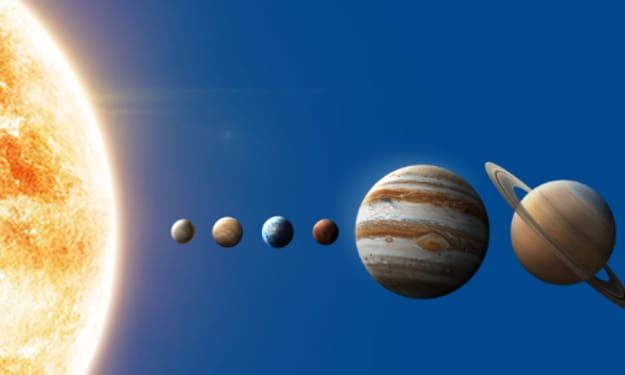
Double phenomena in the heavens Some people say in jest that the planets have aligned in their favor when life works the way they desire. Were you aware that there are seasons when things do line up in the heavens? There will be a planetary alignment AKA a planet parade, on February 28, 2026.
By Cheryl E Preston5 days ago in FYI


Comments
There are no comments for this story
Be the first to respond and start the conversation.