
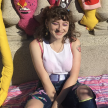
Two eyes, a nose, a mouth stitched in red. I looked down at myself, laying on the table: not me, but a figure that easily morphed into me as the clock struck three A.M. and my eyes grew heavy from exhaustion. I’d come up with the idea while working my retail job the summer before college started––I wanted to make myself out of felt. I was in limbo between the end of school and the start of it, feeling weird about my age and the way that it made me feel both incredibly young and strangely old, and I decided to do something about it: to make a felt version of myself in eighteen hours, carry her around for eighteen more, and then say goodbye to her forever.
I’d worked with felt before, but I’d never made anything so big. In those allotted hours, I figured it out: I traced a pattern of myself, cut the felt, and laid out the pieces. They formed a strange, disjointed reflection, but cut out, I could see how she would become real with surprising speed. I sewed her together and stuffed her, I pulled strands of yarn apart to make it match the way my hair curled. I trimmed her hair into bangs. With time running out, it was finally time for the face. As I stitched it on I swear I saw her moving.
I crawled into bed at four A.M. and woke up two hours later to bring Feltgirl into my room––the eighteen hours of carrying her everywhere had begun. When I woke up later, I hopped on the train with her and my best friend Grace to go to downtown Chicago from my house on the North Side. We spent the day in the Loop, walking around while Grace documented our adventures like we were a weird little family. It was hard to go twenty steps without someone calling out or looking over, approaching us and reaching out for her as if she would reach back. People loved her. People couldn’t stop looking. I carried her in my arms and on my shoulders and thrust over one arm as we went through all the touristy destinations we could find: anywhere that lots of people could see her.
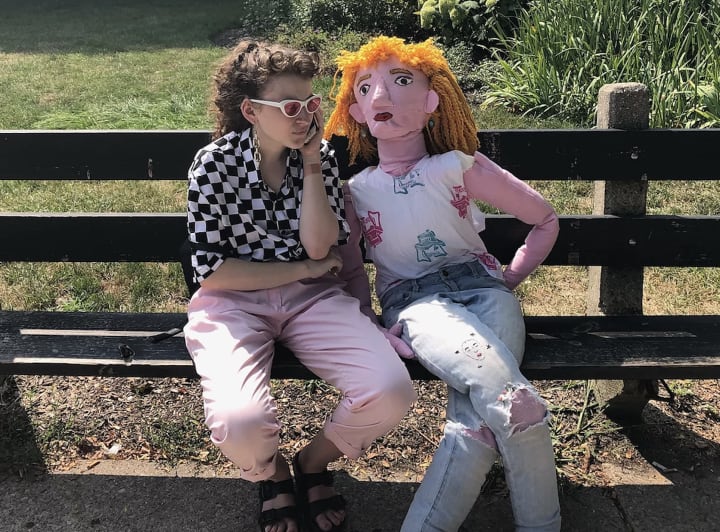
On our way home, I could already feel the finality of what I was doing. The eighteen-hour period ended at midnight. I had wanted it to completely end there, for us to be separated. But I didn’t want Feltgirl to stop existing, so we had come up with a rule: I would give Feltgirl to Grace when the time was up, and she was allowed to put her wherever she wanted under the condition that she would never tell me where Feltgirl was. This way, our time together would end, but Feltgirl wouldn’t. She would keep going, forever––at least forever to me, because if I didn’t know where she was, the possibilities felt limitless. She could be anywhere, doing anything––this version of myself could still be living out there somewhere. When the clock struck twelve, I put Feltgirl in a bag and gave her to Grace. I was never allowed to see her or touch her again, let alone know where she would end up. These were the rules I had set for myself, and in the moment, they felt hard to obey. Our time together was so concentrated and fleeting, and the idea of saying such a finite goodbye to something I had created felt impossible. But I did it.
A lot of the time, I work backwards. I make things purely because I want them to exist, and after they do, I understand what they mean to me, and what they mean to everyone else. Feltgirl was like that. I cut her out, sewed her together, and carried her around so quickly that I barely had time to think about what she meant in the moment. Months later, I would remember random details of the day: the way people reached for her hands, the way we sat side by side on the train, our shoulders swaying together. I would wonder where she was and who would see her. I still wonder––it’s been three years and I still don’t know where she is, and I probably never will. She’s taken on a life of her own now.
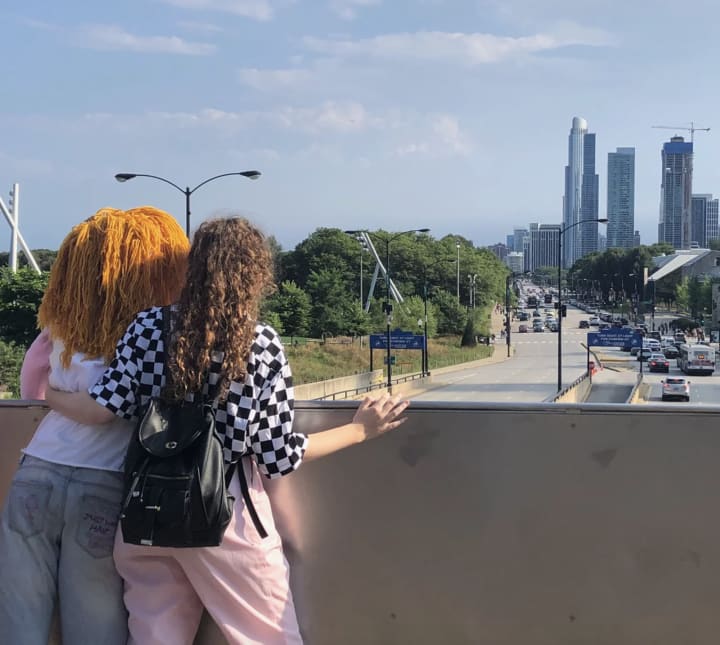
That’s partially why I love making feltpeople so much––they hover somewhere between person and object, silly and intriguing and independent. You want to hold their hands, to talk to them, to do anything that will pull them into your world, and pull you into theirs. Feltgirl was out in the world and I missed her. I wanted another confidant, so I created another feltperson.
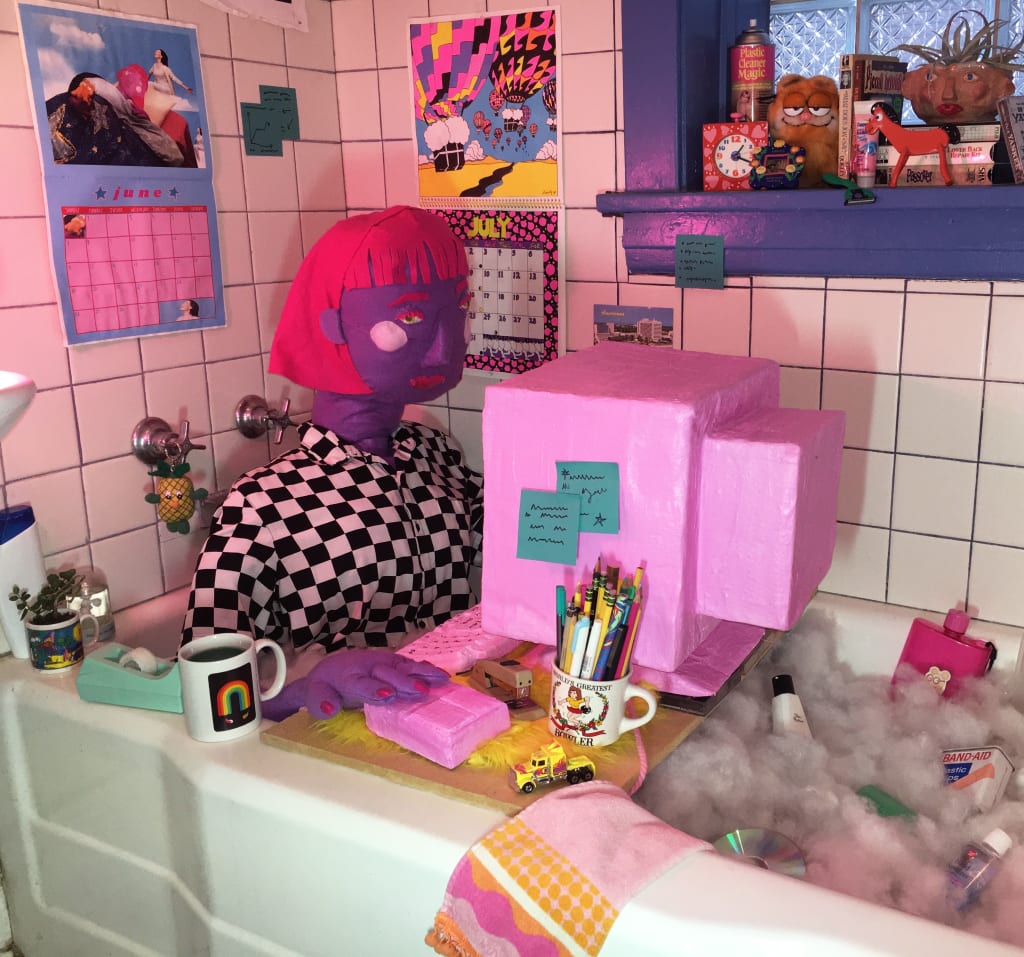
They start to come alive when I cut them out, when they move from flat felt to patchwork pieces that take shape as the scissors glide along. A hand here, a nose there, moving from abstract to concrete, from something inside my head to something that takes up space. My favorite part is making faces. I never plan them out, I just let my hands cut the shapes and see what they end up looking like, and this gives them each a distinct look; it builds their personality before they even have a body. I cut out a face in purple felt and she became Penelope, my second feltperson. But I didn’t want to just keep her to myself. In the summer of 2019, I participated in the Museum of Contemporary Art’s 21MINUS event, a one-day exhibition of Chicago artists under the age of 21. For my piece, I created an interactive installation. Anyone could sit at the dinner table with Penelope to have an Impossible Conversation––a conversation they wanted to have with someone in real life, but couldn’t. Visitors filled out a form with both sides of a conversation, then read out their side while Penelope read out the other person’s through a voice-to-text program, played from a speaker in her chest. All day people drifted over, drawn in by the brightly colored felt and the waiting dinner table to have conversations silly and serious.
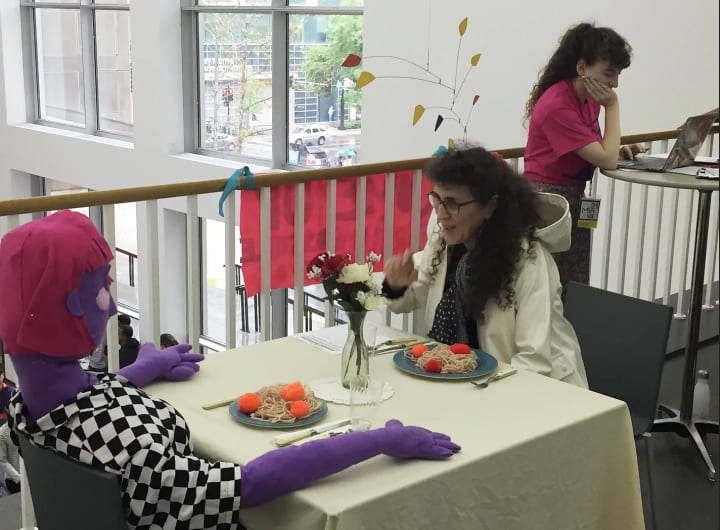
This is the magic power of the feltpeople: they allow us to make an imaginary place real. They create spaces where we feel safe to think about the things we don’t always want to think about, a place to get lost in all the what-ifs. When I make them, I’m pulling my own imaginary world into physical form, glimpsing the possibilities I always see out of the corner of my eye.
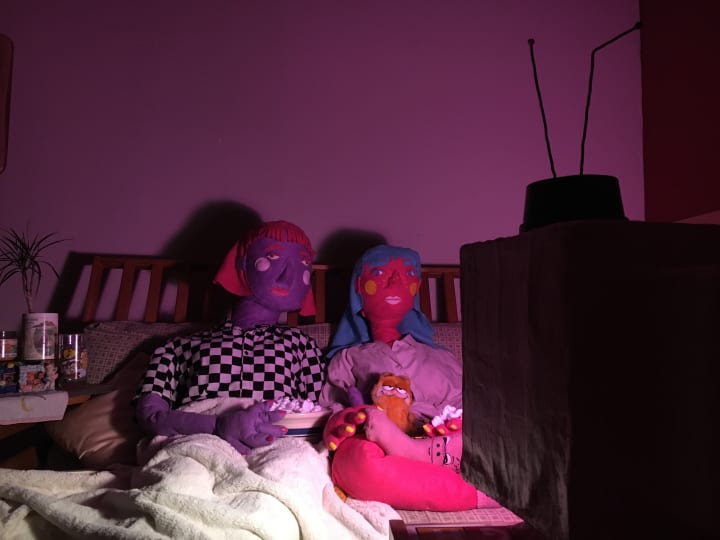
This past year, I’ve continued to actualize that fantastical place. I made another feltperson, Clarice, and posed her with Penelope in various quarantine scenarios throughout my house, photographing them surrounded by carefully arranged knick-knacks. I wanted people to stay up to date on their lives even if they couldn’t interact with them––to give them something fantastical when everything else felt so horribly real.
Feltpeople the kind of project that never ends, because I can always do more with them. I can always do something new, and each new thing they do makes them more alive, letting more people in on the world. When I look at them I’m proud of them. Not proud of making them, but proud of them, as if they created themselves.
About the Creator
Rachel E Dohner
racheldohner.com
Keep reading
More stories from writers in Humans and other communities.



Comments
There are no comments for this story
Be the first to respond and start the conversation.