
"Endless Mountain Rises Without an Egg"
Majestic peaks soar high, untouched by life’s simplest humble beginnings.
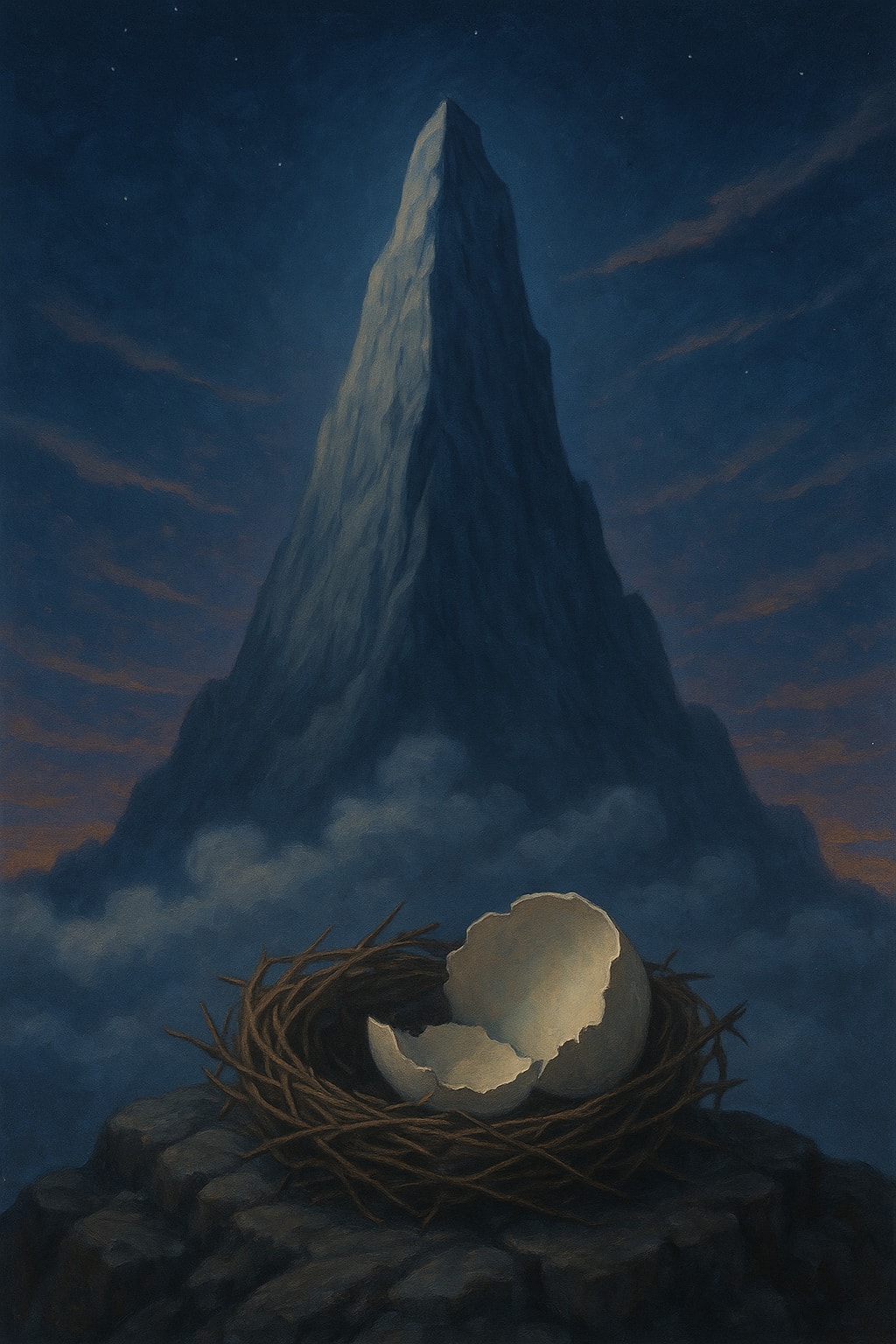
High above the earth, where the air turned thin and silence pressed harder than sound, a mountain stood alone. It had no name, for no map dared mark it. It had no trails, for no feet had touched it. It rose from the land like the spine of the world itself—cold, blue, and eternal.
At the foot of this mountain, a nest sat on a ledge of broken stone. Woven tightly from wiry twigs and tufts of forgotten fur, the nest held only a single, broken eggshell—split in half like a quiet secret. There was no bird, no parent, no fledgling. Just the shell, pale and gleaming softly under the waning moonlight.
The villagers from the valley below spoke of the mountain only in whispers. They said it had always been there, even before the first stone hut was built or the river curved through the valley. “It watches,” old women would say while threading beads. “Not with eyes, but with presence. It knows more than we do.” Children dared one another to walk closer to it, to find the edge where the fields turned to black rock—but few ever returned with more than shivers in their bones.
No one knew who built the nest. No one saw what cracked the egg. The elders claimed the egg had never held anything at all. "It is the promise unfulfilled," muttered one. "A beginning that never began," said another. It was a question left unasked by generations, tucked into corners of dreams and folded into silence.
But one autumn, a girl named Tima came to the foot of the mountain. Her village had suffered a long drought. Crops withered, and the river, once so bold, trickled like a dying breath. Tima believed that the mountain held the answer—its mystery a locked door to salvation. She had read stories of sacred peaks and gods who whispered to those who dared to climb. So she climbed, not for glory, not for myth—but for hope.
The air thickened as she ascended, as if time itself resisted her. On the third day, wrapped in layers of fur and will, she found the nest. It was exactly as the stories described. Smaller than she imagined. More fragile. The shell pieces shimmered with a strange luminescence, as though they remembered something they could not say.
Tima knelt beside the nest. She reached out, not to take, but to understand. The shell was cold—ancient cold, the kind that echoed from the start of things. She closed her eyes and let her palm rest on the curve of the broken half.
A wind stirred.
It did not whistle or roar—it hummed, low and steady, like a breath too deep to belong to any creature. The clouds thickened around the peak, and the mountain, for the first time, seemed to speak—not with words, but with knowing.
Tima saw visions—not in the sky, but inside her own mind. She saw the egg, whole and glowing. She saw a creature within, vast and curled tight, as though the sky itself had coiled into rest. But the egg never opened. No warmth came. The nest waited, century after century. The mountain rose around it like a tomb, or a shrine, or both.
In the vision, the egg shattered—not from birth, but from time. From stillness. From waiting too long. And the mountain was born from that grief—rising up not in celebration, but in mourning.
Tima wept.
When the vision faded, she understood. The mountain was not guarding a treasure. It was remembering a loss. And the nest was not a beginning, but a monument. Not every egg hatches. Not every dream begins. But even those unborn have stories. Even silence has a voice.
She did not take the shell. She did not move the nest. She descended the mountain slowly, every step echoing with reverence. When she returned to the village, she did not speak of gods or magic or miracles. She spoke of waiting, of patience, of understanding when to move and when to mourn.
The rains returned weeks later—not because the mountain was pleased, but because the world turns and grief, too, passes.
The nest still rests there, untouched. The mountain still watches, tall and endless. And Tima’s story became one not of conquest or victory—but of listening.
Because sometimes, the greatest truths come from what never came to be.
About the Creator
Keep reading
More stories from Mukhtiar Ahmad and writers in Humans and other communities.
Whispers Echo Through Green Forest
In a world racing forward with steel cities and glowing screens, the Green Forest stands still — a timeless sanctuary of breath, beauty, and ancient secrets. For centuries, this forest has grown undisturbed, its emerald canopy stretching wide like a protective veil, sheltering every bird, beast, and breeze beneath its branches.
By Mukhtiar Ahmad10 months ago in Earth
Reed Blankenship: The Quiet Journey From Underdog to NFL Starter
Some football careers begin with national attention and five-star rankings. Others begin quietly, far away from the spotlight. The story of Reed Blankenship belongs to the second path. He was not the most famous recruit. He did not enter college with headlines or huge expectations. Instead, his journey was built on patience, discipline, and years of steady work that few people noticed. Today, fans who watch Reed Blankenship on an NFL field see confidence, intelligence, and determination in every play. But those moments are the result of a long road filled with doubts, small opportunities, and relentless effort. His rise shows that success in football is not always about early hype. Sometimes it comes from persistence, preparation, and the courage to keep chasing a dream.
By Muqadas khan4 days ago in Humans




Comments
There are no comments for this story
Be the first to respond and start the conversation.