
End of Season
Life has many seasons and each one of them different

He had come back to the city of his youth almost on impulse. A dare of memory to see if it still existed. Maybe it was to see if it ever actually existed in the way he had once remembered. He had thought of the city every day when he had been in the combat zone. It was his way of coping, he figured.
Now back from the war, things had irrevocably changed. Some of the people that had been at his farewell party to see him off were already dead and buried. These were mostly elderly relatives or neighbors who had succumbed to cancer or heart disease, not the friend or two that had been his age when a sniper’s bullet counted them among dead, as well. There were already too many people gone from his life. Thomas Wolfe was right.
Winter had come early this year. The streets were still wet from the hard, cold rain the night previous. Ahead of him lay the austere, brown rugged mountains and the rambling verdant forest that had stopped the small city in its nascent tracks and ceased it from becoming better known and better managed as its larger neighboring sister cities.
The downpour that had fallen had left snow deeper up into the elevations and the evergreens that lined the nearby peaks were silhouetted by the pristine, frozen summits that rose behind them. It was a picture perfect Ansel Adams postcard, if Adams had ever been thus inspired to photograph mediocrity in its natural form.
A heavy mist hung in the air, chilling those who walked the wet streets below on this overcast, but brisk day. A cold wind bit down from the snow-topped crest, compounding the raw effect, detaining the damp footprints of long-gone passersby on the gray sidewalk below.
Leaves scurried past him, whipped in miniature whirlpools by the wind at his back and he noticed how they landed in the wet and abandoned flowerpots that lined the café railing where the footsteps of many chose to pass, but his own footsteps he chose to leave inside.
He maneuvered through the empty tables, their white, plastic chairs gathered and stacked together in the corner, a requiem to another season passed. The ashtrays were full of rainwater and floating cigarettes, the brown and tan checkered tablecloths sopped with puddles, clinging limply against the faux marble table tops.
The empty eyes of those he walked past reminded him of the blank thousand yard stare villagers would return to him in the war, only the eyes of those he passed presently were empty because of too much of everything and never too much of nothing.
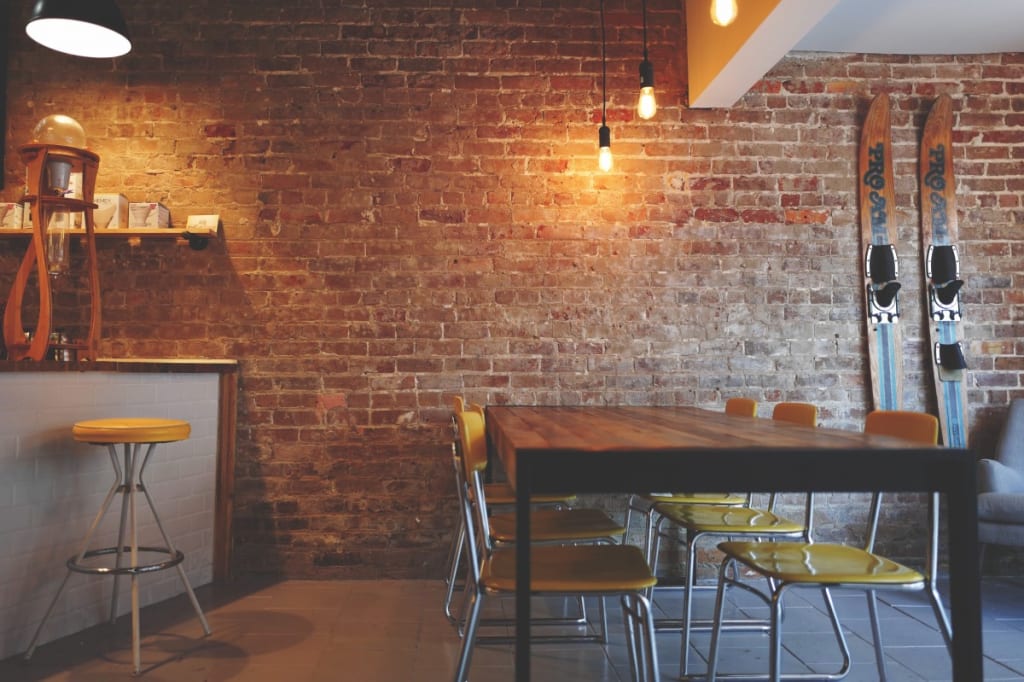
He followed a lone set of drying footprints into the warm and smoky café. Sunlight knifed down diagonally onto three large brown and green picture frames on the orange and red brick wall. Incense burned on the bar and echoed a pungent sensory memory of being back at church as a child. His boot heels echoed on the tiled stone floor the way they did in church as the proprietor looked up at him from behind the counter.
“Hello.” The man said pleasantly, but vacantly. Jack nodded.
“Hello, Phillipe.” He smiled. “It’s been a long time since coming back here, you probably don’t remember me.”
“You used to come in here with that whole literary crowd. Of course, I remember.”
“That’s good.” Jack said and looked around. “It’s good to see the place hasn’t changed a bit.”
“No.” The man shook his head. “Change can stay outside the door, as far as I’m concerned.”
“That’s a good way to be.” Jack agreed.
“Yes. I’m sorry, what’s your name again?”
“Jack.” He said. “Jack Bennington.” He said, now figuring out that the offer to say hello was probably a ruse to get him to say his name, which the man had apparently forgotten after all this time.
“Jack, that’s right, of course.” He nodded. “Now, I remember. What can I get you?” He said, moving away from the counter and the small talk.
“Café Latte, as usual.” Jack said, seeing if the guy would con him and say that he remembered as well.
“Café Latte, it is!” He said and went about making the drink.
Forgotten Christmas decorations hung overhead, even though New Year’s had been weeks past. Only three of the eight overhead lights were lit, the first, the fourth and the fifth, Jack noted. He had no idea why the others were not lit or why he had even cared. He looked to the wall for the infamous nude paintings, but they were gone and had been replaced by some awful reverberation of modern art.
“Tell me, Philippe, did you ever sell those paintings your brother-in-law did, you know the nudes dancing, like the ones in the Monet painting?”
“No, Señor.” He said with a look of painful resolution. “They never sold. They were put in storage.” He said and went back to making the steamed milk for the latte.
“Did your brother ever make a name for himself painting?”
“My brother is dead, Señor. He was a great painter. He sold many paintings during his life. Those I could never get sold.”
“I’m sorry, Philippe. I didn’t know.” Jack said. “My brother was a painter, too. I was reminded of the paintings by these on the wall. I remember when your brother’s paintings hung on the wall and the students from that one Christian University came in from down the street and asked if you would take them down because they were offended by them.”
“Wasn’t it the magazines in the magazine rack?”
“No, it was the paintings. They found the nudity offensive and you told them: ‘If you don’t like it, go somewhere else!’ I always found that amusing.”
“I don’t recall it being the paintings; it was a many years ago. I thought it was the magazines. Do you wish to buy them?”
“What? The magazines?” Jack asked, confused.
“No, the paintings.”
“That’s okay, Philippe.” He begged off.
“You don’t want them?”
“I had a place for them then. I have no place for them now.”
“That’s okay, Señor.” He shrugged. “You seemed interested and I know you always liked them. They’re just gathering dust in my garage. It was a thought, anyway.” He offered. “Here’s your latte. That will be five-thirty, please.”
Jack paid and sat down at a table. He spread out his notebook and took a pen from his jacket pocket and remembered all of the times he sat and wrote at the café. He smiled at the memory of the paintings and those ignorant students. College was for expanding one’s horizons, not limiting them.
The table in front of Jack was a large parquet-style table. He carefully sipped at the steaming latte. He had spent many hours at this very table when he dreamt of writing short stories for a public who apparently no longer read, who got their literature from audio books or tweets. He had since moved on to journalism, then to real estate where fiction-writing was a well-paid art form. He wasn’t happy and wished he could write but he had traded in his dreams for a stable paycheck and a man without dreams is a man without a reason to actually wake up in the morning.
The clock outside tolled. It was not the bell on the nearby church that rang; that clock had been broken for as long as he remembered, but the bell on the bank next door. It always struck Jack as if God had ceased to remind people of their hourly time here on earth, that the people were responsible for themselves and that if they did not attend church, then that was their business and in that, the bank had the only bell that rang, for time was money.
Jack noticed that things changed as they always invariably do. The only thing that could not change were the mountains. Things changed as they always do, but the mountains would always be.
He noted that many of the same prints still hung in the café, the Chinese print of the Master of War pulling into Bangkok Harbor and the way the orange bricks on the inside of the cafe were still chalk-marked to keep the ants off the wall and tables against them. He remembered that Philippe was a Buddhist and wouldn’t hurt a fly, let alone an ant. He recognized the soiled full length curtains that hung from the poles suspended out from the ceiling, demarcating the public front area from the more intimate, darker ‘regulars’ area by the back fireplace.
Jack reflected on the many changes that had taken place since he last sat near the fireplace and held court with his literary friends and how he had showcased many a short story there to good and sometimes not so well-received reviews.
Mainly, he had buried his brother, a true artist of the mind and talent given if there ever was one and he thought of him and how he, along with all his hopes and dreams had one day ceased to be. It was that simple. But, then again, it was also that complicated. He remembered the early morning his other brother had called and how his brother’s voice intoned: “I don’t know any other way to say this. Doug’s dead.” and then hung up. Those five seconds changed him.
Ghosts now filled the empty wandering halls of Jack’s mind where dreams still lay tethered to their mooring.
Jack thought of how everyone is surrounded by little deaths in life. Of how there is little permanence in who we are, in what we do, in how we live or where we go in life. It is that sense of love that creates importance, creates memory and with each person we love, we carry a piece of them with us and that makes us part of who we are, what we do, how we live and where we go and when that love is taken from us, we are once again alone, cut adrift from the umbilical.
Which is why Jack was once again in the city of his youth. Life has many seasons and each one of them different. People entered, stayed for the duration, left in mid-scene, reappeared in the last act or just had that one memorable walk-on part, never to be seen again. It was emotion that tied all the scenery, the entire plot, the people, all of the errata, however intricate or trivially woven together. Whether the emotion was one of happiness, sadness, a strong abiding love or an equal cistern of hate or worse yet, indifference, it made us who we were, defined what we did, taught us how we lived and only absence of love in one’s life affected that season.
Rain began to fall outside. Jack thought of his brother and his soldier buddies lying dead in the frozen ground and felt a twinge of guilt sitting inside the warm café. But that had happened before the war. A lot of young men were still dying this winter.
‘Would you like anything else?” Philippe asked, his voice echoing from the darkness.
“No.” Jack shook his head. It was a loaded question in a city that left too many answers from his past. “No mas, no mas.” He smiled, remembering a fighter once who had famously thrown in the towel. Maybe it was time.
“No.”
“Why?”
“It was good that you came by. I’m closing down the café, Señor. For the season and for good.”
“Why?”
“No one comes around anymore.”
Jack nodded and slipped a couple of bucks onto the copper bar and waved goodbye to his old friend, Philippe. As he left the café, a hard rain began to beat down on the cement, erasing the steps of those who had been. The rain could come down as hard as it wanted, as far as he was concerned, it wouldn’t help him. It was only a fleeting moment in the season.
When he got in his car, he decided he would not stay, would not bear witness to another rainy season in a ruin such as this. He had seen many towns leveled during the war, but this one had been decimated by the past and a memory decimated just the same.
In a few weeks’ time the rain would dissipate into memory and recall the mountainside lush and green as the first time he had seen it. It had been a mistake to come back here, to revisit the past, he knew that now. He had to see it a thousand times before he saw it once, he mused.
The coming of the new season would find him far from here, while the coming seasons changed around him almost imperceptibly, one day to claim him dead many seasons on. But for now, Jack continued oblivious, unabated and unaware in the late summer of his life, the love that would define him awaiting only a season and a half off to walk into his life, erasing the pedestrian footsteps of all those who had come before. The cycle would begin anew and the seasons would continue with him and one day, without him.
About the Creator
Keep reading
More stories from writers in Humans and other communities.
Whiskey At Dusk
Guess the whiskey was more important to you in the end, wasn’t it? It was more than the well-being of your friends; more vital than showing up to the places you promised you would and could come to; more critical of a matter than fulfilling your damn responsibilities and getting the press off your back.
By Snarky Lisa4 days ago in Humans
Seasoned Firewood - Ensures A Clean And Efficient Burn In The Fireplace Throughout The Winter
As winter settles in and fireplaces become the heart of the home, choosing the right Perth firewood is essential for warmth, safety, and efficiency. Seasoned firewood - wood that has been dried for several months or more - offers significant advantages over freshly cut or damp logs. Its reduced moisture content allows it to ignite faster, burn hotter, and produce fewer emissions, making it the preferred choice for homeowners seeking a consistent and clean-burning fire all season long.
By Oakford Firewood7 days ago in Humans
The Duelist
The rays of a dying red sun flashed against the onrushing blade. The grey beards say the key to dueling lies in size, speed, reach, righteous fury, whatever the person in front of them pays them to say. Matteo knew better than any it was none of these and had an undefeated record on these sands to prove it.
By Matthew J. Fromm3 days ago in Fiction


Comments
There are no comments for this story
Be the first to respond and start the conversation.