
Education of Loss
A widower learns that grief isn’t an ending, but the hardest and most human education of all

When Daniel Harper lost his wife, he didn’t cry at the funeral. People whispered that he must be heartless, but he wasn’t. He was simply empty. After thirty years of marriage, his world had become so tied to hers that when she was gone, it was as if the language of life had changed overnight, and he no longer knew the words.
She had been his map. Every meal, every morning walk, every late-night laugh — all quietly depended on her. When death came, it didn’t roar. It arrived like a teacher, placing a heavy hand on his shoulder and saying, “You will learn now.”
At first, Daniel refused to learn. He stayed in their house in the English countryside, keeping everything just as it was. Her coat still hung by the door. Her cup sat on the kitchen table. He even left her reading glasses on the window ledge, where the sun still touched them each morning.
But time, like grief, has its own patience. It waits, watching, testing.
One morning, Daniel poured himself a cup of tea and noticed a small crack in her favorite mug. It had been there for months, but he hadn’t seen it before. He turned it slowly in his hands, and for the first time, the crack seemed to speak. It said, “You can’t hold on forever.”
That day, he went for a walk. It was early spring, and the countryside was beginning to thaw. The birds were louder, the air softer. He walked past the field where they used to picnic and sat on the same bench where she once sketched wildflowers. The world looked exactly the same, and yet completely new — as though he had never seen it without her eyes guiding him.
Loss, he realized, was not something you escape. It’s something you study. It teaches you slowly, painfully, through small lessons you never asked to learn.
He learned that silence could be full — filled with the echoes of what once was. He learned that love doesn’t vanish; it changes shape, becoming something quieter but deeper. He learned that every person carries a private museum of the people they’ve lost, and that grief is not about forgetting but about remembering differently.
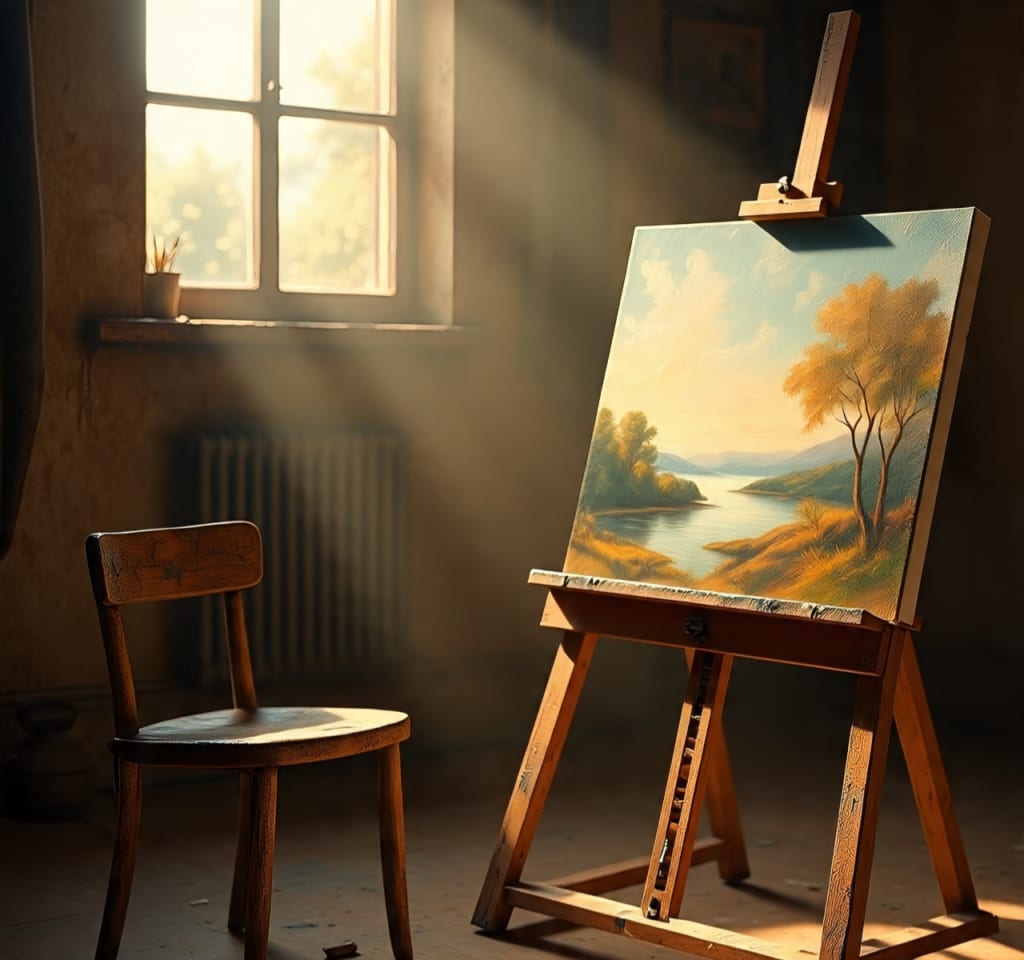
Weeks turned into months. Daniel began to paint again, something he had given up long ago. His first painting was of a chair by the window — her chair. The light fell just as it used to in the mornings. When he finished, he didn’t cry. He simply smiled and whispered, “Thank you.”
Art became his second education. Through every brushstroke, he found a way to talk to her again. He painted the places they had visited — the Irish cliffs, the quiet canals of Amsterdam, the markets of Lisbon. Each canvas carried a piece of their life, each color a conversation they never finished.
One afternoon, a young neighbor named Lily came by with a basket of bread. She was only sixteen and shy, but curious about the man who never left his studio. When she saw the paintings, she gasped. “They look alive,” she said. “Like they’re breathing.”
Daniel smiled. “They are,” he said. “They remember.”
She started visiting often, asking him questions about art, about love, about loss. Slowly, without planning to, Daniel began to teach her what he had learned — that creation is the only answer to destruction, that beauty doesn’t cancel pain but helps it make sense.
One day, Lily asked him, “Do you still miss her?”
He paused, then nodded. “Every day. But missing someone is its own kind of love. It means they’re still here, in a different way.”
Years passed. Daniel grew old, and Lily grew into an artist of her own. On his last birthday, she brought him a painting she had made — two chairs by a window, one empty, one filled with sunlight. “I learned from you,” she said softly.
Daniel smiled, touching her hand. “No,” he whispered. “You learned from loss. I only showed you where to look.”
When he passed away that winter, they found him sitting by the window, facing the morning light. His final painting rested on the easel — a single flower rising from cracked earth, titled Lesson Ten: Hope.
About the Creator
LUNA EDITH
Writer, storyteller, and lifelong learner. I share thoughts on life, creativity, and everything in between. Here to connect, inspire, and grow — one story at a time.
Keep reading
More stories from LUNA EDITH and writers in Humans and other communities.
The Empire of Candles
In a quiet corner of an old European town stood a little candle shop that smelled of beeswax, rose oil, and time itself. Its wooden sign read “The Empire of Candles,” though there was nothing grand about it. The shop was run by a man named Arthur, whose hands were always dusted with wax and whose heart carried the soft glow of a hundred tiny flames.
By LUNA EDITH5 months ago in Humans
Flirting Men Often Use Body Language Subtle Cues And Humor
Flirting refers to a natural and in most cases a mischievous manner in which individuals express romantic or personal interest. Most men show their attraction not just by means of words, but also body language, acting hints, and jokes. These actions aid in building a comfortable and interesting environment and also gives them an opportunity to check if they are interested. Flirting can be rather playful, but it does not lack substance as it can convey feelings and intentions. This knowledge of signals would enable individuals know when someone is interested and how to respond to it and build social bonding and romantic potential.
By Willian James2 days ago in Humans



Comments
There are no comments for this story
Be the first to respond and start the conversation.